
Cane Planter (1966)
U.S. Patent No. 3,286,858, granted on November 22, 1966, to Leonard J. Julien, introduces an automated agricultural machine designed to solve one of the most labor-intensive tasks in the sugar industry: planting whole stalks of sugar cane. Leonard Julien, an inventor based in Donaldsonville, Louisiana, developed a mechanized system capable of handling the irregular, unwieldy stalks that had previously resisted mechanization.
This invention directly overcame a long-standing obstacle in agricultural engineering: how to reliably lift six- to eight-foot cane stalks from a moving field cart and lay them end-to-end along a furrow in a continuous, uniform line without manual handling.
The Innovation: The Overhead Conveyor and Progressive Grab System
Historically, sugar cane planting was performed almost entirely by hand. Unlike seed crops, sugar cane is planted using whole stalks that vary significantly in curvature, diameter, and weight. Existing agricultural machinery could not pick up such irregular stalks from a bulk cart without jamming or dropping them haphazardly.
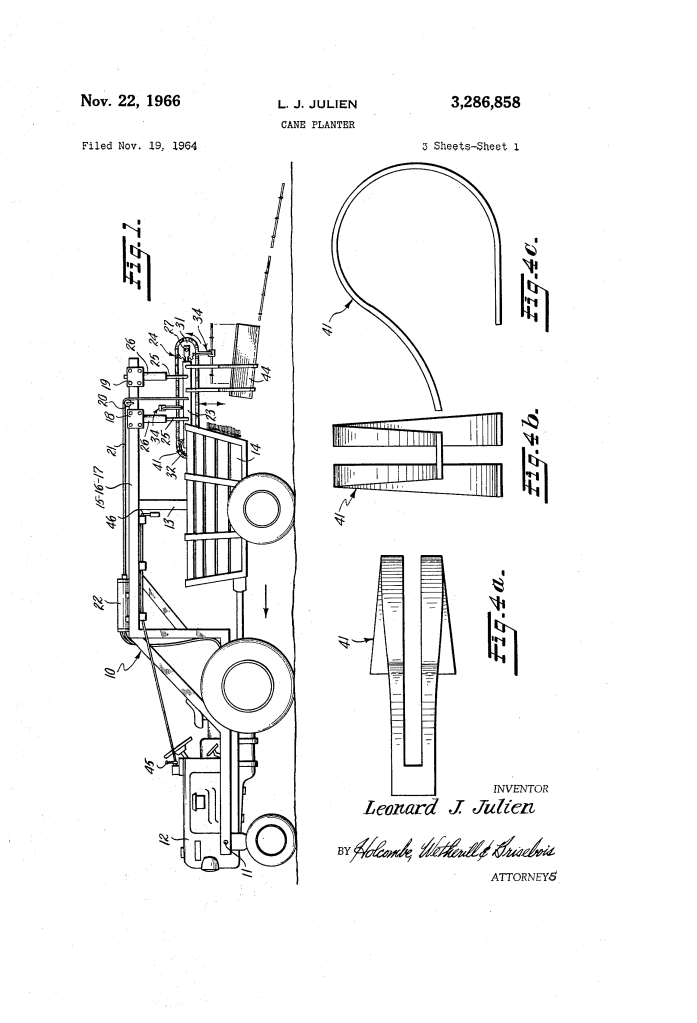
Julien bypassed this issue by designing a suspended, adjustable multi-chain conveyor system positioned directly above a cane cart.
Why the Overhead Grab Architecture?
- Continuous Feed Overlap: By arranging parallel conveyor lines with longitudinally staggered mechanical grabs, the machine delivers a continuous, metered flow of stalks into the planting furrow rather than dropping bulky clusters all at once.
- Automatic Grabbing and Releasing: Mechanical cam expanders force the grab fingers open at the front pick-up point and rear drop point, while internal springs maintain a firm, non-slip grip during transport.
- Progressive Depth Tracking: A suspended sub-frame smoothly lowers into the cart as the pile of cane is used up, allowing the machine to empty the container completely from top to bottom without operator intervention inside the wagon.
- Centering Delivery: Regardless of whether a stalk is grabbed from the far left or far right side of the cart, an inclined V-shaped discharge chute collects each falling stalk and channels it directly into the center of the planting furrow.
Key Mechanical Components
The apparatus combines structural suspension framing with automated continuous-motion handling assemblies:
| Component | Function |
| Main Frame (10) and Cane Cart (14) | The primary structural chassis hitched to the tractor and mounted directly over an eight-foot cane wagon. |
| Adjustable Sub-Frame (23) | A secondary frame suspended beneath the main frame by telescoping guide tubes (25, 26) and cables (21) connected to a hydraulic lift cylinder (22). |
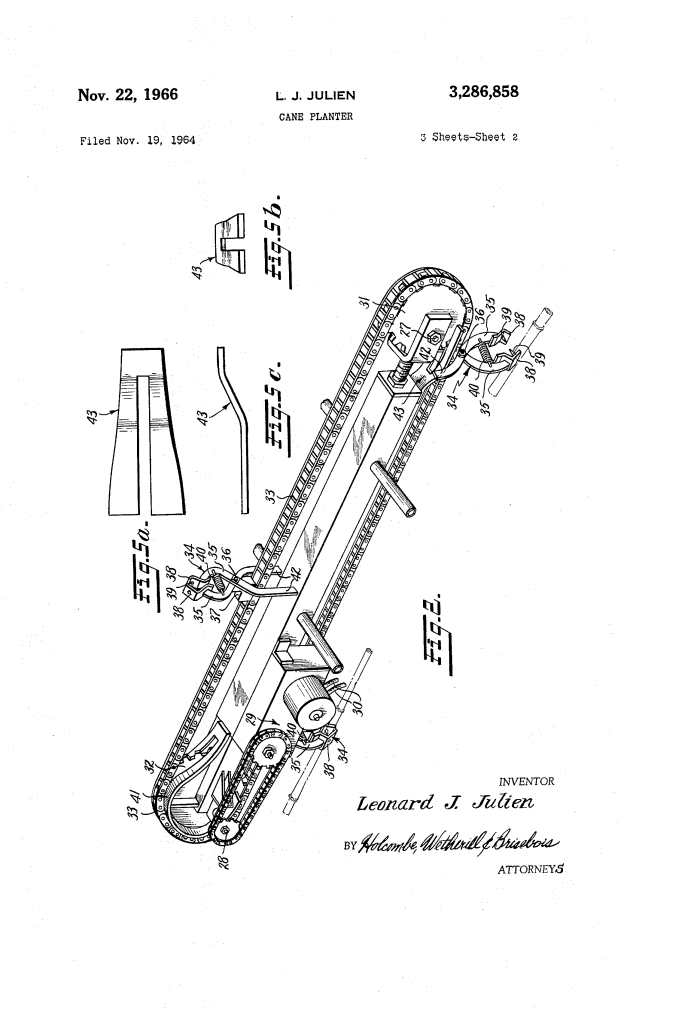
| Parallel Endless Chains (24, 33) | Three side-by-side conveyor chains driven by a dedicated hydraulic turbine unit (29) off the tractor’s hydraulic lines. |
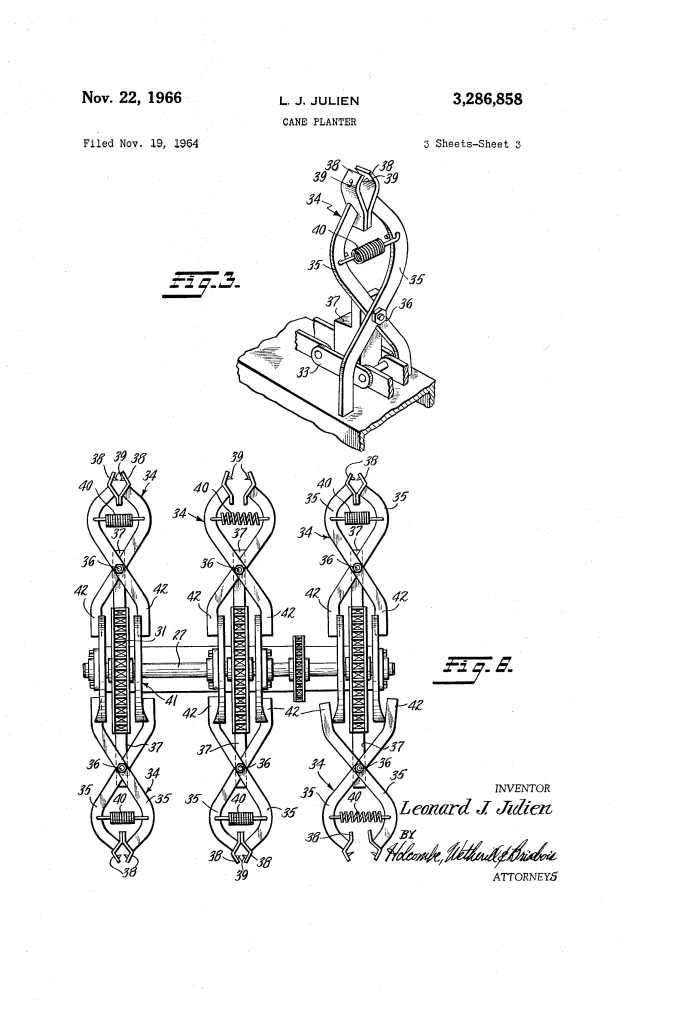
| Spring-Loaded Grabs (34, 35, 38, 39) | Mechanical clamping arms mounted to the chain, equipped with inward-facing gripping spikes (39) and biased closed by heavy-duty springs (40). |
| Cam-Action Grab Expanders (41, 43) | Stationary wedge-like cam surfaces positioned at both ends of the run that spread the rear ends (42) of the grab arms to open the fingers at pickup and release. |
| Inclined V-Shaped Guide Trough (44) | An angled delivery chute extending under the rear discharge points to funnel stalks from all three conveyors into a single line at the base of the furrow. |
How the Apparatus Functions
The machine operates through an automated cycle coordinated with the forward speed of the tractor:
| Step | Action | Operational Purpose |
| 1. Cam Opening | The moving grab approaches the driven sprocket wheel (32) and strikes the pick-up expander (41). | Drives the inner ends of arms (35) apart, opening the claw fingers (38) wide to straddle a stalk. |
| 2. Spring Clamping | The grab clears the expander wedge; spring (40) snaps the fingers shut. | Embedded spikes (39) bite into the fibrous stalk, securing it firmly without dropping it. |
| 3. Transport & Stagger | Stalks travel rearward across the overhead line. Grabs are spaced roughly eight feet apart and staggered across the three conveyor lines. | Prevents one stalk from being grabbed by two arms simultaneously and creates a continuous, unbroken chain of planting material. |
| 4. Ejection | The grab reaches the rear idler sprocket (31) and strikes release expander (43). | Opens the grab claws, letting the stalk drop cleanly into the guide trough (44). |
| 5. Depletion Tracking | An operator on the cart or tractor adjusts hydraulic lever (45) using control cord (46). | Lowers sub-frame (23) incrementally deeper into cart (14) as the cane supply is emptied. |
Historical and Scientific Impact
Leonard Julien’s invention represented a critical modernization leap in the Gulf Coast sugar cane belt:
- Mechanization of Laborious Field Work: Hand-planting cane was grueling, seasonal labor that required dozens of workers to lift, align, and drop stalks by hand behind a tractor. Julien’s planter drastically cut the required labor force per acre.
- Consistent Crop Emergence: By preventing bunched piles and gaps in the furrow, the staggered conveyor feed provided uniform stalk overlap, leading to higher germination rates and more consistent crop yields.
- Blueprint for Cane Machinery: Julien’s integration of independent hydraulic turbine drives, suspended self-leveling sub-frames, and automated cam-operated claw handling set lasting design precedents for subsequent commercial cane planting equipment throughout the Americas.
About the Inventor: Leonard J. Julien
Leonard J. Julien was an inventive African American agricultural designer from Ascension Parish, Louisiana.
- Agricultural Heritage: Living and working in the heart of Louisiana’s sugar cane country along Route 1 in Donaldsonville, Julien possessed firsthand knowledge of the unique physical challenges of handling raw cane crops.
- Mechanical Innovation: Addressing problems that major farm implement manufacturers had failed to solve, Julien engineered several practical farm machines, with his cane planter standing as his signature contribution to harvesting and planting technology.
- Legacy: Julien’s patents demonstrated that practical, ground-level agricultural engineering could transform traditional farming practices, establishing him as a prominent figure in the history of American agricultural innovation.
Summary of Claims
The patent explicitly claims:
- Cane planting machinery featuring a portable main frame supporting an elongated, vertically adjustable sub-frame suspended over an open-topped cart.
- At least one endless flexible carrier chain carrying spring-biased grabs that open and close transversely to the path of travel.
- Stationary expander cams positioned at the forward pick-up point and rear release point to automatically open the grabs against spring tension.
- A plurality of parallel conveyor chains with longitudinally staggered grabs spaced by at least the length of a sugar cane stalk.
- An inclined, V-shaped guide trough positioned below the rear discharge points that converges stalks from multiple conveyors into a single line in the furrow.
