
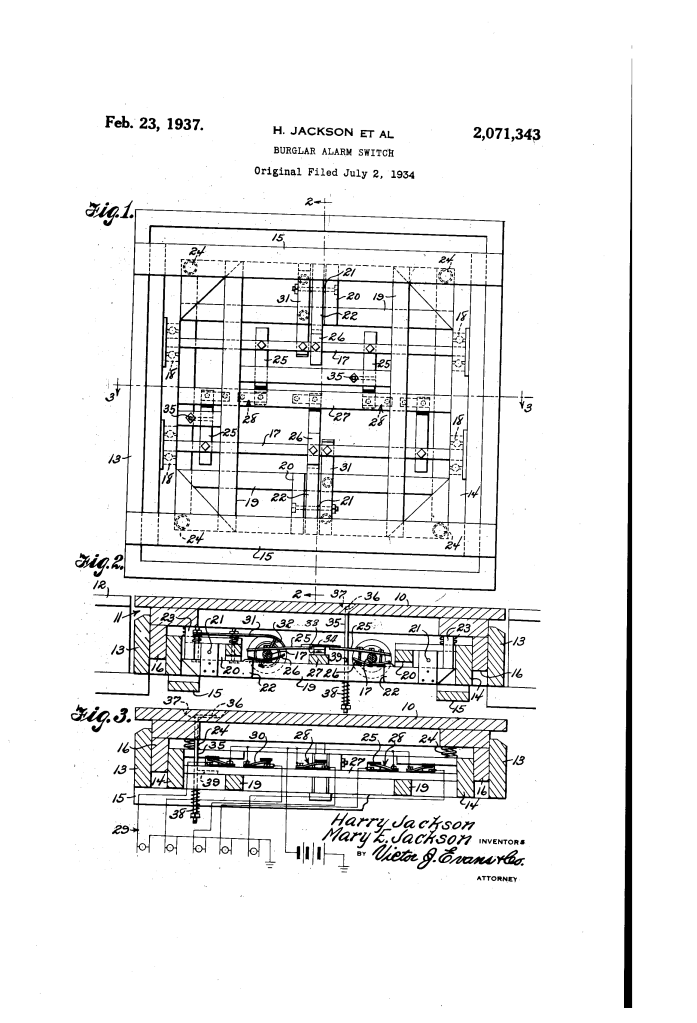
Burglar Alarm Switch, Harry & Mary E. Jackson, Patent No. 2,071,343
The patent by Harry Jackson and Mary E. Jackson of Harrisburg, Pennsylvania, describes a Burglar Alarm Switch (Patent No. 2,071,343), filed in 1935 and granted in 1937. This invention is a sophisticated, floor-integrated trigger mechanism designed for banks and high-security institutions. It features a “stealth-activation” depressible platform that, when stepped upon by a suspect, mechanically locks an electrical circuit into the “on” position, ensuring that a silent alarm or trap remains active even if the intruder moves off the trigger.
The “Why”
In the 1930s, most alarm triggers were hand-operated buttons or foot-pedals that required the victim to maintain constant pressure or make a conspicuous movement. The Jacksons identified a critical pain point: in a high-stress holdup, a teller might be unable to reach a button, or an alarm might cut out if the victim was forced to move. They sought to create a system where the intruder themselves unknowingly triggers a permanent alarm simply by standing in front of the teller’s window.
Inventor Section: Engineering Philosophy
This patent is a “division” of the Jacksons’ broader security portfolio, showcasing their engineering philosophy of mechanical persistence. Harry and Mary Jackson specialized in “logic-based” hardware—machines that could “remember” an event (like a footstep) without the need for complex electronics. Operating as Black inventors in the pre-Civil Rights era, their designs were rugged, tamper-proof, and designed for seamless integration into the existing architecture of white-dominated financial power structures.
Key Systems Section
1. The “Stealth” Floating Platform
The trigger is a floor section (10) that is indistinguishable from the surrounding floor (12).
- Mechanical Principle: The platform is suspended on coiled compression springs (24). It uses a guiding flange (16) to ensure perfectly vertical travel, preventing the “tilting” that might tip off a wary criminal.
- Modern Term: This is a low-profile tactile transducer, designed to convert a specific weight threshold into mechanical work.
2. Arched Saddle & Rocker Transmission
To translate the vertical downward motion into a rotational force capable of flipping a switch.
- The Mechanism: Depending “strikers” (23) hit vertical rocking members (22). These members press against arched saddle pieces (26) mounted on a horizontal shaft.
- Engineering Insight: The arched shape of the saddle ensures that the mechanical advantage increases as the platform is depressed, providing a smooth but decisive “snap” action.
3. Friction-Lock “Memory” System
One of the most innovative features is the Spring-Mounted Wiper (31) and Adjustable Sweeper (32).
- Function: When the shaft (17) turns to close the alarm switch, the wiper/sweeper assembly creates enough friction to hold the shaft in the “active” position.
- Result: Even after the intruder steps off the platform and the springs (24) push the floor back up to its flush position, the alarm stays triggered.
4. Concealed Manual Reset
Because the alarm locks “on,” the Jacksons included a hidden reset mechanism.
- The Mechanism: Small lift rods (35) with hand grips (36) are recessed into the platform.
- Operation: Only an authorized attendant who knows the location of these grips can pull them upward, using the engaging prongs (39) to manually rotate the rocker arms back to the “off” position.
Comparison Table: Standard Alarms vs. The Jackson Switch
| Feature | Typical 1930s Alarm | The Jackson Switch |
| Trigger Method | Intentional (Victim must act). | Passive (Intruder triggers it). |
| Visibility | Exposed buttons or pedals. | 100% Concealed (Flush with floor). |
| Signal Duration | Only while pressed. | Locked-On (Requires manual reset). |
| Reset Method | Automatic/Instant. | Security-Keyed (Manual lift-rod). |
| Reliability | Prone to human error/panic. | Automatic mechanical persistence. |
Significance
The Jackson Burglar Alarm Switch was a major step forward in automated surveillance logic:
- Precursor to Modern Pressure Mats: The mechanical “stealth” floor is the direct ancestor of the pressure sensors used in modern automated doors and security zones.
- Signal Persistence: The concept of a “latching” circuit—one that stays on after a momentary trigger—is a fundamental principle in modern digital alarm systems (Logic Gates).
- Psychological Security: It shifted the burden of safety from the bank employee to the building itself, a core tenet of modern “Defensible Space” architectural theory.
