
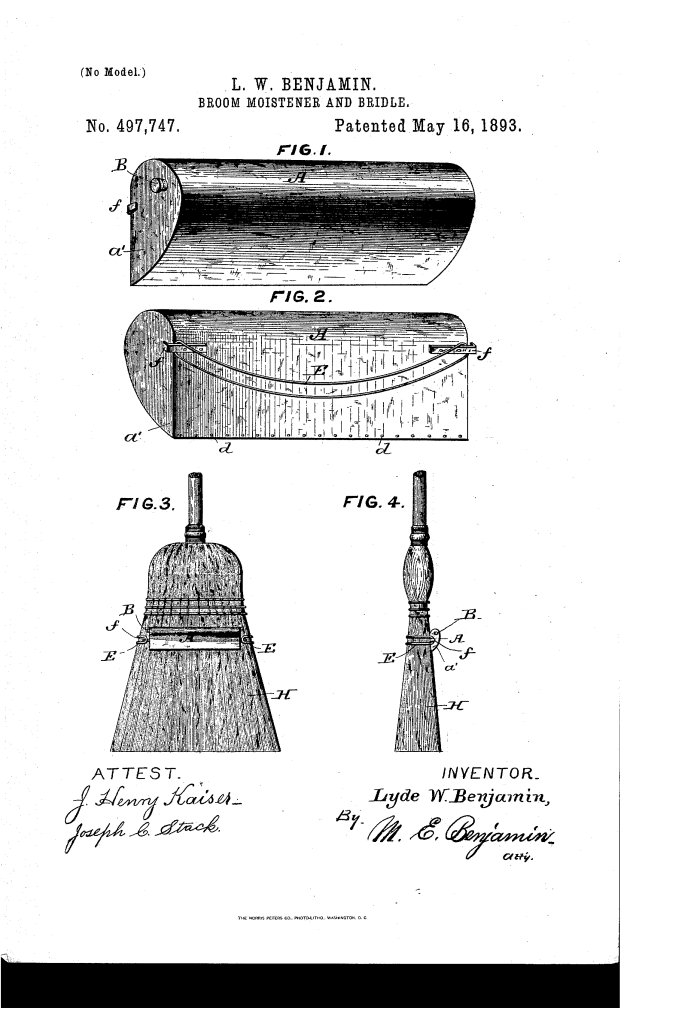
Broom Moistener and Bridle (1893)
U.S. Patent No. 497,747, granted on May 16, 1893, to Lyde W. Benjamin, describes an innovative dual-purpose accessory designed to attaches to a standard broom. The device simultaneously suppresses dust during sweeping and extends the lifespan of the broom’s straws. Lyde Benjamin, an inventor based in Boston, Massachusetts, assigned the patent to Miriam E. Benjamin, a brilliant fellow inventor known for her own patented innovations in mechanical design.
This specific invention solved two persistent household problems of the late 19th century: the unhealthy kicking up of airborne dust during dry sweeping, and the rapid fraying, breaking, and spreading of expensive broom straws over time.
The Innovation: The “Hydraulic Bridle”
Traditional methods of controlling dust required clumsily sprinkling water onto the floor by hand, which often left mud streaks, or using a separate wet mop. Benjamin’s breakthrough was a passive, motion-activated reservoir system attached directly to the broom, integrated seamlessly with a physical “bridle” that bound the bristles tightly together.
The genius of the design lies in its physics-defying simplicity. Rather than utilizing complex plumbing, valves, or stopcocks, it relies entirely on the kinetic energy of the sweeping motion itself to release minuscule amounts of moisture.
Why the Downward Tapering Design?
- Complete Drainage: The cross-section of the reservoir is shaped like a half-heart or triangle, becoming thin at the absolute bottom. This allows gravity to feed every drop of water toward the exit points without leaving stagnant liquid behind.
- Ergonomics: The flat rear face sits perfectly flush against the broom’s head, keeping the center of gravity tight against the handle so it doesn’t upset the user’s natural sweeping rhythm.
- Controlled Flow: By placing the exit point at the narrowest base, the water is forced through tiny openings only when the broom is actively swung.
Key Mechanical Components
The apparatus is an elegant two-piece system that clamps onto any standard industrial or household broom:
| Component | Function |
| Metal Reservoir (A) | A lightweight box (preferably made of tin) that holds the water supply. It tapers downward to guide the liquid toward the bristle interface. |
| Minute Perforations (d) | A series of tiny pinholes drilled along the lower inner edge. They restrict water flow so the broom stays damp but never drips. |
| Filling-Hole (B) | A securely plugged opening at the upper end used to replenish the water supply without removing the device from the broom. |
| Anchor Hooks (f) | Two small metal loops positioned at either end of the reservoir box to anchor the securing strap. |
| Clamping Strap (E) | A heavy-duty band (preferably made of rubber, leather, or canvas) that wraps around the opposite side of the broom to hold the reservoir completely immobile. |
Performance: Allaying Dust and Binding Straws
Benjamin’s design provided a dual-action mechanical advantage over standard brooms through simple physical constraints.
Double-Action Performance Metrics:
- Moisture Regulation: When the broom is static, capillary action and the minute size of the perforations prevent the water from dripping. Once sweeping begins, the centrifugal force of the swinging motion matches the rate of water escape, perfectly dampening the bristles.
- Structural Reinforcement: The combined tension of the tin reservoir and the rubber strap acts as a tight girdle around the upper portion of the straws. This prevents them from bending outward, breaking off at the seams, or losing their structural integrity under heavy friction.
The Operational Sequence
The user operates the device through a simple, maintenance-free workflow:
- Filling: Water is poured into the filling-hole (B) at the top of the tin reservoir, and the inlet is tightly sealed to form an airtight chamber.
- Mounting: The flat side (a) of the reservoir is pressed against one side of the broom’s bristle head (H).
- Tensioning: The rubber strap (E) is pulled tightly around the back of the broom and hooked onto the anchor loops (f), compressing the bristles into a firm column.
- Sweeping: As the broom is held at an angle and swung across the floor, water permeates the inner meshes of the broom evenly, neutralizing dust at the point of contact.
About the Inventor: Lyde W. Benjamin
Lyde W. Benjamin was an inventive thinker working within a historic circle of late 19th-century African American innovators in Boston.
- Collaboration: Lyde formally assigned the rights of this patent to Miriam E. Benjamin. Miriam was a pioneering African American woman inventor who famously patented the “Gong Signaling Chair” in 1888, which was utilized by the U.S. House of Representatives and became the precursor to modern flight-attendant call buttons.
- Market Context: Benjamin’s work arrived during an era of rapid urbanization and heightened awareness of public health, sanitation, and respiratory illness caused by airborne household dust.
- Design Philosophy: By eliminating modern complexities like feed tubes or mechanical stopcocks, Benjamin ensured the device was affordable to manufacture, completely leak-proof, and accessible to everyday working-class households.
Summary of Claims
The patent explicitly claims:
- A broom-moistening reservoir where the inner face is specifically contoured to sit flush against the flat side of a broom head.
- A tightly closed water vessel featuring a series of minute base perforations designed to release liquid exclusively through the kinetic shaking action of sweeping.
- The structural combination of a rigid reservoir and an elastic cord/strap that loops around the broom, functioning concurrently as a structural bridle to prevent bristle displacement.
