
Bridle Bit (1892)
U.S. Patent No. 484,994, granted on October 25, 1892, to Lincoln F. Brown, introduces a specialized curb bit designed as a safety mechanism for controlling “runaway” or unruly horses. Brown, an inventor based in Xenia, Ohio, sought to solve a common 19th-century danger: the inability of a driver to stop a powerful animal once it had reached a state of panic or turbulence.
The invention operates on a dual-mode principle. Under normal conditions, it functions as a standard, painless bit. However, when the driver applies “unusual force,” the bit transforms into a high-pressure gagging tool that renders the act of running away physically painful for the horse.
The Innovation: The “Snap-Loop” Release
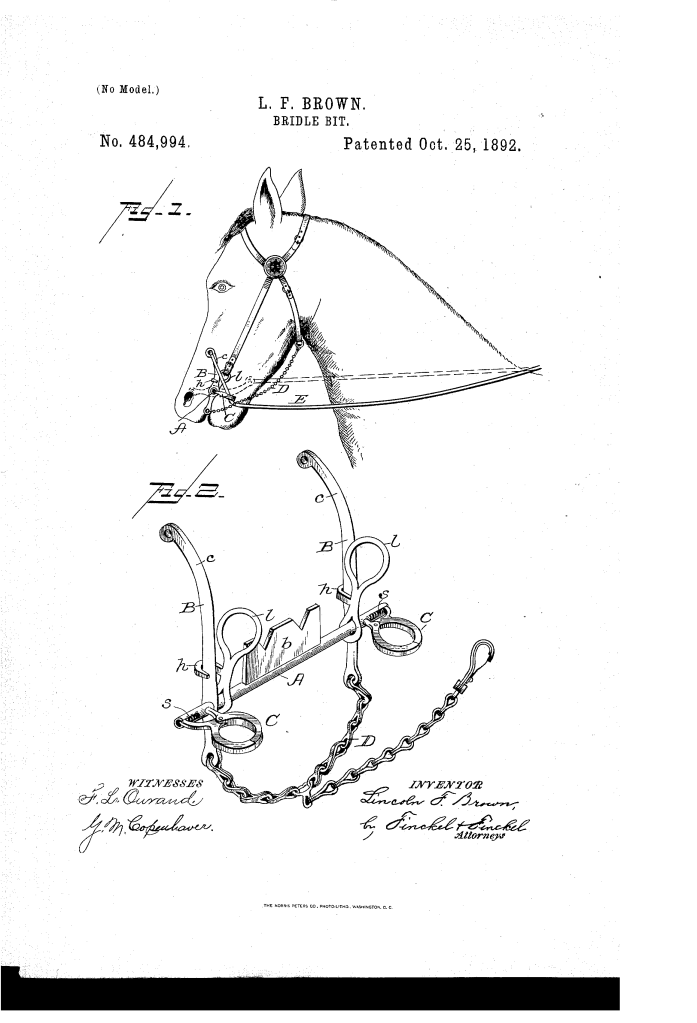
The defining feature of Brown’s bit is the integration of snap-loops (C) containing coiled springs. This mechanism acts as a mechanical “trigger” for the bit’s secondary function.
- Normal Mode: The reins pass through the snap-loops, which are positioned in line with the mouth-bar. This allows the driver to guide the horse with gentle pressure without engaging the lever arms.
- Emergency Mode: If the horse bolts, the driver pulls the reins with significant force. This pressure overcomes the coiled springs (s) in the snap-loops, releasing the reins from their housing. Once released, the pull of the reins acts directly upon the long lever arms, drastically increasing the mechanical advantage.
The Mechanics of Control
The bit utilizes several interlocking components to create a powerful squeezing action on the animal’s lower jaw:
- The Gag-Plate (b): A flat “feather” or plate attached to the mouth-bar. Brown noted that the edge of this plate could be notched to increase its effectiveness.
- Long Lever Arms (a): These provide a “powerful purchase” (leverage). When the reins are pulled back after being released from the snap-loops, they rotate the mouth-bar.
- The Fulcrum Chain (D): A chain connects the lower arms of the levers to the horse’s throat-strap. This creates a fixed pivot point, allowing the driver to bring a “strong squeezing pressure” down upon the tongue and jaw.
Key Technical Components
| Component | Function |
| Mouth-Bar (A) | The central rod that sits in the horse’s mouth; it rotates freely within the side-strap rings. |
| Gag-Plate (b) | Lies flat and comfortable when the horse is calm; pinches the tongue when the levers are engaged. |
| Snap-Loops (C) | Spring-loaded holders that keep the reins in “low-power” mode until a panic-level pull releases them. |
| Lever Arms (B) | Rigidly connected to the mouth-bar to translate rein tension into rotational torque. |
| Hooks (h) | Attached to the side rings to catch the front edge of the levers, preventing them from falling forward and tangling. |
Performance: Checking the Runaway
Brown’s design was a response to the “No Model” era of patenting, where the mechanical logic had to be foolproof. The bit’s success relied on the transition from quiescence to correction:
- During Quiescence: The gag-plate lies flat on the tongue. The horse feels no discomfort, ensuring the animal doesn’t become “rebellious” due to constant pain.
- During Turbulence: The leverage offered by the long arms, combined with the notched plate, ensures that even a smaller driver can exert enough force to “hurt his mouth and render his running away painful,” effectively forcing the horse to slow down or stop.
About the Inventor: Lincoln F. Brown
Lincoln F. Brown was an African American inventor living in Xenia, Ohio, during the late 19th century. His work on the bridle bit is part of a significant lineage of Black inventors from Ohio—such as those in Wilberforce and Xenia—who contributed to the mechanical and agricultural advancements of the era.
At a time when horse-drawn transportation was the primary mode of travel, safety innovations like Brown’s were essential for urban stability. His ability to secure a patent in 1892 highlights a sophisticated understanding of mechanical leverage and animal psychology.
Summary of Claims
The patent explicitly protects:
- A mouth-bar featuring a gag-plate operated by levers to pinch the animal’s tongue.
- The specific construction of spring-actuated snap-loops designed to release reins only under “unusual force.”
- The use of loose rings with hooks (h) that allow the mouth-bar to turn while keeping the lever arms in the correct vertical orientation.
