
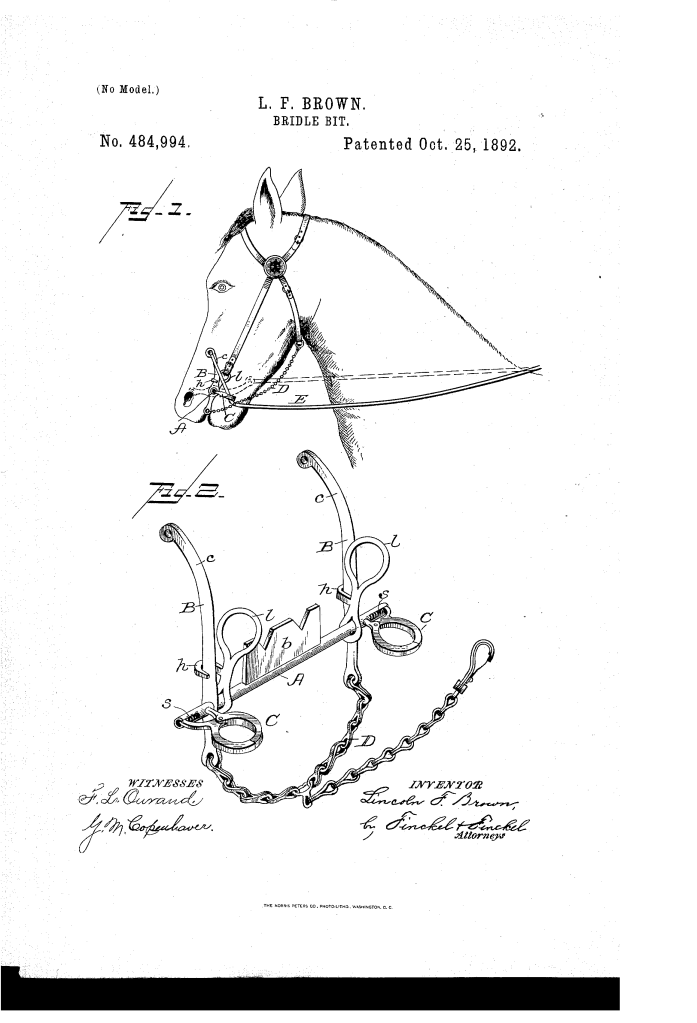
Lincoln F. Brown was granted patent 484,994 on October 25, 1892, for a Bridle Bit. The invention was a special bit designed to stop a runaway horse. It featured a mouth-bar with a gag-plate (a flat metal plate with a notched edge) and long lever arms connected to the reins. When a driver pulled on the reins with unusual force, the reins would release from “snap-loops” on the bit. This would cause the gag-plate to rotate and pinch the horse’s tongue or hurt its mouth, making a runaway attempt painful. A chain connected the lower arms of the bit to a throat strap, which acted as a fulcrum to increase the pinching pressure.
Societal Impact and Legacy
Brown’s invention was a direct solution to a major public safety issue in the late 19th century. In an era when horsepower was the primary mode of transportation, a runaway horse was a serious threat.
- Public Safety: Runaway horses caused accidents, property damage, and injuries to both drivers and pedestrians. Brown’s invention offered a new, more forceful way to gain control over an unruly horse, potentially preventing such incidents. The ability to use the reins to cause a “squeezing pressure on the tongue and lower jaw” provided a powerful deterrent.
- A Glimpse into the Past: This patent shows the kind of practical ingenuity that was applied to the problems of a pre-automobile world. Inventions were not just about new technologies, but also about refining existing ones to make them safer and more reliable.
- The Inventor’s Legacy: The patent record for Lincoln F. Brown does not contain details about his life beyond his residence in Xenia, Ohio. However, his work stands as an example of the thousands of inventors who created devices that solved common, everyday problems of their time.
