
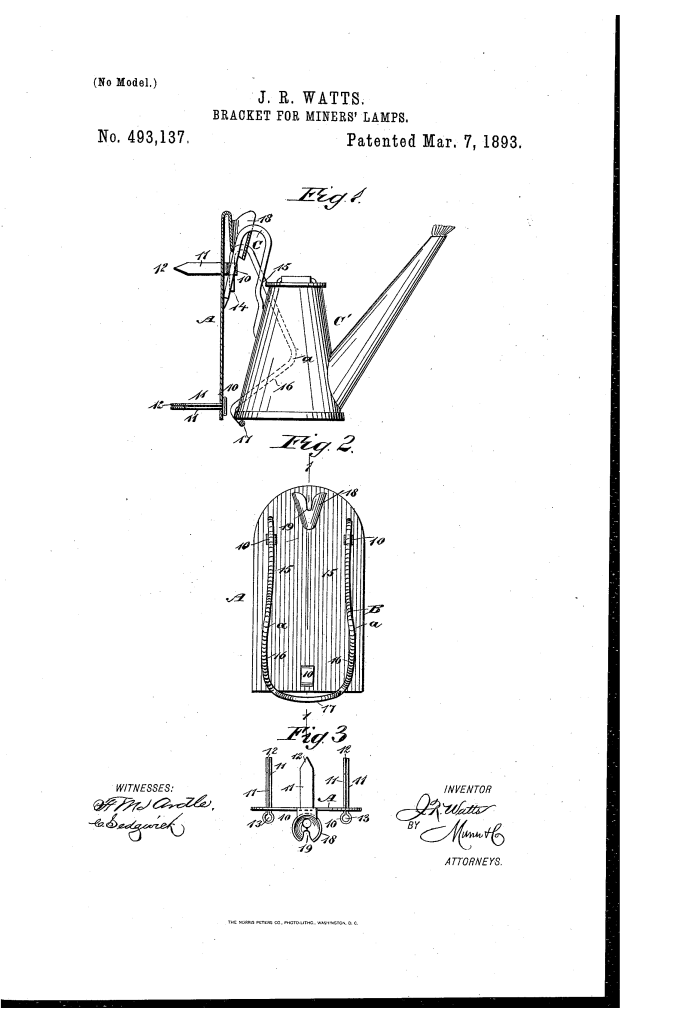
Bracket for Miners’ Lamps (1893)
U.S. Patent No. 493,137, granted on March 7, 1893, to Julius R. Watts, describes an adjustable lamp bracket designed to secure a miner’s safety lamp to any piece of headwear. Julius R. Watts, an inventor based in Springfield, Illinois, focused his design on adaptability, mechanical simplicity, and cost-effectiveness for laborers.
This specific invention solved a critical safety and financial problem in the late-19th-century mining industry: it eliminated the requirement for specialized, expensive miners’ caps by allowing workers to securely mount a heavy oil or oil-wick lamp onto any regular hat or old piece of cast-off clothing without it slipping, burning the wearer, or falling off.
The Innovation: The Outwardly Stepped Yoke
Traditional lamp mounts often allowed the heavy, hot metal lamps to swing loosely or rest directly against the fabric of the hat, creating an imbalance or a fire hazard. Watts’s breakthrough was the engineered geometry of a single piece of bent wire, known as the rest or guide frame B (or supporting yoke).
Instead of dropping straight down, the side arms of this yoke extend downward and outward away from the wearer’s face until they hit a precise peak—the advanced points a. From that point, the wire cuts sharply back downward and inward toward the base plate, terminating in an outwardly stepped bow section (17).
Why this geometry matters:
- Stability: The advanced points $a$ tightly embrace the curved midsection of the lamp body, stopping side-to-side wobble.
- Thermal Isolation & Leverage: By pitching the upper section out, the frame forces the hot lamp to remain at a safe, functional tilt away from the fabric of the cap.
- Weight Distribution: The lower crossbar shifts the vertical load of the heavy lamp base directly onto the rigid frame rather than pulling down on the cloth hook.
Key Mechanical Components
The bracket is an elegant, three-part system built from affordable, stamped metals and bent wire:
| Component | Function |
| Back Plate (A) | The structural foundation, featuring a curved upper edge to conform comfortably to the forehead profile of a hat. |
| Socket or Keeper (18) | An inverted, cone-shaped funnel that accepts the lamp hook. Features a front recess (19) to lock the hook’s bow in place and prevent rotation. |
| Supporting Yoke (B) | The bent wire frame that acts as a structural cage, stabilizing the center and supporting the bottom of the lamp. |
| Pliable Shanks (11) | Dual-pronged brass or tin fasteners that pierce the headwear and split apart to lock the plate to the fabric without specialized tools. |
How the Bracket Functions
The apparatus relies on a simple mechanical interlock that a miner can operate entirely by touch, even in pitch-black mine shafts.
[Insert Hook into Socket 18] ➔ [Drop Hook into Recess 19] ➔ [Rest Lamp Base on Bow 17]
- Funnel Alignment: The wide, flaring mouth of the inverted conical socket (18) guides the lamp’s hook downward into place without the miner needing to remove their hat.
- Rotational Lock: As the hook drops completely through the open bottom of the socket, its top loop settles into the downward-extending recess (19), keeping the light pointed dead ahead.
- Midpoint Stabilization: The sides of the lamp body press firmly against the advanced points $a$ of the wire yoke.
- Base Support: The lower perimeter of the lamp settles onto the outward-facing wire loop (17), completely absorbing the downward weight.
Historical and Industrial Impact
Julius R. Watts’s invention entered the coal mining industry at a transitional period when personal safety equipment was largely unstandardized and funded out-of-pocket by the miners themselves.
- Democratizing Safety: By enabling a miner to convert any “old cast-off hat or cap yet capable of being worn” into a functional safety helmet, it saved low-wage workers from buying dedicated, marked-up industrial caps.
- Hands-Free Reliability: In the tight, dangerous confines of 19th-century subterranean mining, a dropped lamp meant immediate darkness or a catastrophic fire hazard. This dual-point retention system (socket top, wire yoke bottom) kept the flame locked in place during heavy physical labor.
- Toolless Field Assembly: Because the backplate utilized soft, pliable brass or tin tines (11), a miner could install, fix, or transfer the bracket from a worn-out hat to a new one mid-shift using nothing but their fingers.
About the Inventor: Julius R. Watts
Julius R. Watts operated out of Springfield, Illinois, a major Midwestern hub for coal mining and railroad transport during the late 19th and early 20th centuries. Living and working in the capital of Sangamon County, Watts was uniquely positioned to see the direct daily needs of workers in the state’s expanding central coal fields. His work on this utility bracket reflects a classic era of American grassroots engineering—developing highly practical, accessible solutions to elevate safety standards for everyday laborers.
Summary of Claims
The patent explicitly claims:
- A miner’s lamp bracket featuring a back plate, a top socket (18), and a supporting yoke (B) that projects downward and outward to a point $a$ to hug the lamp sides, before angling inward to a cross-piece base (17).
- The specific configuration of a slotted socket (18, 19) flanking two upper fastener loops (10), which hold the downward-pointing terminal pins (14) of the wire frame securely in position against the plate.
- The integration of pliable split-shank fasteners (11) extending directly through the backplate to secure the entire assembly dynamically to flexible headwear fabrics.
