
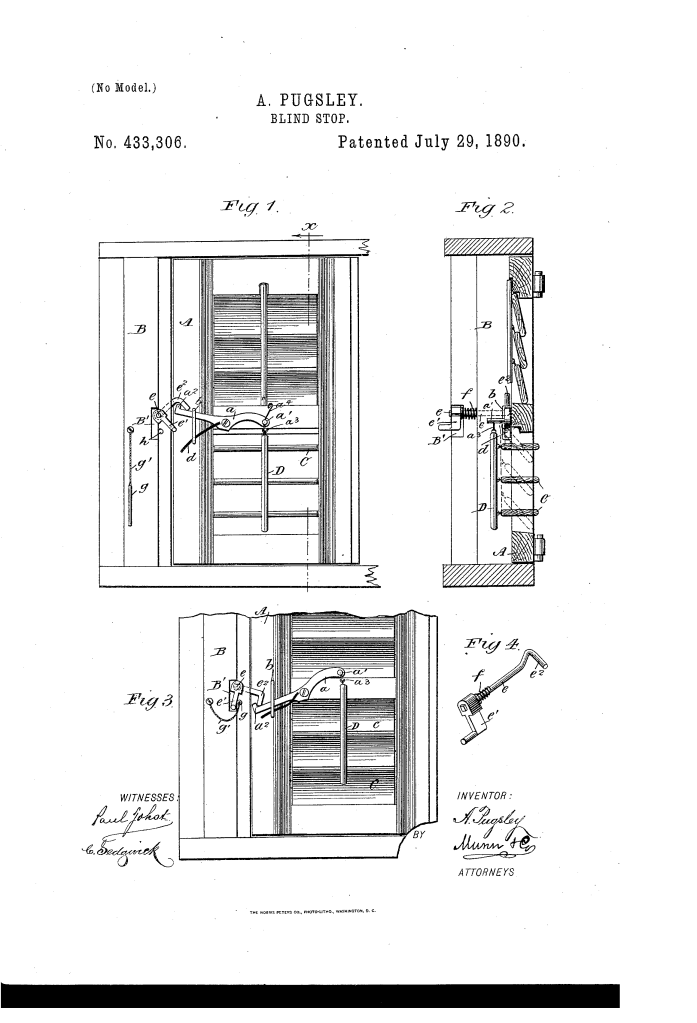
Blind-Stop (1890)
U.S. Patent No. 433,306, granted on July 29, 1890, to Abraham Pugsley, introduces a clever mechanical attachment designed to solve two common 19th-century household frustrations: the tedious manual adjustment of window blind slats and the lack of security they provided against outside tampering.
Pugsley, an inventor from Jamestown, Rhode Island, developed this system to allow a homeowner to operate and lock their external blinds from the inside of the house, without ever having to open the window.
The Innovation: The Lever and Latch System
Most 1890s blinds required the user to reach outside to move the vertical slat rod. Pugsley’s invention moved the control inside by connecting the slat rod to a spring-loaded lever and an external crank.
1. The Spring-Loaded Lever (a)
- The heart of the device is a lever pivoted to the central rail of the blind.
- One end is hooked directly to the vertical slat rod (D).
- A flat spring (d) is fixed under the lever. This spring naturally pushes the lever up, keeping the slats in the open position by default.
2. The Keeper (b)
- Attached to the side frame (stile) of the blind, this metal loop limits the movement of the lever, ensuring it doesn’t swing too far and damage the slats.
How the Apparatus Functions
The system uses a mechanical “handshake” between an internal crank and the external lever.
| Step | Action | Purpose |
| 1. Idle State | The internal spring (f) holds the latch up. | Allows the blind to stay open for light/air. |
| 2. Engagement | The user turns the internal crank (e) to a vertical position. | The external latch (e’) rotates down onto the lever. |
| 3. Closing | The latch overcomes the lever’s spring pressure. | The lever moves down, pulling the slat rod to close the blinds. |
| 4. Locking | A locking pin (g) is inserted into a hole (h) in the window frame. | Secures the crank in place so the slats cannot be moved. |
Key Technical Components
- Horizontal Shaft (e): Passes entirely through the window frame, connecting the indoor crank to the outdoor latch.
- The Latch (e’): An angular metal arm at the end of the shaft that presses down on the lever when rotated.
- The Upward Lug (a’): A vertical “stop” on the end of the lever that prevents the latch from slipping off during operation.
- The Spiral Spring (f): Located on the shaft inside the window frame, it ensures the latch returns to a “neutral” position when not in use.
Historical and Scientific Impact
Pugsley’s “Blind-Stop” was a significant step forward in domestic privacy and home security during the Victorian era.
- Security & Privacy: As Pugsley noted in his patent, once the pin was inserted, the slats were locked. This “effectively prevent[ed] any person from peeking between the slats” or using a tool from the outside to unlock the window.
- Weather Protection: It allowed homeowners to seal their blinds against wind or rain instantly without exposing themselves to the elements.
- Mechanical Simplicity: Unlike modern motorized blinds, Pugsley’s design relied on basic physics—leverage and spring tension—making it durable and easy to install on “blinds of ordinary construction.”
About the Inventor: Abraham Pugsley
Abraham Pugsley resided in Jamestown, Rhode Island, a coastal town where sturdy, functional window treatments were essential against Atlantic winds. While Pugsley may not have reached the global fame of some of his contemporaries, his invention reflects the late 19th-century American spirit of “improvement”—taking a common object like a window blind and making it safer, more convenient, and more private through thoughtful engineering.
Summary of Claims
The patent explicitly claims:
- A combination lever and spring system that keeps slats open by default.
- An operating shaft extending through the window frame to allow internal control.
- A locking mechanism involving a pin and recess to prevent the slats from being manipulated from the outside.
