
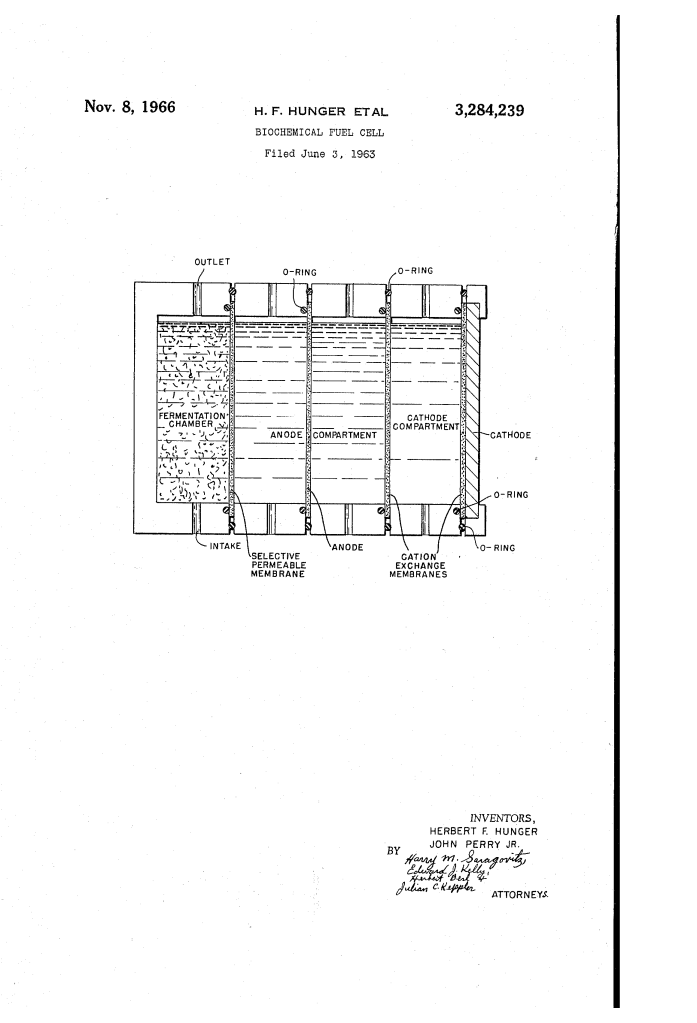
Biochemical Fuel Cell (1966)
U.S. Patent No. 3,284,239, granted on November 8, 1966, to Herbert F. Hunger and John Perry, Jr., describes a multi-compartment, diffusion-type biochemical fuel cell designed to generate steady, long-term electrical energy directly from organic nutrients. Assigned to the United States of America as represented by the Secretary of the Army, the invention addresses a core limitation in early biological power systems: how to harness natural organic materials—such as sugars, starches, and celluloses—to produce electric current without poisoning the electrodes or causing the living biological agents to self-destruct.
Hunger and Perry, researchers working at the U.S. Army Electronics Command in Fort Monmouth, New Jersey, engineered a physical separation architecture that allowed delicate biocatalytic processes to drive high-performance electrochemical oxidation under steady-state conditions.
The Innovation: The Diffusion-Decoupled Compartment System
In conventional biochemical fuel cells, bacteria, enzymes, or living cells were suspended directly in the electrolyte bath or fixed onto the working electrodes. This direct contact caused fatal operating flaws:
- Electrode Fouling: Bulky biological molecules and cell debris coated the active catalytic sites on the electrodes, choking the electrochemical reaction.
- Biochemical Self-Inhibition: As the biological agents consumed the nutrient feed, their own metabolic by-products accumulated around them, altering local pH and killing or deactivating the cultures.
- Power Fluctuations: Because the biological agents could not be held in a stable steady state, the electrical power output decayed rapidly over time.
Hunger and Perry resolved this by creating a three-chamber, diffusion-controlled system. Instead of forcing the biochemical agents to contact the electrodes directly, they relegated the fermentation reaction to an isolated upstream chamber. A selective-permeable membrane acts as a molecular gatekeeper: it traps the bulky organisms and raw carbohydrates inside the fermentation chamber while allowing smaller, electrochemically active intermediate molecules (such as ethanol) to diffuse freely into the anode compartment for clean oxidation.
Why the Diffusion Separation?
- Steady-State Equilibrium: Continuous consumption of the active intermediate at the anode creates a natural concentration gradient across the membrane, steadily drawing more fuel out of the fermentation zone and preventing product accumulation from stalling the biocatalyst.
- Electrode Protection: Bulky unreacted starches, sugars, and cellular debris are physically barred from reaching the platinized electrode surfaces, preventing fouling.
- Constant Power Generation: Regulating the nutrient feed into the fermentation chamber while venting metabolic gases maintains a stable material balance, enabling continuous, unflagging electrical output over long operating cycles.
Key Chemical and Structural Components
The system coordinates biological fermentation with clean electrochemical consumption across specialized compartments:
| Component | Function |
| Fermentation Chamber | The biocatalytic reactor where microorganisms (e.g., yeast cells) or enzymes (e.g., amylase, diastase) break down complex organic feeds (e.g., glucose, sucrose, starch, cellulose) into electrochemically active intermediates. |
| Selective-Permeable Membrane (Nitrocellulose Film) | The molecular boundary between fermentation and anode. It permits small fuel molecules like ethanol to diffuse through while strictly blocking unreacted sugars and yeast cells. |
| Anode Compartment & Platinized Platinum Screen | The primary power generation stage where diffused ethanol is dehydrogenated and electrochemically oxidized, generating electrons and releasing carbon dioxide waste through a top vent. |
| Anolyte & Catholyte (0.05 M Phosphate Buffer, pH ~7) | A neutral electrolyte bath matched across chambers to maintain ionic conduction without damaging the biocatalysts in the event of minor back-diffusion. |
| Cation Exchange Membranes | Commercial ion-exchange barriers positioned between the anode and cathode chambers, with an additional protective membrane laminated directly over the cathode face to prevent fouling from trace contaminants. |
| Cathode (Platinized Carbon-Air Electrode) | The reduction terminal where atmospheric oxygen is reduced to complete the galvanic circuit. |
Performance: Clean Generation from Organic Waste
The patent demonstrates reliable electrochemical conversion of simple sugar feeds into sustained terminal voltage.
Operational Metrics:
- Open Circuit Potential: Delivered a steady open-circuit voltage of 0.7 to 0.8 volt per cell using an active glucose-yeast mixture.
- Fuel Flexibility: Demonstrated effective conversion across multiple natural feedstocks, transitioning from glucose and sucrose to complex starches and celluloses.
- Extended Operational Stability: By continuously drawing generated ethanol out of the fermentation chamber through passive concentration gradients, the biological culture avoided the typical self-poisoning threshold, providing long-term power delivery without requiring mechanical pumping.
How the Apparatus Functions
The multi-compartment fuel cell processes raw agricultural material into electric power through a continuous four-stage sequence:
| Step | Action | Operational Purpose |
| 1. Fermentation | Glucose and yeast suspended in a pH 7 phosphate buffer are introduced into the left chamber. | Yeast cells metabolize the sugar, converting it into ethanol and initial cellular metabolites. |
| 2. Selective Diffusion | Ethanol passes through the pores of the nitrocellulose membrane into the central anode chamber. | Isolates the large yeast bodies and unconsumed sugars, keeping the working electrode pristine. |
| 3. Anodic Oxidation | Diffused ethanol contacts the platinized platinum screen anode. | Dehydrogenates and oxidizes the ethanol, generating electrical current while venting carbon dioxide gas out the top port. |
| 4. Circuit Completion | Hydrogen ions traverse the cation exchange membrane to the platinized carbon-air cathode. | Oxygen from the surrounding air is catalytically reduced, drawing power through the external load to complete the cell’s circuit. |
Historical and Scientific Impact
Conducted at the height of the Cold War and the Space Race, Hunger and Perry’s biochemical fuel cell research addressed key logistics challenges for the U.S. military and space programs:
- Off-Grid Remote Power: Offered a blueprint for ultra-long-duration power generators that could run on readily available local biomass, field rations, or agricultural waste rather than volatile petroleum or short-lived dry cells.
- Life-Support Integration: Explored closed-loop life-support concepts where biological waste products from spacecraft crews could be recycled to produce supplemental electricity.
- Groundwork for Modern Bio-Electrochemical Systems (BES): By introducing the use of selective diffusion membranes to isolate biocatalysts from electrode surfaces, this patent established structural design rules that remain central to modern microbial fuel cells (MFCs) and enzymatic biosensors.
About the Inventors
Herbert F. Hunger was a distinguished physical chemist and electrochemist at the U.S. Army Electronics Command (ECOM) at Fort Monmouth, New Jersey. A leading authority on energy storage, fuel cells, and primary battery chemistry, Hunger authored scores of technical reports and patented several high-performance galvanic and solar conversion cells for military communications.
John Perry, Jr. was an influential African American research chemist and pioneer in military electrochemical power sources. Working alongside Hunger and leading his own research programs at Fort Monmouth’s Power Sources Division, Perry dedicated decades to developing compact power sources, fuel cells, and advanced battery chemistries designed to withstand extreme combat environments. His research directly enabled smaller, lighter, and more dependable portable communications and radar systems for U.S. ground forces.
Summary of Claims
The patent explicitly claims:
- A multicompartment, diffusion-type biochemical fuel cell comprising a dedicated fermentation chamber that decomposes sugar into ethanol using yeast cells.
- An adjacent anode compartment featuring a platinized platinum screen anode suspended in a neutral phosphate buffer solution (pH approximately 7).
- The separation of the fermentation chamber and the anode compartment by a selective-permeable organic nitrocellulose film that permits the diffusion of ethanol while blocking sugars and yeast cells.
- A cathode compartment holding a platinized carbon-air cathode in a matching pH 7 phosphate buffer catholyte, isolated from the anode chamber by a cation exchange membrane.
- A second protective cation exchange resin membrane bonded directly to the working surface of the platinized carbon-air cathode to shield it from biological and organic fouling.
