
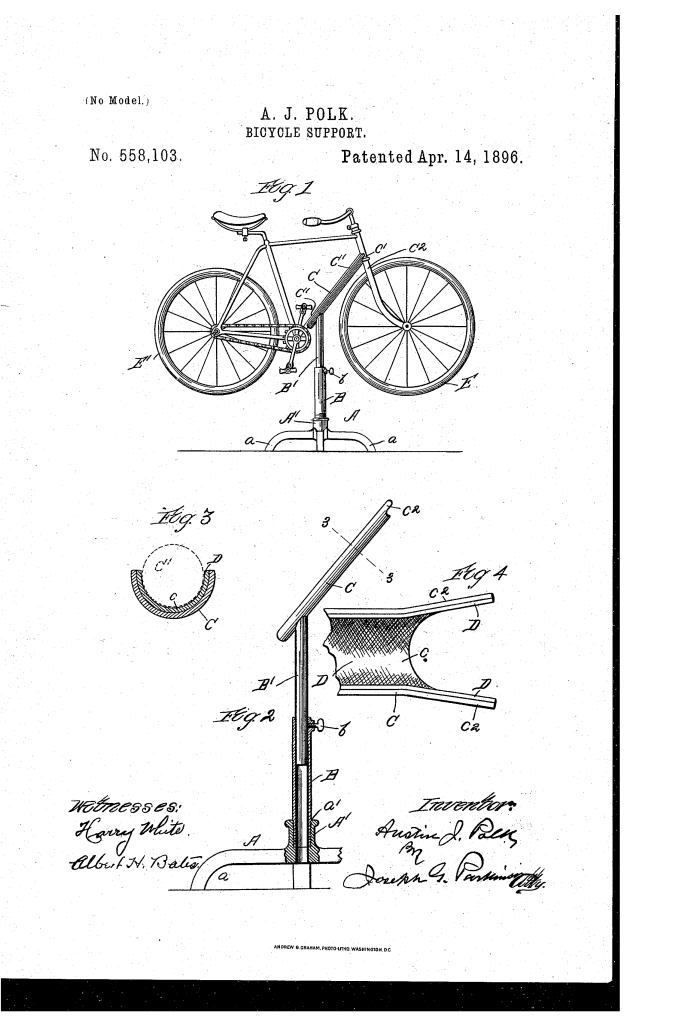
Bicycle-Support (1896)
U.S. Patent No. 558,103, granted on April 14, 1896, to Austin J. Polk, describes an adjustable stand or jack designed to hold a bicycle off the ground for storage, maintenance, or display. Austin J. Polk, an inventor based in Chicago, Illinois, created a structural support tailored to the geometry of late 19th-century safety bicycles.
This specific invention solved a common practical problem during the bicycle boom of the 1890s: how to keep a bicycle elevated and stable in a house, club, or workshop so that both wheels could spin freely for cleaning, repair, or “grooming,” without the front wheel and handlebars flopping over or turning.
The Innovation: The Self-Locking Forked Seat
Traditional props or hooks often allowed the front wheel to turn, destabilizing the bicycle or letting it tilt off balance. Polk’s design integrated an angled, cupped seat that matched the slope of the frame and featured a specialized dual-fork upper engagement mechanism.
When the lower frame tube is set into the support, gravity causes the bicycle to slide down into place. The upper end of the support grips the steering head and fork crown simultaneously, locking the front wheel straight and securing the entire machine against lateral movement without requiring complex mechanical latches.
How the Apparatus Functions
The process relies on simple geometric locking and gravity:
- Height Adjustment: The user adjusts the telescoping upper member (B’) within the lower tubular standard (B) to the desired working height and secures it using the clamping screw (b).
- Mounting: The lower diagonal brace-bar (C’) of the bicycle frame is lowered into the cupped, cushioned channel of the seat (C).
- Automatic Alignment: As the bike slides down into the inclined seat, the cut-away forks (c’) at the upper end slip around the steering head or lower bearing (C”) and settle over the top of the steering fork (c”).
- Operation & Removal: Once resting in the cradle, both the front wheel (E) and rear wheel (E’) are fully elevated and free to rotate. To remove the bicycle, the user simply executes a smooth, oblique upward lifting motion to disengage the fork crown.
Technical Components
- Base (A): Features outsetting feet (a) and a threaded central hub (A’) that provides a stable foundation on any flat floor or workbench.
- Telescoping Standard (B, B’): A pair of tubular steel members sliding one inside the other to adjust elevation, locked in place by a clamping screw (b).
- Cupped Seat (C): An elongated, inclined rail contoured in cross-section (c) to embrace the lower frame bar.
- Cushioning Layer (D): A lining made of leather or soft material fitted inside the metal seat to protect the bicycle’s paint, enamel, or nickel finish from scratch marks or abrasion.
- Forked Engagement Head (c’): Two projecting prongs at the top of the seat that flank the steering head and straddle the front fork crown (c”) to freeze steering movement.
Historical and Practical Impact
Polk’s patent came during the height of the American bicycle craze of the mid-1890s, when safety bicycles were becoming the primary mode of personal transit and recreation.
- Hands-Free Grooming: By elevating both wheels off the floor and locking the front fork straight, mechanics and owners could easily wipe down spokes, oil chains, and service bearings without needing a second person to hold the handlebars.
- Versatile Adaptation: The invention was specifically engineered to accommodate various frame styles, including men’s safety bicycles, women’s drop-frame models, and standard backbone configurations.
- Zero-Latch Simplicity: Rather than using heavy straps or clamps that could mar the frame, Polk relied on precise contours and gravity to form an automatic physical lock.
About the Inventor: Austin J. Polk
Austin J. Polk operated out of Chicago, Illinois—a major industrial hub for manufacturing and transportation innovation at the turn of the 20th century. Polk focused on practical mechanical enhancements for everyday consumer goods, applying straightforward structural engineering principles to improve user convenience during the rapid expansion of urban cycling culture.
Summary of Claims
The patent explicitly claims:
- A bicycle support comprising a standard carrying an elongated seat contoured to receive the lower forward bar of a bicycle frame.
- A fork engagement mechanism at the upper end of the seat that engages the front wheel fork and steering head to prevent turning or tilting once the frame slides into position.
- An adjustable, telescoping central standard mounted on a multi-footed base, featuring a padded or cushioned channel to prevent frame abrasion.
