
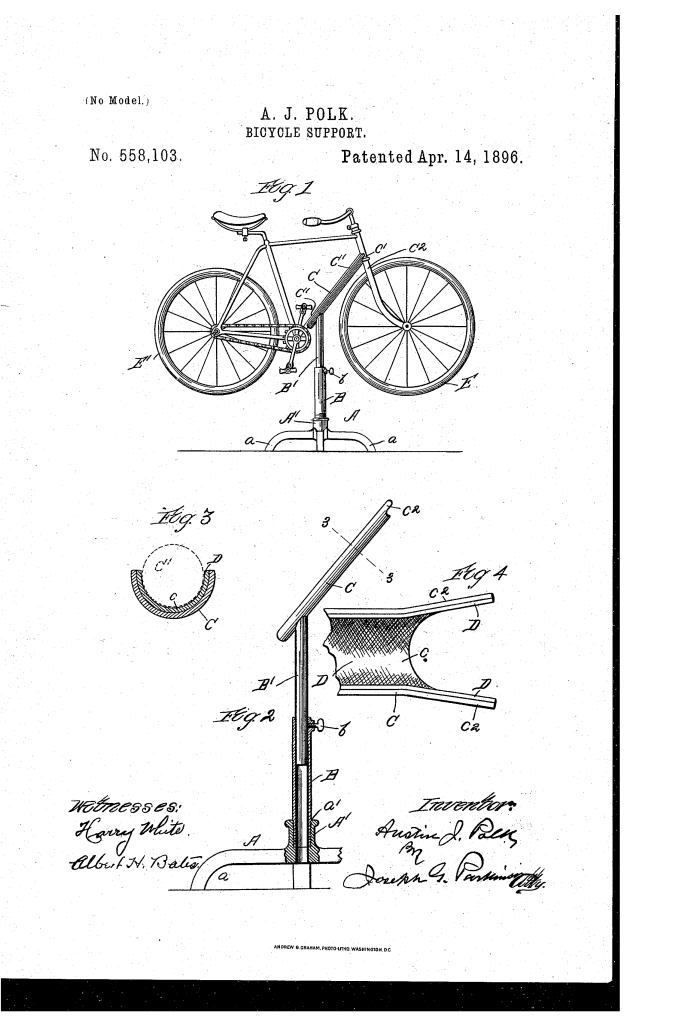
The patent by Austin J. Polk of Chicago, Illinois, describes a Bicycle-Support (Patent No. 558,103, 1896). The object of the invention is to provide a simple and convenient jack or stand for stabling, housing, or repairing a bicycle, holding it with its wheels clear of the ground at any desirable height.
Invention and Mechanism
The support is a telescoping stand with a specially contoured seat designed to cradle and lock the bicycle frame.
- Adjustable Standard:
- Base (A): A base with feet (
) for stability, having a screw-threaded socket (
) for the standard.
- Telescoping Members (): The standard is made of a lower tube (B) and an upper member (
) that slides within it.
- Clamping Screw (): A clamping screw (or similar device) secures the upper member (
) at any desired height.
- Function: This allows the machine to be supported at a suitable height for grooming or repairs.
- Base (A): A base with feet (
- Contoured Seat (Key Innovation):
- Seat (C): An elongated seat secured to the upper end of the standard (
).
- Frame Conformity: The seat has a longitudinal outline that conforms to the lower bar of the bicycle frame (the brace-bar
of a men’s safety or the backbone of other types). It is preferably cupped or concave () in cross-section to embrace the lower side of the bar .
- Steering Head Engagement: At its upper or forward end, the seat is cut away to receive the steering-head or the lower bearing (). This cut-away forms two forks ().
- Function (Locking): The frame is slid down onto the seat (C) until the forks (
) pass on either side of the steering-head and take over the top of the steering-fork (). This arrangement simultaneously cradles the frame bar and locks the steering assembly, steadying the machine against lateral movement and preventing the front wheel and fork from turning or tilting.
- Seat (C): An elongated seat secured to the upper end of the standard (
- Utility:
- The design holds the bicycle at a convenient height, with both the front wheel (E) and the rear wheel () free to be revolved, useful for cleaning, repair, or observation.
- The seat is lined with leather (D) or other cushioning material to prevent abrasion.
Historical Significance and the Inventor
Austin J. Polk’s 1896 patent comes at the height of the bicycle craze in the United States, reflecting the massive demand for accessories and maintenance tools for the new technology.
- Bicycle Maintenance: Bicycles required frequent cleaning, adjustment, and repair (especially chain and tire maintenance). Polk’s stand solved the practical problem of how to hold the delicate, lightweight diamond frame securely and stably while keeping the wheels off the ground, a necessity in the home, club, or repair shop.
- Ergonomic Design: The focus on adjustability allowed the stand to be used for different operations (low for storage, high for cleaning the drivetrain), enhancing the convenience of the increasingly popular personal vehicle.
- The Inventor (Austin J. Polk): Polk, residing in Chicago, contributed to the vast accessory market that grew alongside the bicycle industry.
Concepts Influenced by This Invention
Polk’s design influenced the engineering of subsequent portable stands and cradles by emphasizing form-fitting support and passive locking.
- Form-Fitting Support Cradles: The concept of an elongated, cupped or concave seat designed to match the contour of a frame tube is a standard feature in modern bicycle repair stands and display racks . This maximizes surface contact, distributes weight evenly, and prevents scratching.
- Passive Locking via Geometry: The crucial idea of using geometric features (the forks ) that engage the steering head/fork to passively prevent lateral movement and steering rotation influenced the design of many modern bicycle display stands and wheel chocks for transport. The device “locks itself” through the simple action of setting the frame down.
- Telescoping, Adjustable Stands: The fundamental design of a height-adjustable, telescoping standard with a central locking screw influenced the mechanical design of countless portable support devices, including modern professional bicycle work stands, lighting stands, and adjustable mechanical jacks.
