

Bicycle-Frame (Isaac R. Johnson, No. 634,823)
The patent by Isaac R. Johnson of New York, N.Y., describes a new and useful improvement in Bicycles or Velocipedes (Patent No. 634,823, 1899). The invention provides a separable or dismountable frame so that the bicycle can be compactly stored (e.g., in trunks or small compartments) or conveniently carried.
Inventor Background: Isaac R. Johnson
Isaac R. Johnson was an inventor focused on mechanical solutions for convenience and portability. His invention directly addresses the limitations of the traditional, rigid bicycle frame, capitalizing on the need for urban cyclists and travelers to easily transport or store their machines in small spaces, a growing need at the turn of the 20th century.
Invention and Mechanism
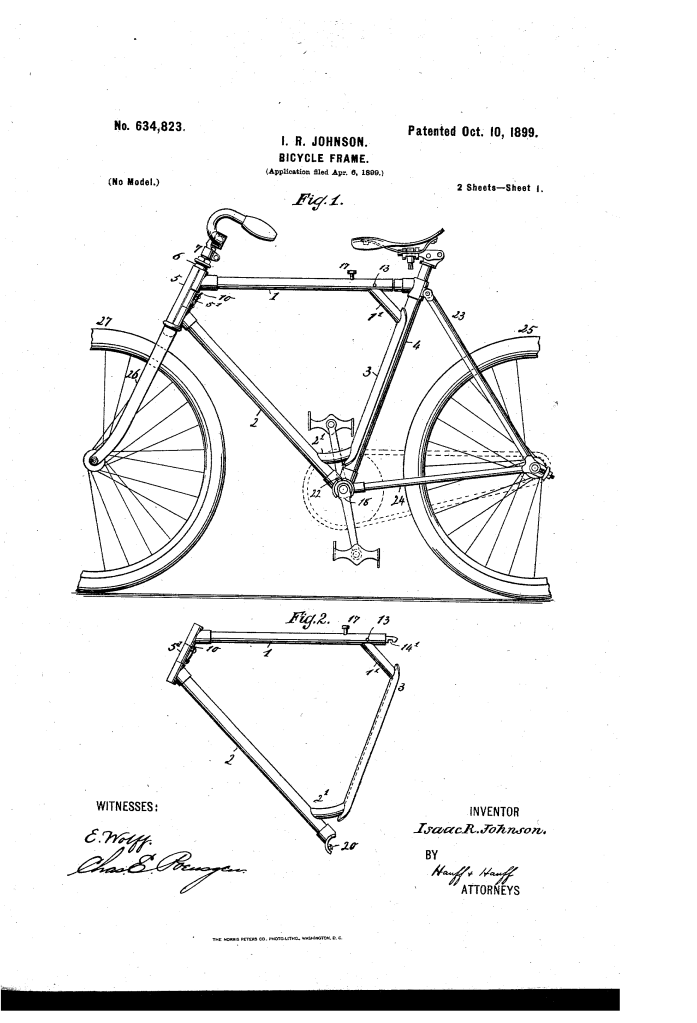
The bicycle frame is designed to separate into three main sections—the front steering assembly, the central diamond, and the rear wheel/crank assembly—using a combination of keyhole-slot fasteners and internal catches.
1. Frame Segmentation
The frame is divided into three parts:
- Steering Head/Front Wheel Assembly: Contains the handlebars, steering post (7), and front fork (26).
- Central Diamond: Consists of the upper tube (1) and lower tube (2).
- Rear Wheel/Crank Hanger Assembly: Contains the seat-post tube (4), rear wheel, and crank-hanger (18).
2. Slot-and-Stud Connection (Key Innovation)
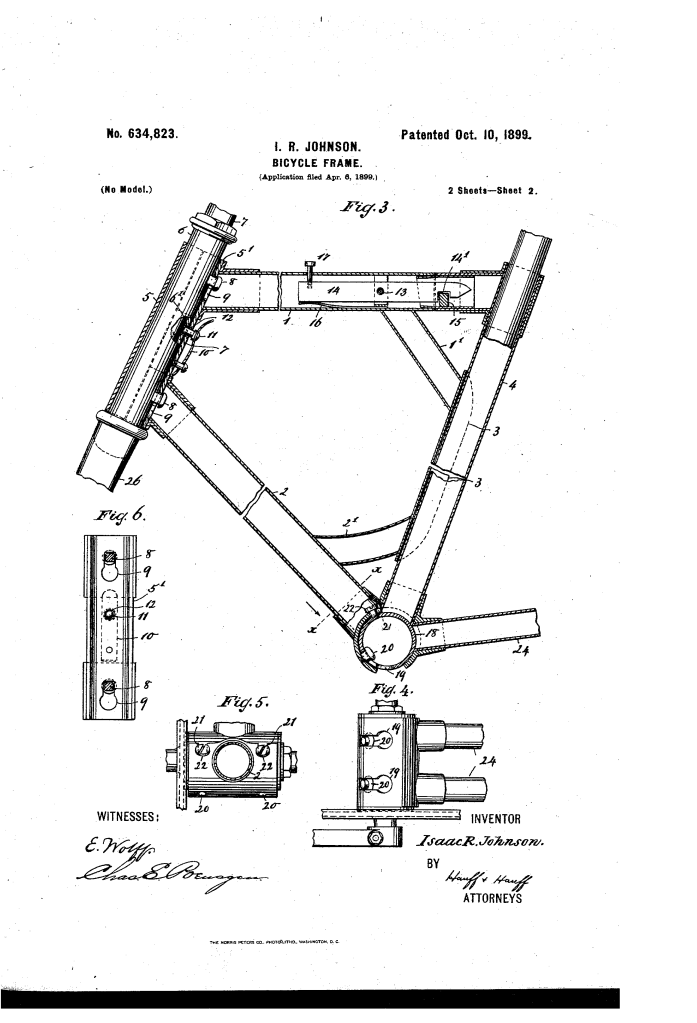
- Mechanism: The main connections (between the diamond and the steering head, and between the diamond and the crank hanger) use a slot-and-headed-stud connection (often called a keyhole slot).
- Headed Studs (8, 20): Fixed studs project from one section (e.g., the steering head).
- Keyhole Slots (9, 19): Corresponding slots on the other section (e.g., the diamond) have an enlarged portion (the “keyhole”) that allows the stud head to pass through, and a narrow slot portion that locks the stud head into place.
- Function: To assemble, the user aligns the studs with the wide part of the slot, pushes them in, and then slides the frame down so the stud heads overlap the narrow slot edges, creating a tight and secure joint.
3. Locking and Internal Release
- Steering Head Lock (10, 11): A spring (10) is secured to the steering head and carries a stud or pin (11). This pin locks into an aperture (12) when the keyhole slot is engaged.
- Function: This secondary pin ensures the joint is locked and prevents the main studs (8) from jostling loose.
- Upper Tube Catch (14): The connection between the rear wheel portion and the upper tube (1) uses a lever (14) that pivots internally within the tube. One end of the lever catches over a fixed projection (15).
- Function: The lever is held locked by a spring (16). To separate, the user presses a button (17) extending through the tube, which disengages the lever and allows the frame to come apart.
Concepts Influenced by This Invention
Johnson’s dismountable frame influenced subsequent design in portable hardware and assembly, establishing the keyhole slot as a primary method for quick, rigid disassembly.
- Keyhole-Slot Locking (Quick Disassembly): The invention’s reliance on the keyhole-slot and headed-stud mechanism is its primary influence. This system is now a standard, simple, and effective fastener in:
- Modular Furniture: Used to attach tabletops to bases, or secure shelves and cabinets for flat-pack shipping.
- Wall Mounts: The mounting point on televisions and wall brackets that slides onto a fixed screw head.
- Component Disassembly: Industrial machinery and equipment panels that need to be quickly removed for access.
- Multi-Point Mechanical Integration: The use of multiple, different mechanical fasteners (keyhole slots, internal pivoting catches, and spring pins) to ensure structural integrity across a single frame influenced the design of modern modular systems where complex forces require varied locking solutions.
- Portability and Flat-Packing: The successful engineering of a full-size bicycle that could be broken down into small, non-fragile components contributed to the design philosophy of flat-pack shipping and maximizing transport density in consumer goods.
