
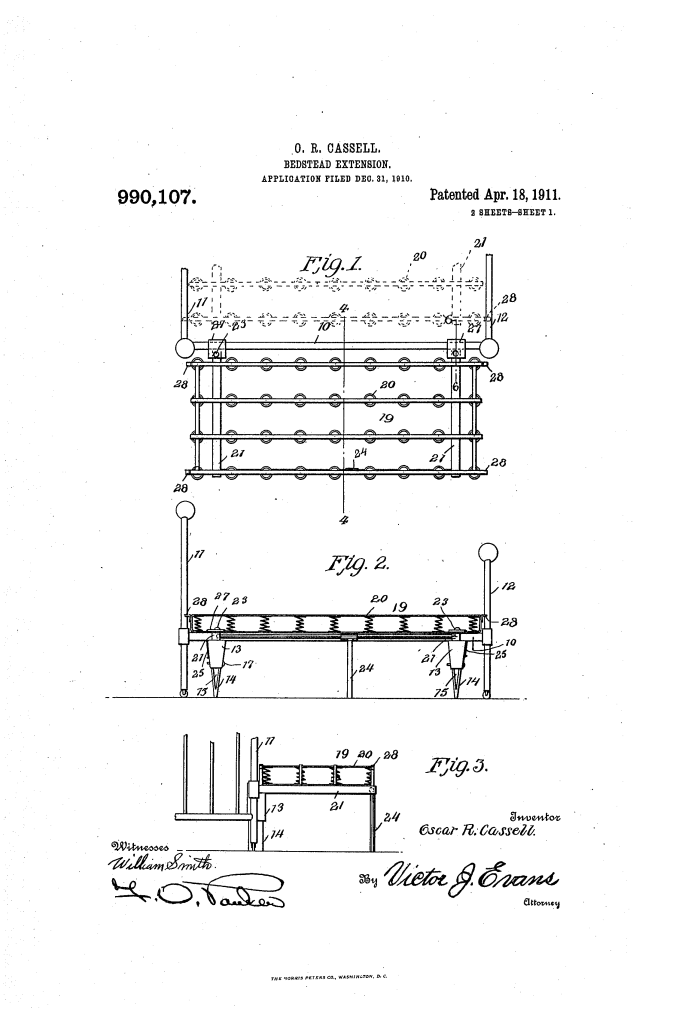
Bedstead Extension (Oscar R. Cassell, No. 990,107)
The patent by Oscar Robt. Cassell of New York, N.Y., describes a Bedstead Extension (Patent No. 990,107, 1911). The invention is a detachable attachment for metal bedsteads designed to increase the width of a bed, allowing a single bed to comfortably accommodate two or more people, or to provide a secure sleeping space for an infant or adult. A key feature is its ability to be quickly dismounted and suspended beneath the bed when not in use.
Inventor Background: Oscar R. Cassell
Oscar Robert Cassell was an African-American inventor and architect based in New York City. His work often focused on practical domestic improvements and space-saving furniture. Cassell’s architectural background is reflected in the structural integrity and modularity of this bed extension, which utilizes mechanical interlocking and telescoping components to solve urban living challenges—specifically the need for flexible sleeping arrangements in limited spaces.
Invention and Mechanism (Simplified)
The extension consists of a secondary spring frame supported by specialized “L-shaped” legs that clamp directly onto the existing bed’s side rail.
1. Extensible Supporting Legs (Key Innovation)
- Body (13) and Telescoping Foot (14): The extension is supported by a pair of legs. Each leg has a hollow body (13) and an extensible foot (14) that telescopes inside it.
- Function: Vertical apertures (16) and a locking pin (17) allow the user to adjust the height of the leg to match the bedstead perfectly.
- L-Shaped Recess (18): Each leg body (13) features a specific inverted L-shaped recess (18).
- Function: This recess is shaped to fit exactly over the side rail (10) of a standard metal bedstead, allowing the leg to “hook” onto the bed without permanent fasteners.
2. Spring Frame and Attachment
- Frame (19) and Rails (21): The extension frame (19) carries a standard bed spring (20) and has transverse rails (21) extending toward the bed.
- Locking Pins (23): These rails fit into the same L-shaped recess (18) as the bed rail. A vertical locking pin (23) passes through an opening in the rail to secure the frame to the legs.
- Foldable Leg (24): The outer side of the frame is supported by a foldable leg (24), which maintains the frame in a horizontal position.
3. Bracing and Storage
- Brace Hooks (25): To prevent the overhanging part of the leg from breaking under the weight of an occupant, brace hooks (25) engage with eyes (26) on the leg body to distribute the strain.
- Suspension Hooks (28): The frame includes hook members (28) at the head and foot.
- Function: When the extension is not needed, it can be detached and hung from the head and foot sections (11 and 12) underneath the main bed, saving floor space.
Concepts Influenced by This Invention
Cassell’s bedstead extension influenced subsequent designs in modular furniture and domestic utility by pioneering non-destructive clamping and nested storage.
- Non-Destructive Modular Attachments: The core concept of using a form-fitted recess (18) to attach a heavy accessory to a pre-existing structure (the bed rail) without screws or bolts influenced a wide range of “no-drill” furniture and home organizational products.
- Telescoping Height Adjustment: The use of telescoping tubes with pin-and-aperture locking for load-bearing furniture influenced the design of modern adjustable desks, hospital beds, and temporary scaffolding.
- Integrated Secondary Storage: The inclusion of suspension hooks (28) specifically designed to store the product within the “dead space” of its parent unit (under the bed) is a fundamental principle in modern space-saving and “tiny home” furniture design.
- Strength through Mechanical Interlocking: By combining the weight of the occupant with the L-shaped hook and the brace hook, Cassell demonstrated how to create high structural stability using gravity and tension rather than complex hardware.
