
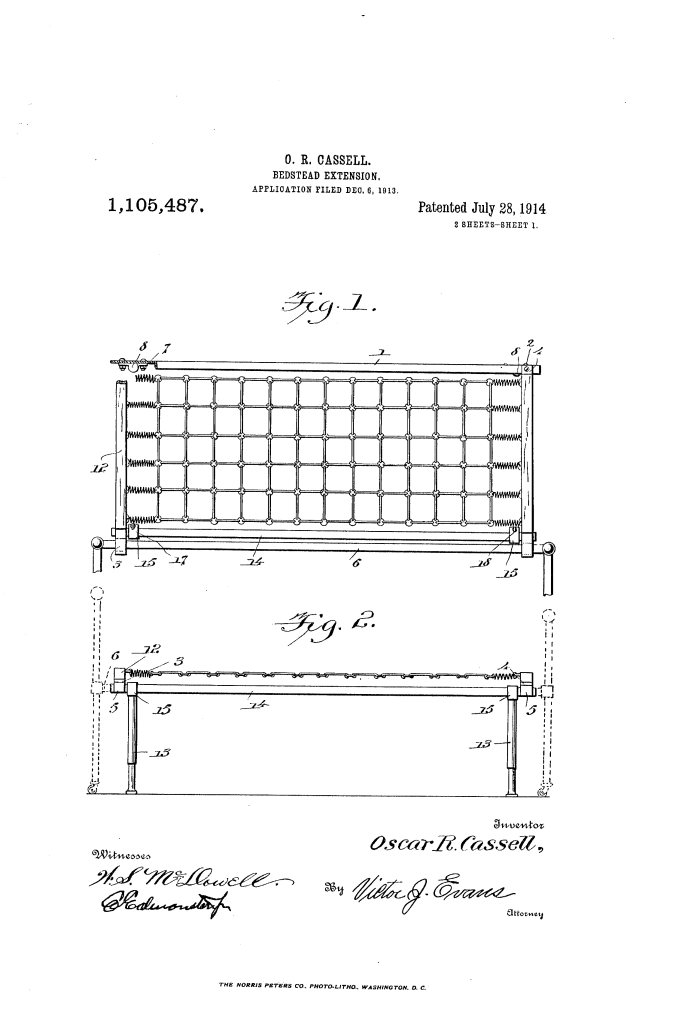
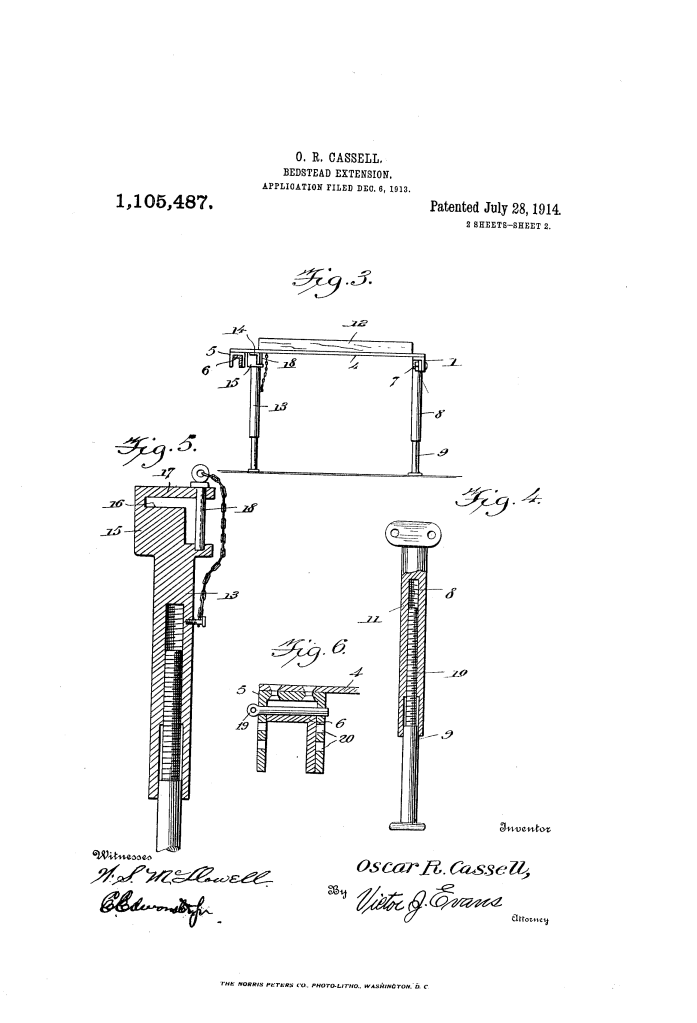
🛏️ Bedstead Extension (Oscar R. Cassell, No. 1,105,487)
The patent by Oscar R. Cassell of New York, N.Y., describes a Bedstead Extension (Patent No. 1,105,487, 1914). This invention is a specialized mechanical attachment designed to convert a single bed into a double bed. It can also function as a standalone cot. Cassell’s design focused on portability and structural integrity, ensuring the extension could support significant weight without straining the main bed frame.
Inventor Background: Oscar R. Cassell
Oscar Robert Cassell was an African American inventor and architect based in New York City. His work often bridged the gap between structural engineering and domestic utility. Following his 1911 patent for a similar device, this 1914 version refined the supporting leg mechanism. Cassell’s architectural expertise is evident in the way he distributed the load across auxiliary bars rather than relying on the “side rails” of the existing bed, a common point of failure in earlier designs. His inventions reflect a deep interest in modular living—creating solutions for high-density urban environments like New York.
Key Mechanical Components & Functions
The extension is a folding metal frame supported by a unique system of adjustable, weight-bearing legs.
1. The Folding Frame (1, 3, 4)
- Side Bar (1) and End Members (3, 4): The main frame consists of an angle iron side bar (1). Pivotally attached to it are two end members (3, 4).
- Angle Clips (5): At the free ends of the end members are clips that hook over the side rails (6) of the existing bed.
- Function: These clips keep the extension perfectly aligned with the main bed but do not bear the primary weight of the sleeper.
2. Adjustable Supporting Legs (8, 9, 13)
The weight of the extension is carried by four heavy-duty metal legs.
- Telescoping Design: The legs (8) are tubular and contain extensions (9) with threaded ends (10).
- Height Adjustment: By screwing the extensions into or out of an internal collar (11), the user can change the height of the extension.
- Function: This ensures the extension mattress remains perfectly level with the main bed mattress, regardless of the bed’s original height.
3. The Auxiliary Side Bar (14) (Key Innovation)
In his previous designs, the inner ends of the extension rested directly on the bed rail. In this patent, Cassell introduced an auxiliary side bar (14).
- L-Shaped Shoulder (16): The legs (13) on the inner side feature a specialized head (15) with an L-shaped shoulder where the auxiliary bar rests.
- Load Distribution: The bar (14) extends beneath the end members (3, 4), effectively creating a “bridge” that carries the weight down to the floor via the auxiliary legs.
- Function: This protects the main bedstead from bending or warping under the weight of a second person.
4. Portability and Storage
- Pivot Bolts (2): Because the end members are pivoted, the entire device can be collapsed.
- Action: Once the mattress frame (12) is removed and the auxiliary bar is disconnected, the end bars fold horizontally against the side bar, allowing the unit to be stored in an out-of-the-way place like a closet or under a bed.
Improvements Over Existing Technology
| Feature | Standard Bed Extensions | Cassell’s Extension |
| Weight Bearing | Placed strain directly on the bed’s side rails. | Uses an auxiliary side bar and independent legs to protect the bed. |
| Versatility | Only usable when attached to a bed. | Can be used as a standalone unitary bed/cot. |
| Leveling | Fixed height; often created an uneven sleeping surface. | Threaded telescoping legs for precision leveling. |
| Durability | Rigid parts prone to snapping at joints. | Pivoted joints and tubular steel construction for resilience. |
Significance to Furniture Engineering
Oscar R. Cassell’s bedstead extension is an early example of convertible “transformer” furniture.
- Independent Suspension: The logic of providing a separate support structure (the auxiliary bar and legs) while still “linking” to a main unit is a fundamental principle in modular engineering.
- Spatial Optimization: By designing a double-bed capacity that could “disappear” when not in use, Cassell addressed the primary constraint of urban apartment living: limited floor space.
- Precision Leveling: The use of threaded collars for micro-adjustments in furniture legs is a standard feature today in everything from office desks to heavy machinery, ensuring stability on uneven floors.
