
Bed Rack Attachment, Henrietta Bradberry, Patent No. 2,320,027
The patent by Henrietta Bradberry of Chicago, Illinois, describes an innovative Bed Rack attachment (Patent No. 2,320,027), filed in 1941 and granted in 1943. This mechanical device is designed to be clamped to the foot of a bed, providing a collapsible framework of rods used to air out and freshen bed linens after use. Notably, the system features a sophisticated pedal-operated “lazy-tongs” mechanism, allowing a person to expand or collapse the heavy rack using only their feet.
The “Why”
In the early 1940s, household hygiene was a manual and labor-intensive task. Fresh air was considered a primary defense against staleness and odors in bedding. However, hanging heavy sheets and blankets over the foot of the bed was untidy and provided poor air circulation. The pain point Bradberry addressed was the physical strain and inconvenience of setting up drying racks. She sought to create a permanent, out-of-the-way attachment that could be deployed instantly and tucked away just as quickly, without requiring the user to bend over or lift heavy frames.
Inventor Section: Engineering Philosophy
Henrietta Bradberry’s engineering philosophy focused on Hands-Free Mechanical Automation. She recognized that a rack sturdy enough to hold multiple heavy blankets would be difficult to manipulate by hand. Her solution was to utilize the strength of the legs and the principle of linkage synchronization. By connecting the trip mechanisms on both sides of the bed, she ensured that the rack would never “bind” or tilt—if you pressed the pedal on the left, the right side would respond perfectly in unison. This level of mechanical coordination was advanced for domestic appliances of the era.
Key Systems Section
1. Lazy-Tongs Extensible Framework
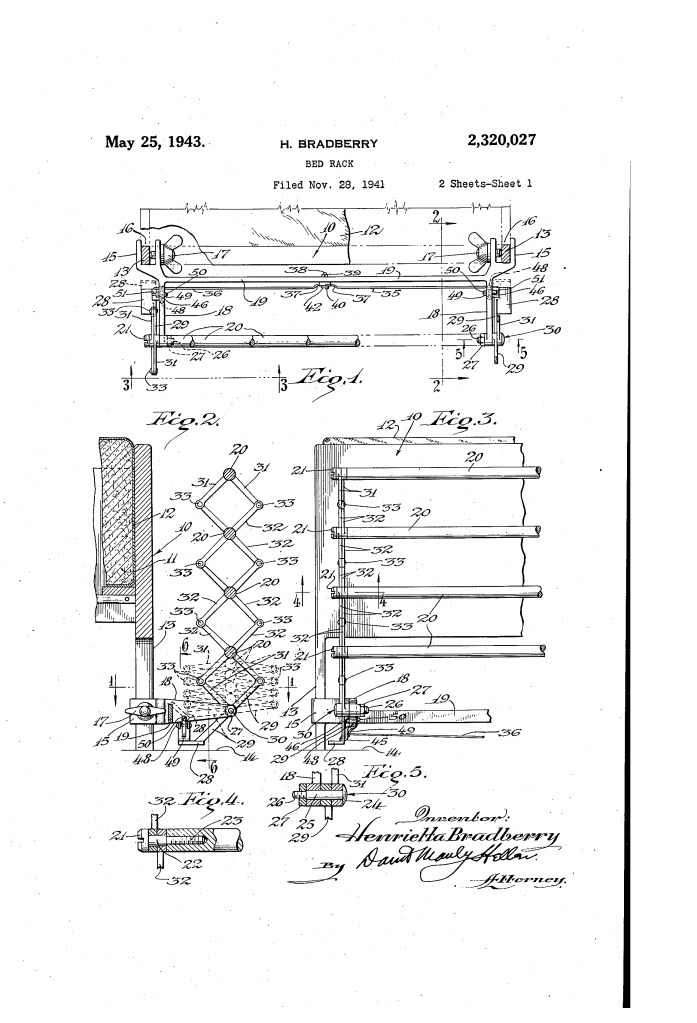
The rack uses a classic “lazy-tongs” (pantograph) structure (31, 32) to achieve massive vertical reach from a compact base.
- Mechanical Principle: A series of crisscrossed pivots allows a small horizontal movement to translate into a large vertical extension.
- Function: When the treadle (28) is pushed down, it pulls the base of the tongs together, forcing the supporting rods (20) upward into the “freshening” position.
2. Dual-Side Synchronized Trip Means
A critical safety and ease-of-use feature is the linkage that connects the locking mechanisms on either side of the bed.
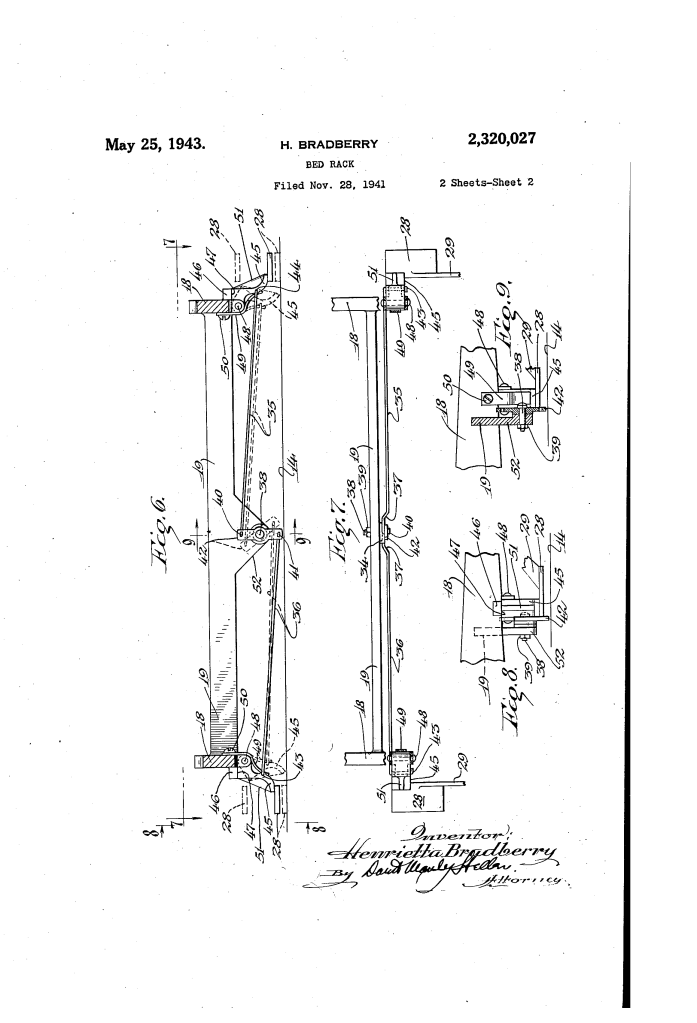
- The Mechanism: An oscillating link (42) and connecting rods (35) join the two trip levers (45).
- Engineering Insight: This “dual-trip” system means that the user can lock or unlock the entire rack from either side of the bed. There is no need to walk around the bed to ensure both sides are secure; the mechanical bridge ensures identical operation.
3. Foot-Operated “Cam-Action” Lock
The device is operated entirely by foot, utilizing a cam-style locking engagement.
- Operation: To expand the rack, the user slides their toe along the treadle (28). As the treadle reaches the bottom, it hits a ribbed structure (51) on the trip means, which acts as a cam, forcing the lock open and then snapping it shut over the treadle via springs (49).
- Release: To collapse the rack, the user simply slides their toe along the rib again to move the trip inward, providing an “escapement” that allows the rack to fold back down.
4. Weight-Optimized Hardware
Bradberry accounted for the physical weight of a metal rack attached to a bed frame.
- The Solution: The patent suggests that the rods (20) be made of hollow tubing with threaded plugs.
- Gravity Management: She advised users to use their foot to “deter the action of gravity” when collapsing the rack, preventing the heavy assembly from slamming down and damaging the floor or the bed.
Comparison Table: Standard Drying Racks vs. The Bradberry Rack
| Feature | Portable 1940s Rack | The Bradberry Bed Rack |
| Storage | Must be moved to a closet/corner. | Permanently attached & collapsible. |
| Operation | Hand-folded (requires bending). | Foot-pedal operated (hands-free). |
| Stability | Freestanding (prone to tipping). | Clamped to bed legs (13). |
| Synchronization | Manual adjustment of both sides. | Automatic unison via link rods (42). |
| Deployment | Multistep setup. | Single-step cam-lock engagement. |
Significance
Henrietta Bradberry’s Bed Rack was a sophisticated contribution to Residential Ergonomics:
- Hands-Free Innovation: It preceded the modern “step-on” trash can and other pedal-operated home goods, applying industrial linkage principles to a domestic problem.
- Mechanical Symmetry: The use of an oscillating link to synchronize two distant locking points is a fundamental principle in automotive and industrial design.
- Hygiene Advocacy: The invention reflected a cultural shift toward proactive home sanitation, providing a dedicated space for “airing out” that didn’t disrupt the tidiness of the bedroom.
