
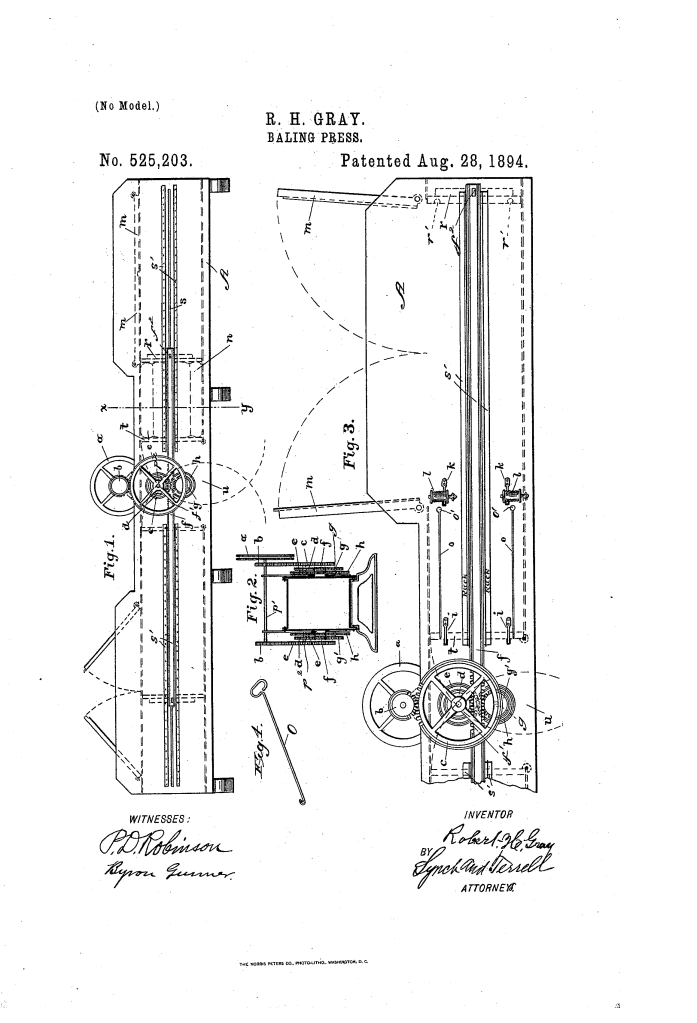
Baling-Press (1894)
U.S. Patent No. 525,203, granted on August 28, 1894, to Robert H. Gray, describes an improved mechanical baling press designed for compacting cotton, hay, and similar agricultural materials into dense, easily transportable blocks. Operating out of Lexington, Kentucky, Gray developed a highly efficient, double-ended system that prioritized structural simplicity, rapid continuous operation, and portability.
This invention solved several major issues plaguing 19th-century agricultural machinery: the immense weight and bulk of traditional wooden or heavy cast-iron presses, the mechanical strain placed on gears during the bale-tying process, and the downtime associated with operating single-chamber designs.
The Innovation: Continuous Alternate Compression
The core breakthrough of Gray’s design lies in its dual-chamber, double-acting architecture. Instead of a single piston that must be retracted before the next batch can be loaded, Gray utilized a pair of interconnected rack-bars that operated two separate pressure heads simultaneously.
While one pressure head is moving inward to compress a bale at one end of the machine, the opposite head is automatically retracting to its outer position at the other end. This layout left the secondary chamber perfectly primed for immediate reloading, effectively doubling the processing speed of standard presses.
Furthermore, Gray built the entire chassis out of sheet metal. This allowed the press to be lightweight, easily disassembled, and packed into a compact configuration for effortless transport across farms and shipping routes.
How the Apparatus Functions
The machine operates through a precise sequence of mechanical actions that safely compresses, locks, binds, and automatically discharges the finished bale:
| Step | Action | Mechanical Purpose |
| 1. Charging | Binding wires from spools (l) are drawn across the chamber; trap doors (m) flip open to receive raw material. | Pre-positions the structural ties and prepares the chamber without disrupting the gear train. |
| 2. Compression | Power is applied to the main pulley (a), driving a localized sequence of double-sided gear pinions (dg). | The pinions grip the top and bottom teeth of the rack-bars (f), smoothly forcing the pressure head inward. |
| 3. Strain Relief | Upon reaching maximum compression, internal spring catches (k) snap shut behind the pressure head. | Locks the compressed bale in place and completely relieves the driving gears of mechanical tension during tying. |
| 4. Binding | A specialized hook tool (O) is inserted through side slots (o) to grab and pull the binding wires tight. | Allows the operator to easily wrap and securely tie off the bale via recessed channels ($o”$) built directly into the face of the pressure head. |
| 5. Discharge | Spring catches (t) are tripped, dropping the pivoted inner walls (15) downward. | The next gear cycle pushes the finished bale forward, causing it to fall cleanly out of a central delivery opening in the bottom of the press. |
Key Mechanical Components
The press functions as a perfectly synchronized kinetic system:
- Sheet-Metal Press Box (A): The lightweight, collapsible main frame containing dual compression chambers and a centralized bottom-drop exit.
- Double-Toothed Rack-Bars (f): Heavy-duty side rails featuring gear teeth along both their top and bottom edges, providing balanced, non-binding tracking under heavy loads.
- Pivoted Swinging Heads (15/t): Internal swinging walls that serve as the backstop for compression. Once released, they swing completely out of the way to facilitate gravity-assisted bale ejection.
- Dual-Tier Gear Train (b, c, d, e, h, g): A strategic assembly of intermeshing shafts and pinions designed to split driving power evenly across both the upper and lower edges of the rack-bars.
Historical and Scientific Impact
Robert H. Gray’s baling press arrived during a vital period of late 19th-century industrialization in agricultural distribution.
- Logistical Portability: By leveraging a sheet-metal construction that could be broken down, Gray moved heavy manufacturing capabilities directly to the field, eliminating the need to transport uncompressed, high-volume crops to centralized milling stations.
- Gear Longevity: Standard agricultural presses of the era frequently suffered from stripped gears because the machinery had to hold maximum compression force purely through gear-on-gear friction while operators tied off the bales. Gray’s introduction of independent spring catches fundamentally prolonged the operational lifespan of these machines.
About the Inventor: Robert H. Gray
Robert H. Gray was an African American inventor based in Lexington, Kentucky. Working in the post-Reconstruction South, Gray’s contributions to agricultural engineering highlight the critical role that Black inventors played in driving the automation and mechanical modernization of American agricultural logistics.
Summary of Claims
The patent explicitly claims:
- A press box engineered with a compression chamber at each end operating on side-mounted guideways with alternating pressure heads, configured around a central bottom delivery opening.
- The implementation of movable, pivoted inner heads secured by spring catches that drop open to allow automated bottom discharge.
- A specialized system of locking spring catches designed to catch and hold the advancing pressure head at its peak internal point to relieve gear strain during binding.
