
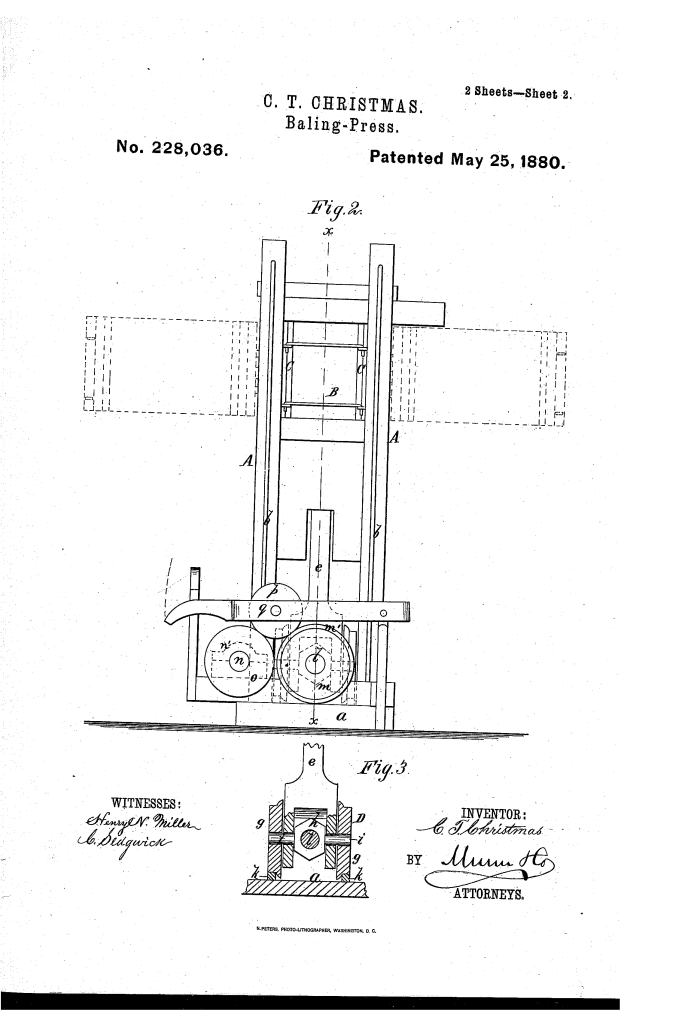
Charles T. Christmas’s patent for a Baling-Press, No. 228,036, describes a machine designed to compress materials like cotton or hay into compact bales. Patented on May 25, 1880, the press was an advanced design for its time, focused on efficiency, power, and uniform pressure.
The key features of the baling press were:
- Right-and-Left Handed Screw-Shaft: The press used a single screw-shaft with a right-handed thread on one end and a left-handed thread on the other. This meant that as the shaft turned, two trucks would move simultaneously toward the center of the press. This provided a balanced, powerful compression.
- Lever and Follower Mechanism: The follower, which applied pressure to the material, was connected to the trucks by a system of levers. As the trucks moved inward, the levers would move from a horizontal position to a more vertical one. This geometry ensured that the speed of the follower diminished gradually while the compressive power increased, allowing for precise and powerful final compression.
- Versatile Power Source: The screw-shaft could be operated by either a pulley and friction-wheel system for mechanical power or by a hand-lever for manual operation.
- Uniform Pressure: By applying the force from the center, the design ensured that the pressure was “equal and uniform upon all parts of the bale.”
Societal Impact and Legacy
Christmas’s invention was a significant contribution to agricultural technology, particularly in the cotton-growing regions of the South.
- Agricultural Efficiency: The invention improved the speed and quality of baling. Tightly compressed, uniform bales were easier and more economical to store and transport. By maximizing the amount of material in each bale, it reduced shipping costs, which was a major factor for cotton farmers.
- Economic Benefits: The machine’s ability to produce consistent, high-density bales made agricultural products more marketable and profitable. This type of mechanization helped to modernize farming practices in the late 19th century.
- The Inventor’s Legacy: The patent record for Charles T. Christmas does not contain information about his life beyond his residence in Riverton, Mississippi. However, his work stands as an example of the thousands of inventors who created devices that, while not world-changing, made a direct and tangible improvement to the lives and livelihoods of working people.
