
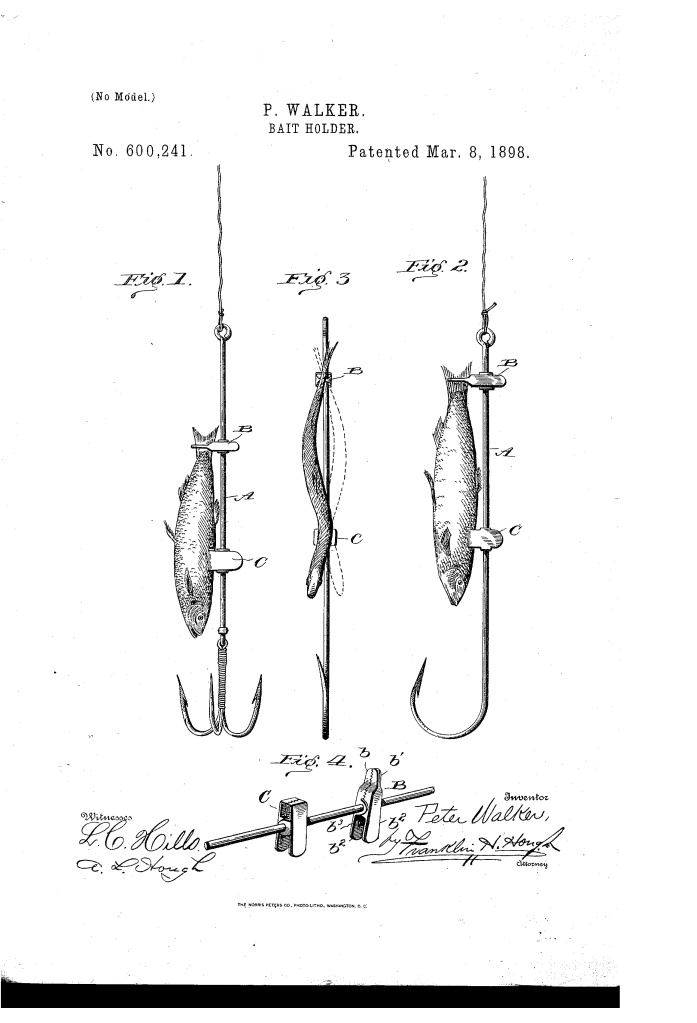
Fishing Bait Holder (1898)
U.S. Patent No. 600,241, granted on March 8, 1898, to Peter Walker, describes an adjustable clamping attachment designed to secure live bait fish without impaling them on hooks. Peter Walker, an inventor residing in Friars Point, Coahoma County, Mississippi, developed the device for use in both trolling and still fishing.
This invention addressed a common limitation in recreational and commercial fishing: traditional methods required threading or piercing live minnows directly onto hooks, which quickly injured or killed the bait and reduced the natural swimming motion needed to attract game fish. Walker’s mechanical holder preserved bait viability by gripping the fish securely along its body while allowing natural movement.
The Core Design: The Dual-Clamp System
The assembly relies on two spring-actuated, adjustable clamps mounted along a central wire or hook shank (A). The clamps can slide longitudinally to adjust for different bait sizes.
- Tail-Clamp (B): Positioned toward the rear to grasp the bait fish at the base of the tail. It consists of two pivoted jaws (b, b) sized to fit standard minnows, complete with lever arms (b’) and a spiral spring (b2) that holds the jaws closed under continuous tension.
- Body/Dorsal Clamp (C): Positioned near the longitudinal center of the fish. Unlike the tail clamp, its serrated gripping jaws run parallel to the length of the wire (A) or at right angles to jaws (b, b), gripping the bait along its back or directly at the dorsal fin.
Mechanical Components
| Component | Function |
| Central Wire / Hook Shank (A) | Serves as the structural spine; either forms the shank of a single hook or connects via swivel ring to a gang-hook rig. |
| Tail-Clamp (B) | Secures the narrow base of the minnow’s tail using transverse spring-loaded jaws. |
| Dorsal Clamp (C) | Features serrated teeth set at right angles to clamp B to grip the fish’s back or dorsal fin along its longitudinal axis. |
| Spiral Springs (b2) | Provide constant inward clamping pressure to keep the jaws closed around the fish without crushing tissue. |
| Clamp Lever Arms (b’) | Extended tabs past the pivot point that allow the angler to pinch the jaws open for bait loading. |
How the Apparatus Functions
- Adjustment: The angler slides clamps B and C along the wire shank (A) to match the length of the selected minnow.
- Body Attachment: Clamp C is pinched open and attached along the back or dorsal fin near the fish’s center of mass.
- Tail Securing: Clamp B is opened and positioned around the base of the caudal peduncle (tail base).
- Line Rigging: The fishing line is attached either to the swiveled gang hook ring or wrapped directly onto the eyeless end of the hook shank after the clamps have been positioned.
Functional Impact & Advantages
- Prolonged Bait Life: Eliminating the need to pierce the fish keeps the bait alive and energetic significantly longer in the water.
- Natural Movement: Securing the bait at the dorsal fin and tail base leaves the body free to flex and wiggle, producing realistic vibrations and visual cues that attract predatory fish.
- Versatility: The adjustable spacing accommodates varying bait sizes and mounts interchangeably onto single long-shank hooks or wire leaders paired with multi-hook gang rigs.
About the Inventor: Peter Walker
Peter Walker was an African American inventor based in the Mississippi Delta town of Friars Point. Operating during the late 19th century, Walker contributed practical mechanical innovations to everyday sporting and working life, securing federal patent protection for outdoor sporting gear during an era when Southern Black inventors faced severe economic, legal, and social hurdles.
Summary of Claims
The patent explicitly claims:
- A fishing-bait holder combining a fish-hook shank with pivoted clamping jaws mounted directly to the hook.
- Spring-actuated clamping jaws pivoted to the shank of a fish hook to retain live bait.
- Serrated clamping jaws arranged at right angles to the shank to hold the bait securely along its back.
- A wire rig for gang-hook assemblies featuring independent, longitudinally adjustable, spring-actuated clamps.
