
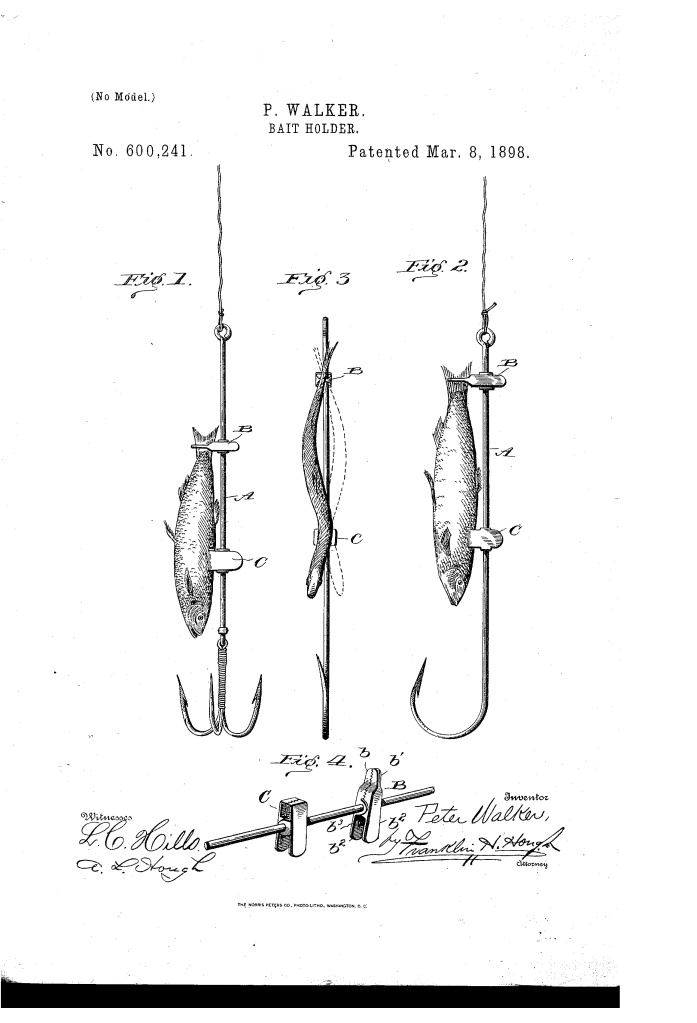
Bait-Holder (Peter Walker, No. 600,241)
The patent by Peter Walker of Friars Point, Mississippi, describes a Bait-Holder (Patent No. 600,241, 1898). The invention is a simple, inexpensive, and efficient device for securing live bait (small fish or minnows) for both trolling and still fishing. The primary object is to obviate the necessity of impaling the bait upon a hook, thereby prolonging the life of the bait-fish and allowing it to move naturally, which attracts fish more effectively.
Inventor Background: Peter Walker
Peter Walker was an African-American inventor residing in Friars Point, Mississippi, known for his patents in agricultural and utilitarian mechanisms (such as his Machine for Cleaning Seed-Cotton). This patent demonstrates his ingenuity applied to consumer and recreational equipment, focusing on a practical, robust solution for improving fishing efficiency.
Invention and Mechanism
The bait-holder uses a system of adjustable, spring-actuated clamps attached to a fishing line or hook shank.
1. Support and Structure
- Wire/Shank (A): A straight piece of wire, which may be independent (connected to a gang of hooks) or constitute the shank portion of a single fish-hook.
- Clamps (B and C): Two independent clamps (B and C) are adjustably secured to the wire (A), allowing them to be moved to conform to the size of the bait fish.
2. Spring-Actuated Clamps (Key Innovation)
- Tail-Clamp (B): Designed to grasp the fish at the base of the tail. Its jaws ($b, b’$) are oriented transversely to the length of the fish.
- Body-Clamp (C): Designed to grasp the fish along its back (dorsal fin). Its jaws are oriented longitudinally to the length of the fish (at a right angle to clamp B).
- Spring Tension: Both clamps are made of pivoted jaws with extensions that are held normally closed by a spiral spring ($b^{3}$).
- Function: The clamps are opened against the spring tension to secure the bait. The spring tension holds the fish firmly without impaling its body, allowing the fish to “bend the body or wiggle” naturally.
3. Operational Advantages
- Prolonged Life: By avoiding impalement, the life of the bait-fish is prolonged.
- Natural Movement: The secured fish is still permitted to move and wiggle, which, through practical experiment, was found to attract game fish much better than an impaled, static bait.
- Dorsal Fin Attachment: The inventor notes the preferred method is to attach the lower clamp to the dorsal fin rather than the body, to maximize the bait’s natural movement.
Concepts Influenced by This Invention
Walker’s bait holder influenced subsequent tackle design by pioneering non-lethal, spring-tensioned gripping for live bait presentation.
- Spring-Tension Gripping (Live Bait): The core concept of using adjustable, spring-actuated clamps to hold live bait without puncturing the body influenced the design of modern:
- Live Bait Harnesses: Trolling or still-fishing rigs that use spring clips, wire forms, or flexible bands to secure bait fish non-lethally to maximize their movement.
- Releasable Clips: Various forms of clip-on weights, bobbers, and tension releases used in fishing tackle that rely on adjustable spring tension for attachment.
- Modular, Adjustable Attachments: The design of having independent clamps (B and C) that are longitudinally movable on the shank influenced the design of modern fishing rigs that use multiple adjustable leaders, swivels, and hooks to adapt to different bait sizes and fishing conditions.
- Non-Invasive Tooling: The application of mechanical ingenuity to solve a problem (holding bait) with a non-invasive, high-utility method influenced the design of specialty tools across various fields where gentle but secure gripping is required.
