
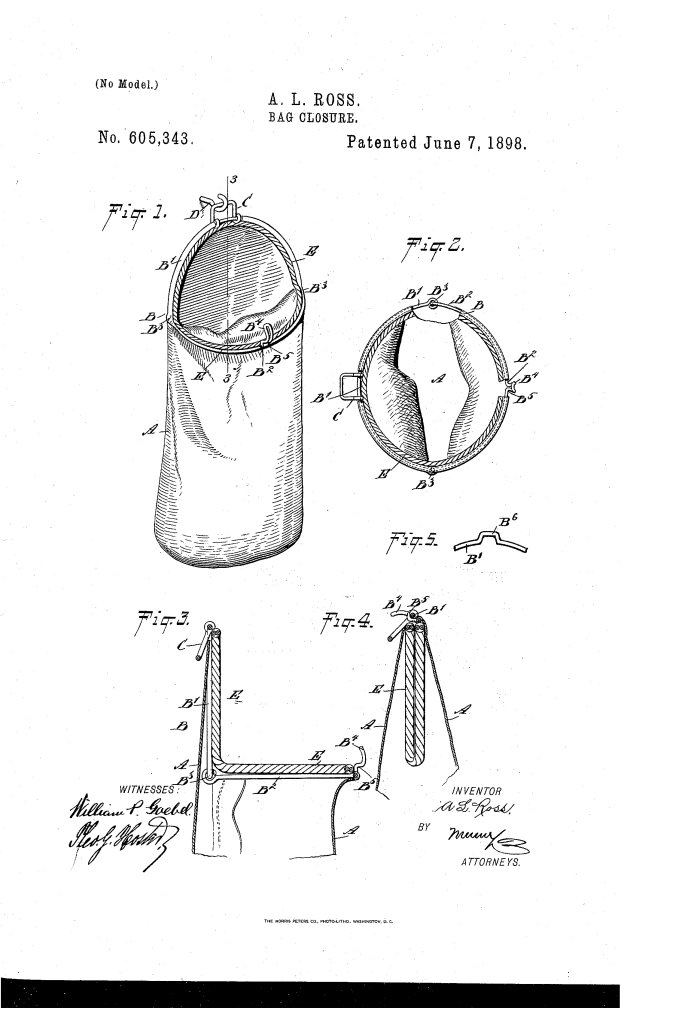
Bag Closure (1898)
U.S. Patent No. 605,343, granted on June 7, 1898, to Archia L. Ross, describes an innovative mechanical bag-closure frame designed for heavy-duty household and industrial refuse collection. Archia Ross, an inventor based in New York City, assigned half of the patent rights to David Hyams.
The invention solved a common sanitation and handling problem of the late nineteenth century: how to keep refuse bags open hands-free while filling them with messy household waste like coal ashes and scrap paper, and how to reliably close and seal the mouth to prevent dust, soot, and litter from spilling during transport.
The Innovation: The Spring-Wire Locking Frame
Traditional cloth sacks were awkward to fill single-handedly and lacked an airtight seal, leading to dust and ash escaping into living quarters or city streets. Ross introduced an arched, hinged spring-wire mouth frame coupled with a specialized braided packing seal.
The design achieved two vital operational goals: it allowed the sack to hang wide open against a wall hook during filling, and it snapped shut tightly with a single integrated spring latch that compressed the inner seal.
Why This Design?
Hands-Free Suspension: A dedicated hanging loop allows the entire sack to suspend from a nail or wall hook, keeping the mouth propped wide open without manual support.
One-Handed Release: The latching shoulder releases with a downward pull against the suspension loop, enabling rapid opening and closing.
Dust-Tight Sealing: A continuous inner welt strip creates an abutting closure along the rim to contain fine airborne particles like stove ash.
Key Technical Components
The mechanism integrates the bag fabric directly into a flexible metal framework:
| Component | Function |
| Spring-Wire Frame (B) | Formed of two arched, U-shaped spring metal members (B1, B2) hinged at the ends (B3) to open wide or snap shut. |
| Integral Catch (B4) & Shoulder (B5) | Formed by doubling and bending the wire of member B2; snaps over member B1 to lock the frame closed. |
| Suspension Loop (C) | A U-shaped holder pivoted on member B1; hangs the bag from a hook (D) and provides leverage when opening the catch. |
| Packing-Strip (E) | A continuous strip of braid or cord sewn along the inner hem; abuts against itself when closed to seal the mouth. |
| U-Shaped Keeper (B6) | An optional recessed receiver on member B1 that captures the catch to prevent lateral shifting on larger bags. |
| Bag Body (A) | Constructed of canvas or durable fabric, hemmed directly around the wire perimeter of the frame. |
Operational Sequence
The closure functions through a straightforward mechanical cycle designed for utility and cleanliness:
- Suspension: The operator hangs the bag by loop C onto a wall hook or nail (D), which props frame members B1 and B2 apart to hold the mouth open.
- Filling: Household refuse, papers, or fine ashes are shoveled or placed into the wide, unobstructed opening.
- Closure: The bag is lifted off the support, and member B2 is pushed toward member B1 until shoulder B5 snaps securely underneath member B1 (or into keeper B6).
- Compression: As the frame locks, the opposing lengths of braided packing-strip E compress firmly against one another, creating a dust-proof seal for transit.
- Release: To empty, the user grasps loop C with one hand and pulls downward on the free end of catch B4 to disengage the spring latch.
Historical and Practical Impact
In the late 1890s, municipal waste management was emerging as a primary public health concern in dense cities like New York. The disposal of coal ash—the standard byproduct of home heating and cooking—was notoriously dirty, hazardous to respiratory health, and prone to blowing through city streets during collection.
Ross’s invention provided a reusable, washable canvas receptacle that eliminated the need for clumsy separate ties, offered reliable containment of hazardous dust, and streamlined domestic sanitation routines.
About the Inventor: Archia L. Ross
Archia L. Ross was an inventor working in New York City at the turn of the twentieth century. His work focused on practical mechanical utilities and consumer improvements, demonstrating how clever wire-forming techniques and integrated textile seals could solve everyday industrial and domestic sanitation challenges.
Summary of Claims
The patent explicitly claims:
- A bag-closure frame composed of two spring-metal members pivotally connected at their ends, featuring a pivoted suspension loop and a transversely extending catch with an interlocking shoulder.
- The incorporation of an internal cord or braid packing strip following the frame line to create a tight, abutting seal when shut.
- The addition of a U-shaped keeper on the opposing frame member to prevent shifting and ensure a firm latching engagement on larger sacks.
