
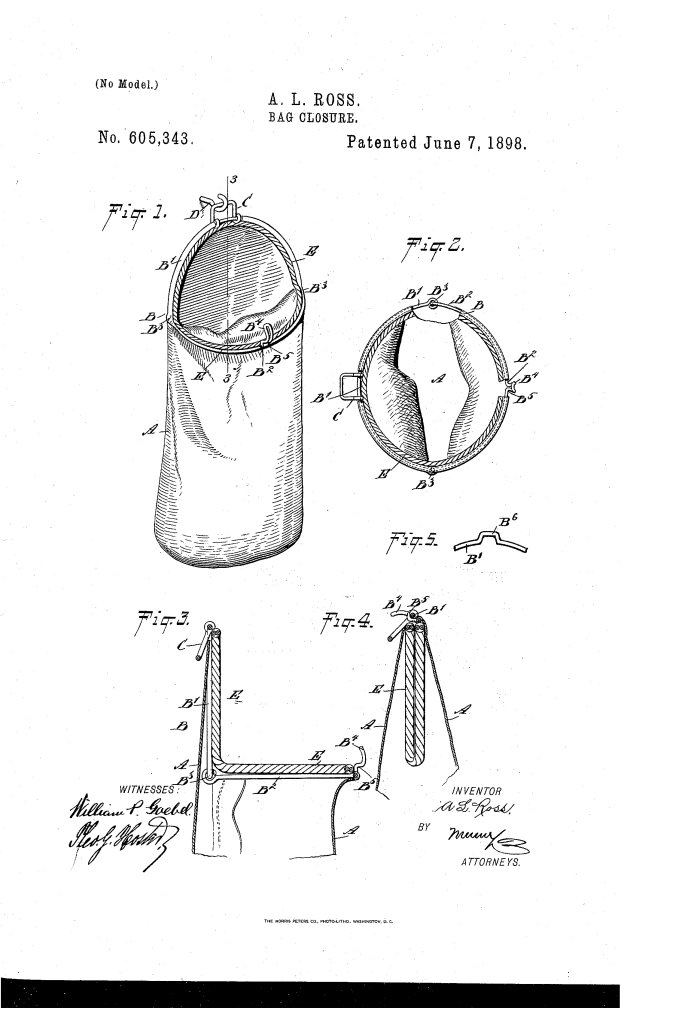
Bag-Closure (Archia L. Ross, No. 605,343)
The patent by Archia L. Ross of New York, N.Y., describes an improved Bag-Closure (Patent No. 605,343, 1898) for bags used to receive ashes, papers, and other refuse from households. The object is to provide a closure that can conveniently suspend the bag and hold its mouth open for filling, and then permit hermetically sealing the mouth to prevent spillage when transporting the refuse.
Inventor Background: Archia L. Ross
Archia L. Ross was an inventor based in New York City, contributing practical solutions to domestic and municipal utility. He also invented the Runner for Stoops (No. 565,301). His work in 1890s New York addresses the critical urban logistics problem of waste management, which required handling refuse cleanly and efficiently during collection.
Invention and Mechanism
The invention is a spring-wire frame built into the bag mouth that provides hinged opening, self-locking closure, and suspension.
1. Frame and Bag Structure
- Bag (A): Made of canvas or other suitable fabric.
- Frame (B): A frame made of spring-wire, formed with two arched or U-shaped members ($B’, B^{2}$).
- Hinge: The two members are pivotally connected ($B^{3}$) at their ends to form a hinge-joint.
- Function: The frame members swing toward each other to close the bag or away from each other to open it.
2. Suspension and Opening
- Holder/Loop (C): A U-shaped holder or loop is hung onto the middle of member $B’$.
- Function: This serves two purposes: suspending the bag from a hook or nail (D) while filling, and providing a convenient grip for the operator to pull downward when opening the frame.
3. Self-Locking and Sealing (Key Innovation)
- Catch ($B^{4}$) and Shoulder ($B^{5}$): Member $B^{2}$ has a transversely extending catch ($B^{4}$) formed by doubling the wire. This catch has a shoulder ($B^{5}$) designed to snap under the middle part of member $B’$ when the frame is closed.
- Packing Strip (E): A packing strip (cord or braid) is sewed to the hem of the bag, engaging both frame members.
- Function (Sealing): When the frame members are closed, the opposite sides of the packing strip (E) abut one upon the other, creating a hermetic seal to prevent spillage or escape of contents during transport.
- Operation (Closing): The operator closes the mouth of the bag and pushes the members together until the catch shoulder ($B^{5}$) snaps into place, locking the frame members tightly together.
Concepts Influenced by This Invention
Ross’s bag closure influenced subsequent designs for waste containment and bulk material handling by pioneering an integrated, reusable, and self-sealing closure system.
- Snap-Lock Frame Closures: The core concept of using a hinged, spring-wire frame (B) with an integrated snap-catch ($B^{4}$) to lock a flexible container influenced the design of modern hoop-style laundry hampers, mesh collection bags, and bulk material sacks that use a semi-rigid frame for structural support and closure.
- Integrated Suspension/Utility: The design to incorporate a hanging hook (C) directly into the closure mechanism influenced the engineering of various utility bags and containers that require simultaneous closure and suspension (e.g., hanging camping waste bags).
- Hermetic Sealing with Flexible Components: The use of an abutting packing strip (E) within a mechanically closed hinged frame to achieve a hermetic seal influenced the design of reusable industrial and commercial containers used for powders or hazardous waste, where the closure must be tightly sealed against dust or odor escape.
- Accessory for Refuse Management: The invention contributed to the necessary infrastructure for cleaner municipal waste collection in the early 20th century, where bags needed to be easily opened, securely closed, and safely transported.
