Auxiliary Circulating Device for Automobile Heaters: L. F. Page (Patent No. 2,170,553)
The patent by L. F. Page describes an Auxiliary Circulating Device for Automobile Heaters (Patent No. 2,170,553), granted on August 22, 1939. This invention is a supplemental plumbing and pumping system designed to keep an automobile cabin warm after the engine has been turned off. By utilizing an independent electric motor and a specific check-valve arrangement, Page enabled the “residual heat” trapped in the engine block to continue circulating through the car’s heater core, providing comfort for passengers during short errands or stops without the need to keep the engine idling.
The “Why”
In the 1930s, automobile heaters relied entirely on the engine’s water pump to move hot coolant. The primary “pain point” was that as soon as the engine stopped, the heat stopped. Within minutes of parking in cold weather, the cabin temperature would plummet. While the engine block remained hot for a significant amount of time, there was no mechanical way to move that thermal energy into the cabin. Page sought to “reclaim” this wasted energy by providing an independent, battery-powered circulation loop.
Inventor Section: L. F. Page
L. F. Page focused on thermal efficiency and passenger ergonomics. His engineering philosophy was centered on non-interference. He designed this device to be an “auxiliary” addition—meaning it could be retrofitted to existing cars without disrupting the standard cooling system’s performance while the engine was running. This patent showcases a sophisticated understanding of fluid directionality, using a “light float” check valve to prevent the auxiliary pump from fighting the engine’s primary pump.
Key Systems Section
1. The Independent Electric Pump Unit (29, 30)
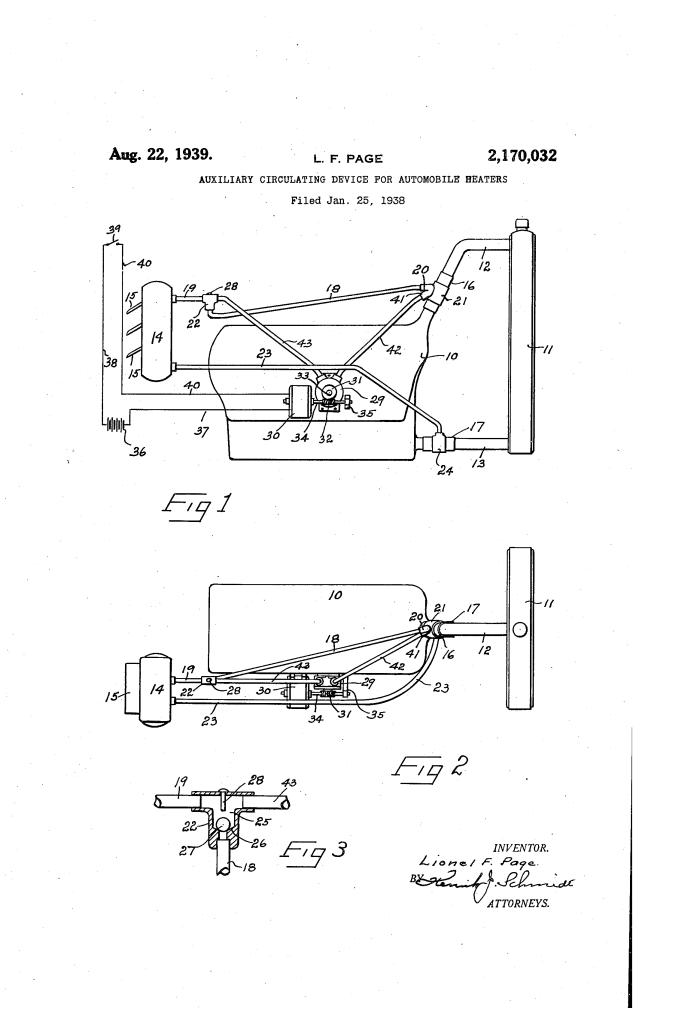
The heart of the device is a rotary pump (29) driven by a small electric motor (30), typically powered by the car’s 6V or 12V battery.
- Modern Term: Auxiliary Electric Water Pump.
- To maximize torque and efficiency, Page utilized a worm-gear reduction (31, 32). This allowed a small, high-speed motor to drive the pump at a steady, effective pace to move the viscous coolant.
2. The Floating Ball Check Valve (22)
A critical safety component, this valve (25) contains a “very light float” (27) and a valve seat (26).
- Modern Term: Gravity-Assisted One-Way Check Valve.
- When the engine is running, the main pump’s pressure lifts the float, allowing normal flow. When the engine is off and the auxiliary pump starts, the backpressure seats the float, forcing the water to travel through the heater rather than backwards into the engine supply line.
3. The Y-Shaped Supply Fitting (21)
Page utilized a specialized “Y” fitting (21) attached to the engine’s upper coolant sleeve (16).
- Modern Term: Dual-Port Manifold Adapter.
- One branch (20) serves the standard engine-driven heating circuit, while the second branch (41) serves as the “intake” for the auxiliary pump. This allows the system to pull the hottest water directly from the top of the engine block.
4. The Cabin Control Interface (39)
The system is activated by a simple dashboard switch (39) connected to the vehicle’s battery (36).
- Modern Term: Remote Actuator Switch.
- This gives the driver manual control over the “residual heat” function, allowing them to engage the pump only when needed to conserve battery life.
Comparison Table
| Feature | Standard 1930s Heating | Page’s Auxiliary System |
| Heat Duration | Ends immediately upon engine cutoff. | Continues as long as engine block is warm. |
| Circulation Power | Mechanical (Engine Belt/Pump). | Electrical (Battery-driven motor). |
| Idle Requirement | Must idle engine to stay warm (Fuel waste). | Engine can be off (Fuel efficient). |
| Installation | Factory-standard only. | Universal retrofit for all hot-water heaters. |
Significance Section
- Early “Rest” Heating: This invention is the direct mechanical ancestor to the “REST” (Residual Heat) button found in modern luxury vehicles, which performs the exact same function.
- Battery Efficiency: By using a worm-gear reduction, Page ensured the motor wouldn’t “drain the battery” instantly, making the device practical for the limited electrical systems of the era.
- Thermal Conservation: This was an early step in “green” automotive thinking, recognizing that an internal combustion engine is a massive heat reservoir that should be utilized even when stationary.
- Check-Valve Logic: The use of a “light float” rather than a heavy spring-loaded valve ensured that the auxiliary pump didn’t need high pressure to operate, reducing mechanical wear.