
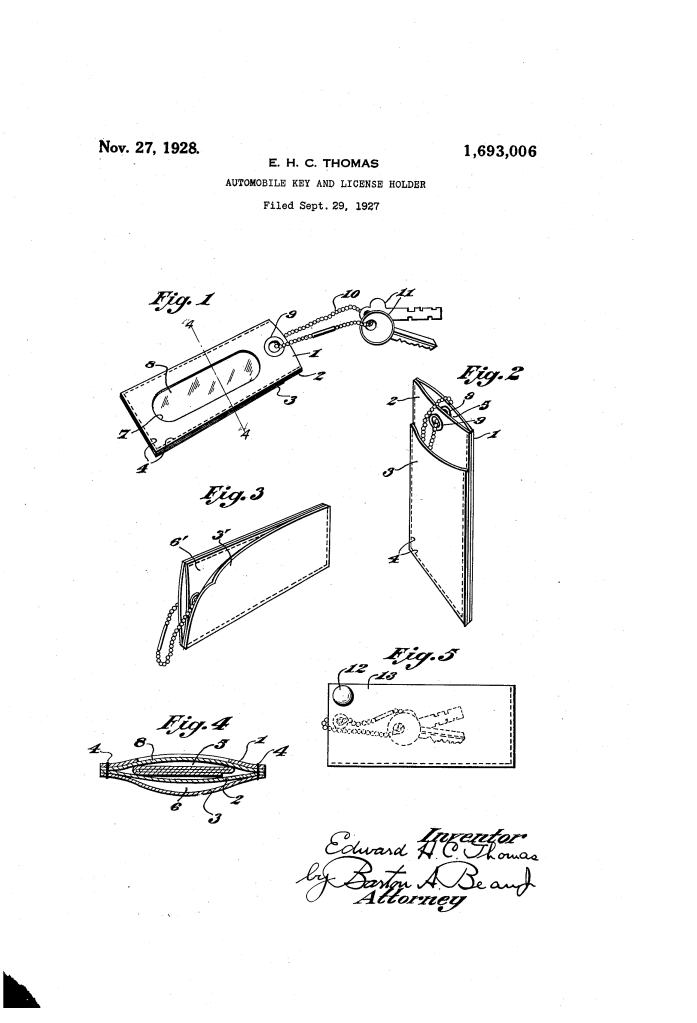
Automobile Key and License Holder (Edward H. C. Thomas, No. 1,689,800)
The patent by Edward H. C. Thomas of Buffalo, New York, describes an Automobile Key and License Holder (Patent No. 1,689,800, 1928). This invention is a specialized wallet-like device designed to ensure that a driver never operates their vehicle without their required license. Thomas’s primary objective was to create a “fail-safe” organization system where the act of securing one’s car keys physically locks the driver’s license inside the holder. His innovation utilizes a three-section flexible body with dual pockets and a shared fastener that prevents the accidental loss or separation of these two essential items.
Inventor Background: Edward H. C. Thomas
Edward H. C. Thomas was an African American inventor based in Buffalo during the late 1920s. His patent reflects a practical response to the increasing legal regulations surrounding the “Golden Age of the Automobile.” As states began more strictly enforcing driver’s license requirements, motorists frequently faced fines for simply forgetting their paperwork at home. Thomas, applying his engineering logic to daily logistics, designed a tool that turned a legal requirement into a mechanical habit. His work is a prime example of functional accessory design, focusing on security, transparency, and portability.
Key Mechanical & Organizational Systems
The holder is constructed from three layers of flexible material (like leather) stitched together to create two distinct functional zones.
1. The Superposed Pocket Architecture (1, 2, 3, 5, 6)
- Three Sections: The device is made of three rectangular sheets (1, 2, 3) united along three edges (4).
- License Pocket (5): Formed between the first and second sections.
- Key Pocket (6): Formed between the second and third sections.
- Function: This “sandwich” design allows the holder to remain slim and pocket-sized while keeping the dirty, metallic keys physically separated from the delicate paper license card.
2. The Interlocking Key Chain (9, 10, 11) (Key Innovation)
- Eyelets (9): Metal-reinforced holes are placed near the open edges of the license pocket sections.
- The Chain (10): A flexible key chain is threaded through these eyelets.
- Action: To attach the keys (11), the chain must pass through both eyelets. Once the chain is looped and secured, it physically blocks the opening of the license pocket (5). It is impossible to remove the license without first detaching the keys.
3. The Exhibition Window (7, 8)
- Opening (7): The front section has a cutout to display the name and address on the license.
- Transparent Plate (8): A sheet of celluloid or similar clear material protects the document.
- Function: This allows a driver to present their credentials to an official without having to remove the license from its “locked” position, further reducing the risk of loss or damage.
4. The “Flip” Pocket and Snap Fastener (12, 13)
- Modified Key Entry: In one variation, the key pocket is open at both the end and the side.
- Snap Fastener (12): A metal snap secures the corner of the key flap (13).
- Function: This allows the driver to “flip” the keys into their pocket with one hand. When snapped shut, the tension on the chain pulls the license pocket edges tight, providing a secondary seal.
Improvements Over Standard Key Cases
| Feature | Standard 1920s Key Pouches | Thomas’s Key & License Holder |
| Accountability | Keys and license were separate. | Interlocking chain ensures they stay together. |
| Visibility | Required removal to read the license. | Transparent window (8) for instant exhibition. |
| Security | Licenses could slip out of loose pockets. | Key supporting means acts as a physical gate. |
| Ease of Use | Fiddly to insert keys. | Side-opening pocket (Fig. 3) for “flipping” keys in. |
Significance to Industrial and Personal Design
Edward H. C. Thomas’s holder influenced the development of integrated personal organizers and fail-safe hardware.
- Mechanical Dependency Logic: Thomas’s idea—that the use of “Part A” (keys) must secure “Part B” (license)—is a foundational principle in safety engineering, similar to how a car won’t start unless the brake is depressed.
- Transparent Protective Coatings: His use of celluloid windows to protect paper documents anticipated the lamination and plastic ID windows found in every modern wallet and badge holder.
- Symmetry and Superposition: The three-layer “sandwich” construction is a precursor to modern multi-compartment leather goods, maximizing storage without adding bulk.
- Legal Compliance via Design: By recognizing a social problem (forgetting a license) and solving it with a mechanical constraint, Thomas practiced an early form of Behavioral Design.
