

Traffic Signal (Garrett A. Morgan, No. 1,475,024)
The patent by Garrett A. Morgan of Cleveland, Ohio, describes a Traffic Signal (Patent No. 1,475,024, 1923). This invention is the direct ancestor to the modern three-position traffic light. Morgan’s primary objective was to improve road safety by adding a “caution” or “all-stop” phase to existing signals, giving vehicles time to clear an intersection before traffic from the transverse direction was allowed to proceed.
Inventor Background: Garrett A. Morgan
Garrett Augustus Morgan was a prolific African American inventor and businessman. Before inventing the traffic signal, he gained fame for creating the Morgan Gas Mask (Safety Hood), which he famously used to rescue workers trapped in a tunnel beneath Lake Erie in 1916. His 1922 patent application for the traffic signal was inspired after he witnessed a horrific carriage accident at a busy intersection. Recognizing that the “Stop” and “Go” systems of the time were too abrupt, he engineered a mechanical solution to manage the growing chaos of early automotive traffic.
Key Mechanical & Operational Systems
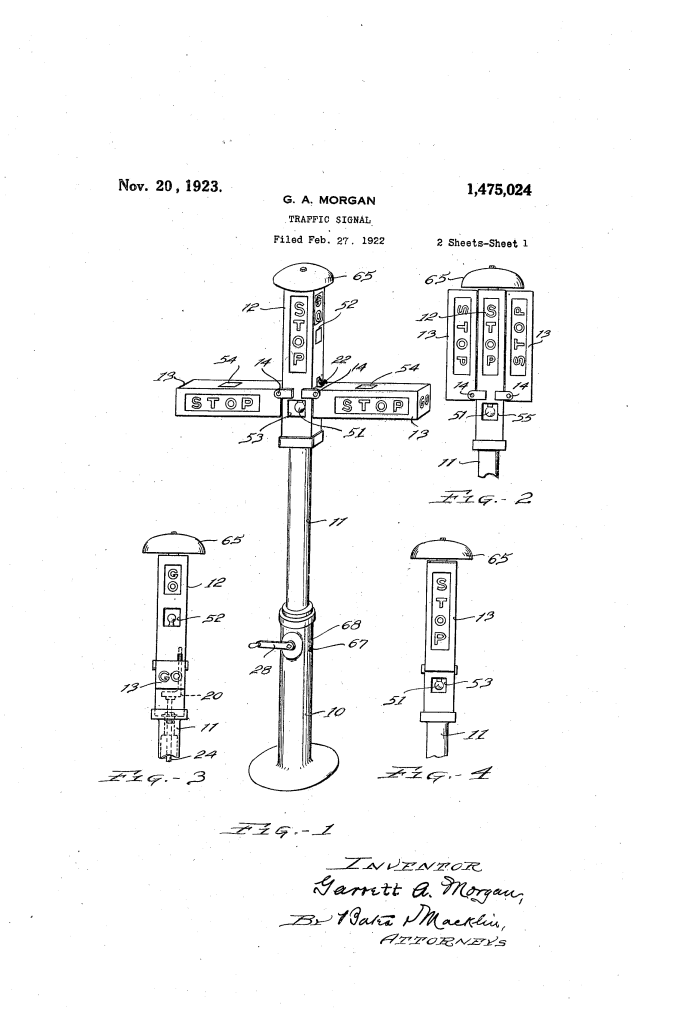
The signal consists of a T-shaped standard with movable semaphore arms, operated by a manual crank at the base.
1. The “All-Stop” Position (Fig. 2 & 4)
- The Problem: Early signals only switched between “Stop” and “Go.” This caused accidents when over-anxious drivers started moving the instant their light turned green, hitting cars still clearing the intersection.
- Morgan’s Solution: A third position where the semaphore arms are raised vertically. In this state, the signal displays “STOP” in all directions.
- Safety Benefit: This “all-stop” interval (the predecessor to the yellow light) allowed pedestrians to cross and vehicles to clear the junction safely.
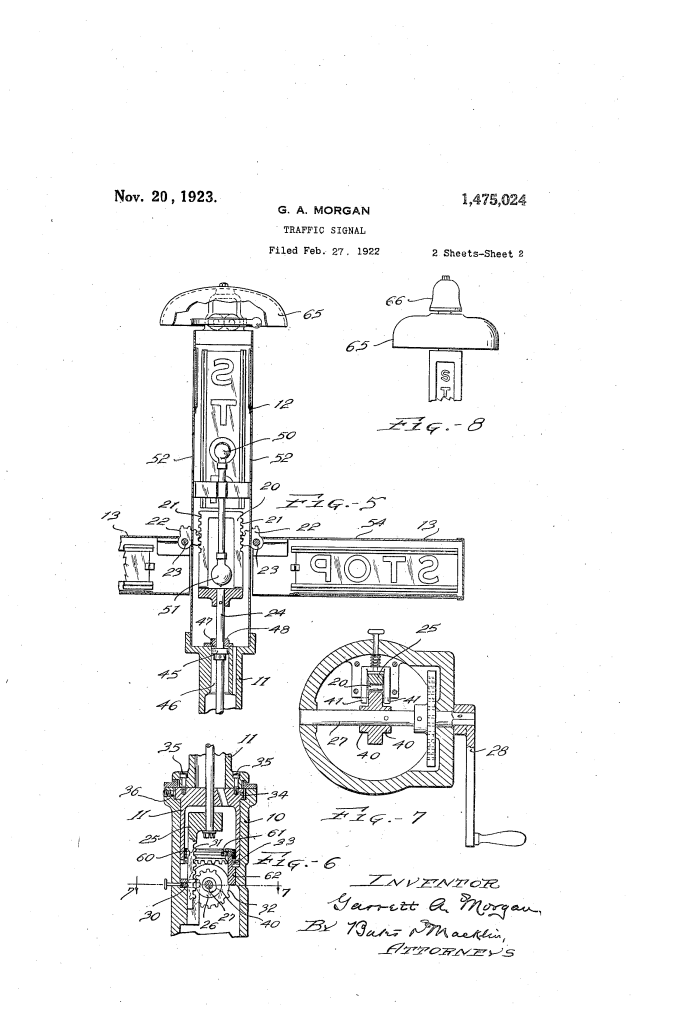
2. The Crank and Rack Mechanism (20-28)
- Manual Operation: A traffic director turns a crank (28) at the base of the standard.
- Internal Gearing: The crank moves a rack (25) and pinion (26), which pulls a vertical shaft (24) downward. This movement uses a gear segment to raise the semaphore arms (13) into the vertical “Stop” position.
- Automatic Sequencing: The gears are designed so that a single continuous turn of the crank first raises the arms, then rotates the entire head 90 degrees, and finally releases the arms back to horizontal.
3. Day and Night Visibility (50-54)
- Daytime: Bold, painted characters on the box-like arms (13) and the main indicator (12).
- Nighttime: The signal is illuminated by two internal electric lamps (50 and 51).
- Light Shifting: When the arms are raised, they uncover specific openings (54) that allow the lamp’s light to flash a illuminated “STOP” signal to the drivers.
Engineering Features and Safety Logic
| Feature | Hazard Addressed | Morgan’s Engineering Solution |
| Vertical Arm Position | Intersectional collisions. | Creates an “all-stop” phase to clear the street of all movement. |
| Dashpot (46) | Mechanical damage/noise. | An air-cushioned cylinder that absorbs the shock when the heavy arms drop to horizontal. |
| Indexing Plunger (36) | Misalignment of signal. | A spring-loaded pin that snaps into notches (34) to ensure the signal head stops exactly at 90-degree intervals. |
| Box-Arm Construction | Limited visibility. | Directional characters are placed on the side, bottom, and end faces so the instruction is visible regardless of the arm’s angle. |
Significance to Modern Infrastructure
Garrett Morgan’s invention transformed how the world manages movement in urban spaces.
- Standardization of Caution: By introducing a neutral state between “Stop” and “Go,” Morgan established the fundamental logic used in every modern automated traffic light (the yellow light).
- Technological Commercialization: Morgan eventually sold the rights to his patent to General Electric for $40,000 (a massive sum in 1923), which allowed the technology to be mass-produced and installed in cities across the United States.
- Pioneering Public Safety: His signal was among the first to prioritize the safety of the pedestrian and the “transverse” vehicle, moving traffic management from a system of convenience to a system of life-saving order.
