
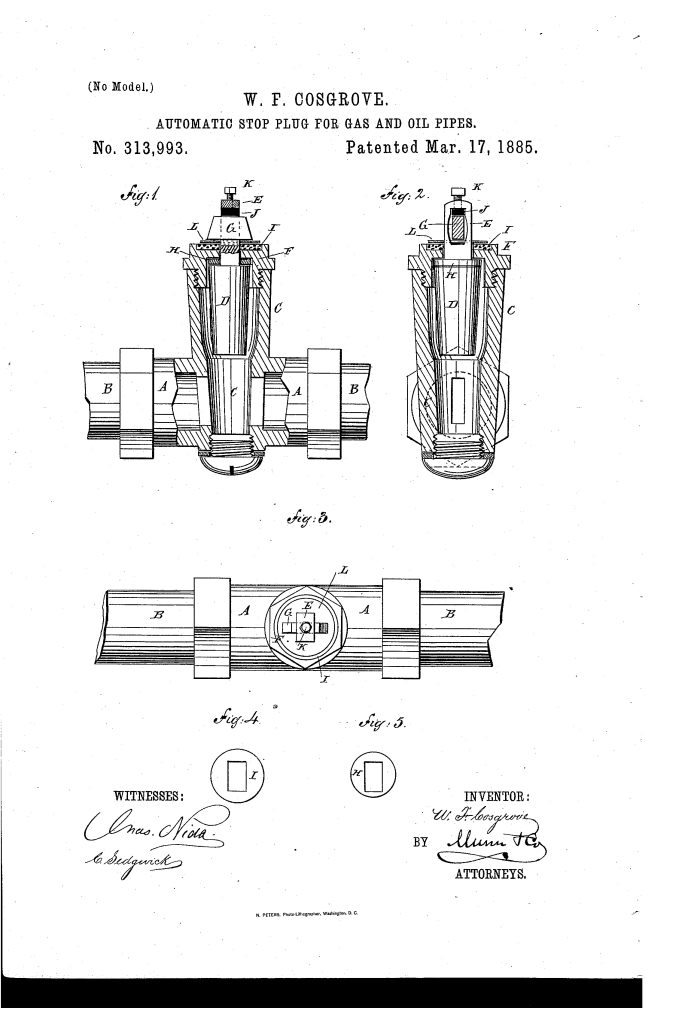
William Francis Cosgrove’s patent for an “Automatic Stop-Plug for Gas and Oil Pipes”, No. 313,993, describes a safety device designed to prevent gas or oil from fueling a fire. Patented on March 17, 1885, the invention was a plug that would automatically seal a pipe in case of a fire.
The device’s key features were:
- Fusible Key: A metal plug was held in an open position by a “fusible key” made of a low-melting-point metal like lead. This key passed through a slot in the plug’s stem and rested on a cap.
- Automatic Closure: If a fire occurred and the temperature reached the key’s melting point, the key would melt. This would allow the plug to drop down and seal the pipe, cutting off the flow of gas or oil.
- Non-Conducting Washers: The key was insulated from the rest of the device by non-heat-conducting washers. This ensured that the key would melt quickly at a specific temperature without its heat being dissipated.
- Adjustable Seal: A set screw could be used to pull the plug up snugly against the cap, creating a tight seal to prevent any leakage.
Societal Impact and Legacy
Cosgrove’s invention was a crucial safety device for an era when gas and oil were becoming increasingly common in homes and buildings.
- Improved Fire Safety: Before this invention, a broken gas or oil pipe in a burning building could act as a fuel source, making the fire far more dangerous and difficult to extinguish. Cosgrove’s stop-plug provided an automatic way to cut off this fuel supply, a major step forward in fire safety technology.
- Industrial and Domestic Safety: This patent reflects a growing societal awareness of the risks associated with new technologies. Inventors were actively creating devices to make these new fuels safer for both industrial and domestic use.
- The Inventor’s Legacy: The patent record for William Francis Cosgrove does not contain information about his life beyond his residence in Jersey City, New Jersey. His work, however, stands as an example of the thousands of inventors who created devices that, while not world-changing, made a direct and tangible improvement to the safety and well-being of people.
