
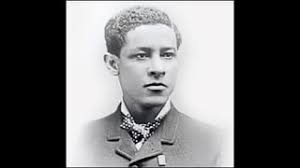
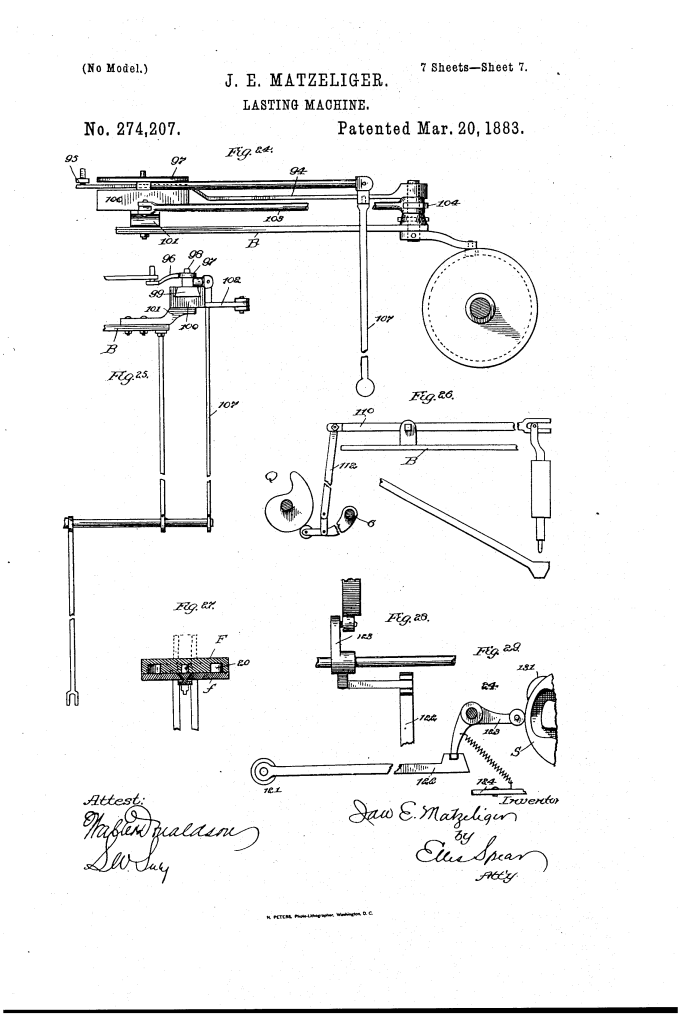
Inventor: Jan Ernst Matzeliger Patent Number: 274,207 (US-0274207-A) Date of Patent: March 20, 1883 Invention: Lasting-Machine
Description of the Invention (from Patent Details and Historical Accounts): Jan Ernst Matzeliger’s 1883 patent revolutionized shoe manufacturing with his “Lasting-Machine.” Lasting is the process of shaping the upper part of a shoe over a “last” (a foot-shaped mold) and attaching it to the sole. Before Matzeliger’s invention, this complex and labor-intensive process was done entirely by hand by highly skilled workers known as “hand lasters.”
Matzeliger’s machine automated this intricate task by performing three crucial operations:
- Pulling the leather upper down: The machine gripped the upper material and stretched it smoothly over the last.
- Arranging the leather around the insole: It then pleated and positioned the leather perfectly around the edges of the insole.
- Driving tacks into place: Finally, it automatically drove and secured the tacks that held the upper to the insole, ready for the outsole to be attached.
The machine was designed to work with incredible precision and speed, handling different sizes and styles of shoes. This automation dramatically increased production efficiency and reduced the cost of shoes.
Personal Significance (Jan Ernst Matzeliger): Jan Ernst Matzeliger (1857-1889) was a brilliant African American inventor born in Paramaribo, Surinam (Dutch Guiana). At a young age, he worked in his father’s machine shop and later as a sailor, eventually settling in Lynn, Massachusetts, a major shoe manufacturing center. He observed the slow and laborious hand-lasting process in shoe factories and dedicated years to developing a machine to automate it.
Matzeliger faced immense challenges, including racial discrimination, poverty, and skepticism from investors who doubted a single machine could perform such a complex task. He painstakingly built prototypes, often working through the night, sometimes using scrap materials. Despite falling ill with tuberculosis, he continued his work. He died young, at 32, just six years after receiving his patent. However, his invention’s impact was monumental. He eventually sold his patent rights to the Consolidated Lasting Machine Company, which later became part of the United Shoe Machinery Corporation.
Historical Significance: Jan Ernst Matzeliger’s “Lasting-Machine” holds immense historical significance, fundamentally transforming the shoe industry:
- Revolutionized Shoe Manufacturing: Before Matzeliger, a skilled hand laster could produce about 50 pairs of shoes a day. His machine could produce between 150 to 700 pairs a day, a truly astounding increase in productivity.
- Mass Production and Affordability: The machine drastically reduced the cost of shoes, making them affordable for the general public, including working-class families. This allowed more people to own multiple pairs of shoes, improving hygiene and quality of life.
- Industrial Impact: His invention contributed significantly to the growth of Lynn, Massachusetts, as a shoe manufacturing hub and played a key role in the overall industrialization of the United States.
- Economic Impact: It allowed for the mass production of consistent-quality shoes, transforming shoe manufacturing from a craft-based industry into a modern, efficient factory system.
- African American Contribution to Industry: Matzeliger’s patent is one of the most significant examples of an African American inventor’s contribution to a major American industry. His work broke racial barriers and underscored the profound impact of Black ingenuity on economic and technological progress. His legacy is a powerful testament to overcoming adversity and achieving groundbreaking innovation.
