

Automatic Gear Shift, Richard B. Spikes, Patent No. 1,889,814
The patent by Richard B. Spikes of San Francisco, California describes an Automatic Gear Shift (Patent No. 1,889,814). This invention is a constant-mesh transmission system that allows a driver to pre-select a gear ratio using a lever and complete the mechanical shift simply by depressing the clutch pedal, eliminating the need for a traditional floor-mounted manual gear stick and preventing gear “clashing.”
The “Why”
In the early 1930s, driving an automobile required significant physical coordination and “feel.” Gearboxes were typically “crash” transmissions where the driver had to perfectly time the engine RPM to the wheel speed to avoid grinding the metal gears (clashing). Richard Spikes aimed to make the automobile accessible to more people by creating a silent, “foolproof” shifting mechanism. His goal was to separate the selection of the gear from the execution of the shift, ensuring that gears were always in mesh and could not be damaged by an unskilled operator.
Inventor Section: Richard B. Spikes
Richard Spikes was a visionary engineer who understood that the future of transportation lay in user-centric design. Already known for his work on directional signals and the “thief-proof” sampling device, Spikes approached the gearbox not just as a set of cogs, but as a logical system. His philosophy was to automate the “violent” parts of mechanical work—like sliding heavy gears into one another—replacing them with elegant, synchronized linkages.
Key Systems Section
1. Constant-Mesh Gear Trains
Unlike standard transmissions of the day where gears slid in and out of contact, Spikes’ gears are “constantly in mesh” (always touching).
- Modern Engineering Term: Constant-mesh transmission.
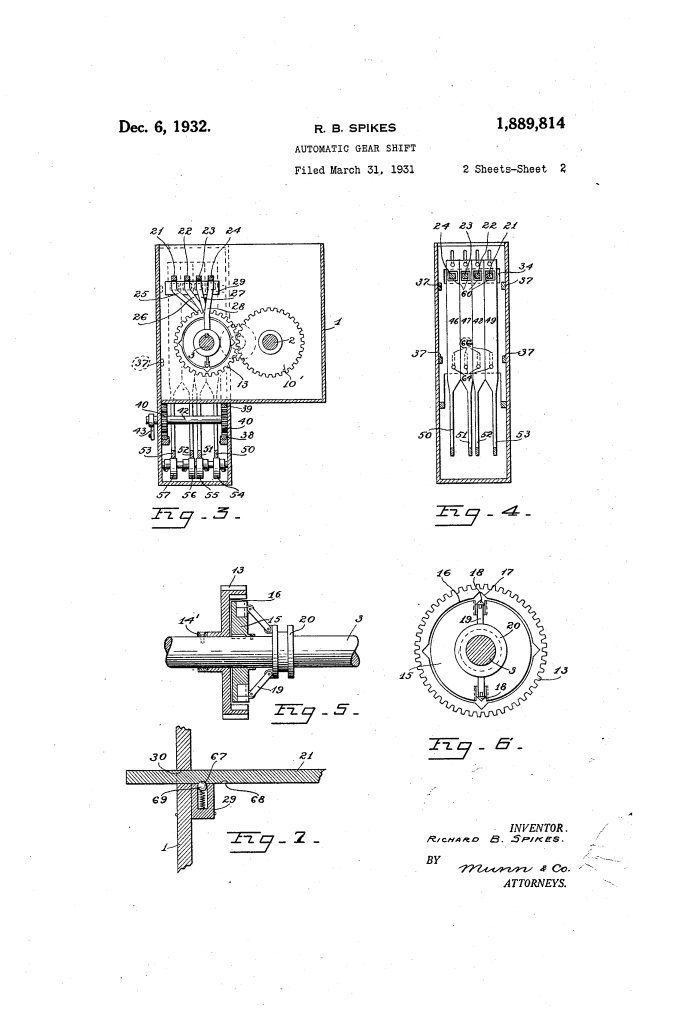
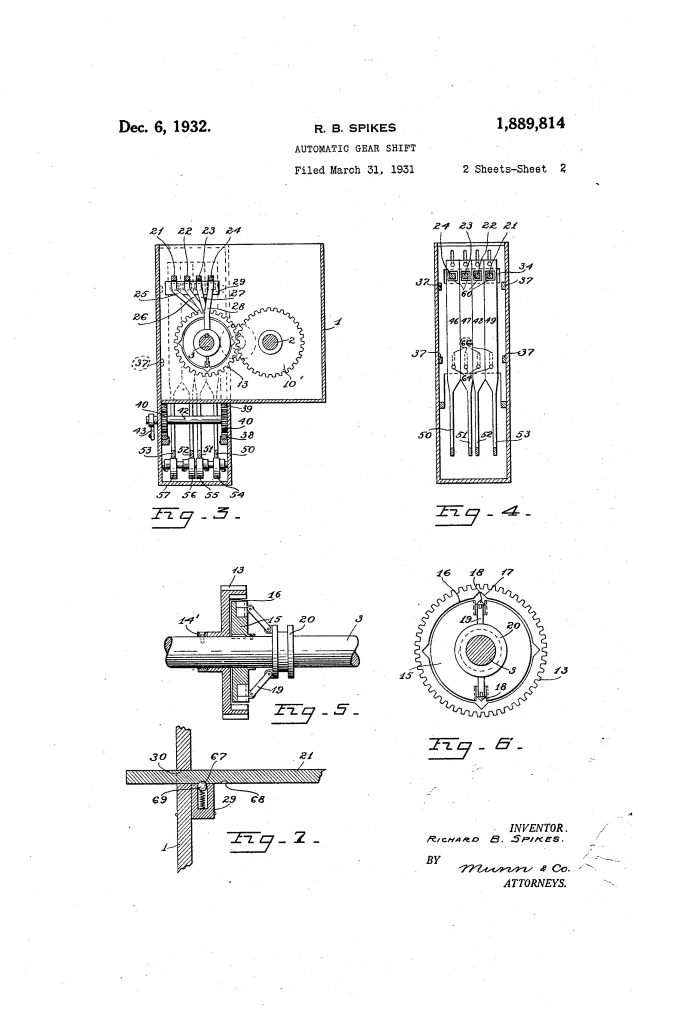
- Gears (13, 14, 15) rotate freely on the shaft until a locking dog (18) moves radially outward to bind the gear to the shaft. This is the direct ancestor to the “synchromesh” systems used in modern manual cars.
2. The Selector “Gates” and Eccentric Cams
The selection process is handled by a series of sliding plates called “gates” (46–49) mounted on two moving members (31, 32).
- Modern Engineering Term: Pre-selector logic gate.
- When the driver moves a lever on the steering column, an eccentric cam (54) lifts a specific gate. This “programs” the machine to know which gear rod (21–24) to push and which to release when the clutch is next pressed.
3. Reciprocating Rack and Pinion Actuator
The actual force required to move the heavy internal clutches is provided by the driver’s leg through the clutch pedal, not a hand lever.
- Modern Engineering Term: Mechanical power-assist shifting.
- Depressing the clutch pedal rotates a gear (40) that drives racks (38, 39). These racks move the shifting members (31, 32) toward each other. This motion simultaneously knocks the old gear out of engagement and locks the new gear in place.
4. Radial Dog Clutches
Instead of sliding the entire gear, Spikes uses small “dogs” or pins that emerge from the shaft.
- Modern Engineering Term: Dog clutch engagement.
- When the shifting collar (20) moves, links (19) push the locking dogs (18) into indentations (17) inside the gear. This provides a positive, instant connection that can handle high torque without slipping.
Comparison: Traditional Shifting vs. The Spikes Automatic Shift
| Feature | Standard 1931 Manual Shift | Spikes Automatic Gear Shift |
| Gear Interaction | Sliding gears (risk of “grinding”). | Constant mesh (gears never uncouple). |
| Shift Force | Hand-operated lever (requires strength). | Foot-operated via clutch pedal (leverage). |
| Timing | Precision “double-clutching” required. | Pre-selection allows for relaxed timing. |
| Sound | Loud clashing/grinding if missed. | Silent operation due to dog-clutch design. |
Significance
- Precursor to Automatic Transmissions: While not “automatic” in the modern sense of shifting by itself, it automated the synchronization and engagement of gears.
- Ergonomics: By moving the controls to the steering wheel (63), Spikes anticipated the modern “paddle shifter” or column shifter layout.
- Transmission Longevity: By eliminating gear clashing, Spikes significantly extended the life of the transmission components, a principle that guided the development of heavy-duty truck transmissions for decades.
