
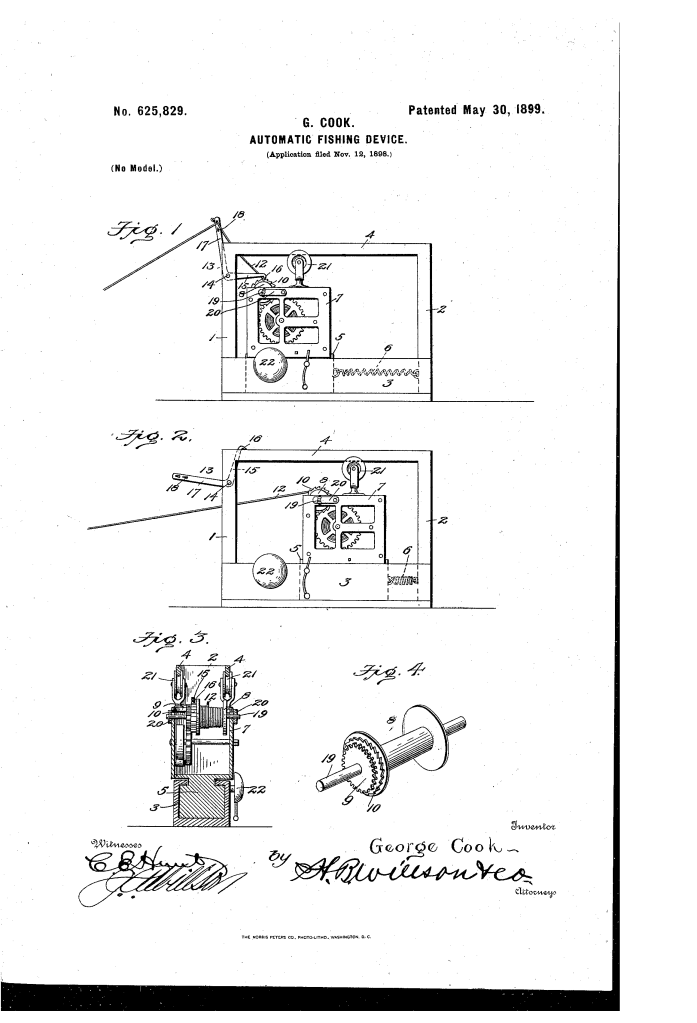
Automatic Fishing Device (George Cook, No. 625,829)
The patent by George Cook of Louisville, Kentucky, describes an Automatic Fishing Device (Patent No. 625,829, 1899). The object is to provide a simple, inexpensive, and effective device that automatically sets the hook and reels in the line when a fish strikes, while simultaneously sounding an alarm.
Inventor Background: George Cook
George Cook was an inventor contributing to recreational and utility devices. His invention addresses a common need in fishing: automatically detecting a bite and initiating the reeling process, freeing the fisherman from constant monitoring and ensuring a hook set even with sudden strikes.
Invention and Mechanism
The device is a spring-loaded, trip-activated frame that executes the reeling motion and sounds an alarm when released.
1. Frame and Power
- Standards (1, 2) and Base (3): Parallel standards arise from a hollow base (3) and are connected by horizontal brace-rails (4).
- Carriage (5): A carriage mounted for longitudinal movement in the base (3).
- Spring (6): A large spiral spring (6) is attached between the carriage (5) and the base (3).
- Function: When the device is “set” (Fig. 1), the carriage is moved forward, expanding the spring (6) and storing potential energy. When released, the spring rapidly draws the carriage to the rear.
2. Reeling and Hook-Setting
- Reel-Box (7): Fixed to and travels with the carriage (5).
- Reel (8): Journaled in the reel-box, powered by an internal spring-actuated train of gearing (a clockwork or tension spring mechanism). The fishing line (12) is wound on this reel.
- Locking Mechanism: A bell-crank lever (13), fulcrumed on a rock-shaft (14), has a tooth (16) that engages a ratchet-wheel (10) on the reel.
- Tripping Arm (17) (Key Innovation): The outer arm (17) of the bell-crank lever extends forward and has V-shaped notches (18) to receive a bight or loop of the fishing line.
3. Automatic Strike and Alarm
- Strike and Release: The line is cast and held taut in one of the notches (18). When a fish strikes and draws the line forward, the line pulls the arm (17) downward. This action throws the tooth (16) up, simultaneously releasing the reel (8) and releasing the carriage (5) (due to the pivot configuration).
- Hook-Set and Reel-In: The carriage spring (6) rapidly draws the carriage and reel-box backward. The reel’s internal gearing immediately winds up the line, setting the hook and beginning the retrieval process.
- Alarm: A gong (22) is fixed on the frame and has a trip-lever projecting into the path of the reel-box (7). When the carriage slides back under the influence of the spring (6), it strikes the trip-lever and sounds the alarm, notifying the fisherman of the strike.
Core Concepts Utilized Today
Cook’s device influenced subsequent mechanical fishing gear and automatic release systems by pioneering integrated, spring-powered, strike-actuated mechanisms.
- Spring-Powered Hook Setting (Automatic Reels): The core principle of using a tension-spring (6) to store the force for hook-setting, which is released by a trip mechanism (17) engaged by the fishing line, is foundational to modern automatic fishing reels, tip-up mechanisms for ice fishing, and auto-hook setters .
- Line-Actuated Trip: The simple, V-notched lever arm (17) that uses the force/pull of the fishing line itself to disengage a latch is a classic mechanical trigger design. This mechanism is used in various low-force switches and release systems where a taut line or wire provides the trip input.
- Integrated Alarm/Indicator: The use of the kinetic energy of the primary action (the carriage recoil) to mechanically strike an auxiliary indicator (the gong) influenced the design of various industrial and consumer mechanisms where an alarm must be synchronized with the completion of a cycle.
- Simultaneous Release of Dual Locks: The design’s ability to simultaneously release the carriage lock (stored potential energy) and the reel brake (ratchet 10) with a single line-pull input is a principle used in sequenced mechanical control systems.
