
Automatic Film Mover (Berger Edmond & Ned E. Barnes, No. 1,124,879)
The patent by Berger Edmond and Ned E. Barnes of Houston, Texas, describes an Automatic Film Mover (Patent No. 1,124,879, 1915). This invention is a sophisticated automated projection system designed for public transportation and advertising. It was primarily intended for use in streetcars and railway coaches to automatically announce stops or display advertisements on a screen, using a film strip that could move, reverse, and reset itself without human intervention.
Inventor Background: Berger Edmond & Ned E. Barnes
Berger Edmond and Ned E. Barnes were African American inventors and business partners in Houston during the early 20th century. Their invention represents an early foray into automated multimedia signaling for the transportation industry. In an era when streetcar conductors had to shout out every stop, Edmond and Barnes sought a “clerical” automation solution that would improve the passenger experience. Their design utilized complex solenoid-driven mechanical logic and electrical contact sensors, demonstrating a high level of mastery in electro-mechanical engineering.
Invention and Mechanism (Simplified)
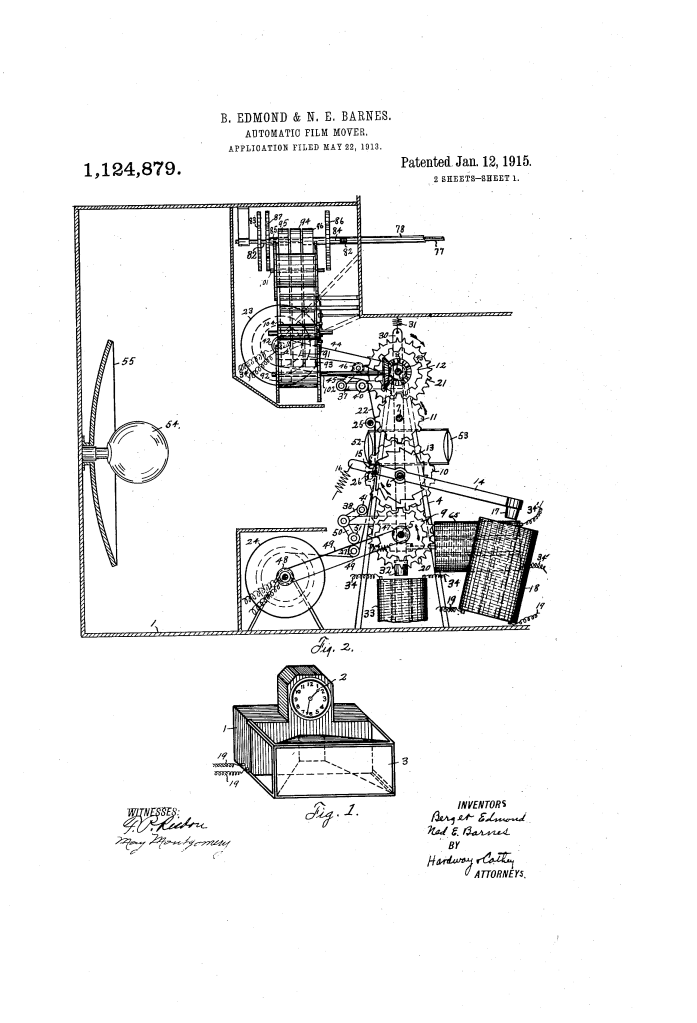
The device is housed in a box-like casing containing a clock, a projector lamp, and a film-moving assembly that reacts to electrical pulses.
1. Solenoid-Driven Film Advance (14, 18)
- The Solenoid (18): When a conductor pushes a button (or an automatic timer triggers), an electrical current energizes a solenoid (18).
- Ratchet and Pawl: The solenoid attracts an armature (17) on a lever (14), which turns a ratchet wheel (13) and intermeshing gears.
- Function: This moves the film (22) forward by exactly one frame, aligning the next street name or advertisement between the magnifying lenses (52, 53) and the lamp (54).
2. The Reversing Mechanism (30, 33) (Key Innovation)
A major challenge of early film systems was rewinding. Edmond and Barnes solved this with a secondary solenoid (33) and a sliding rod (30).
- Vertical Shifting: The rod (30) carries rollers that guide the film.
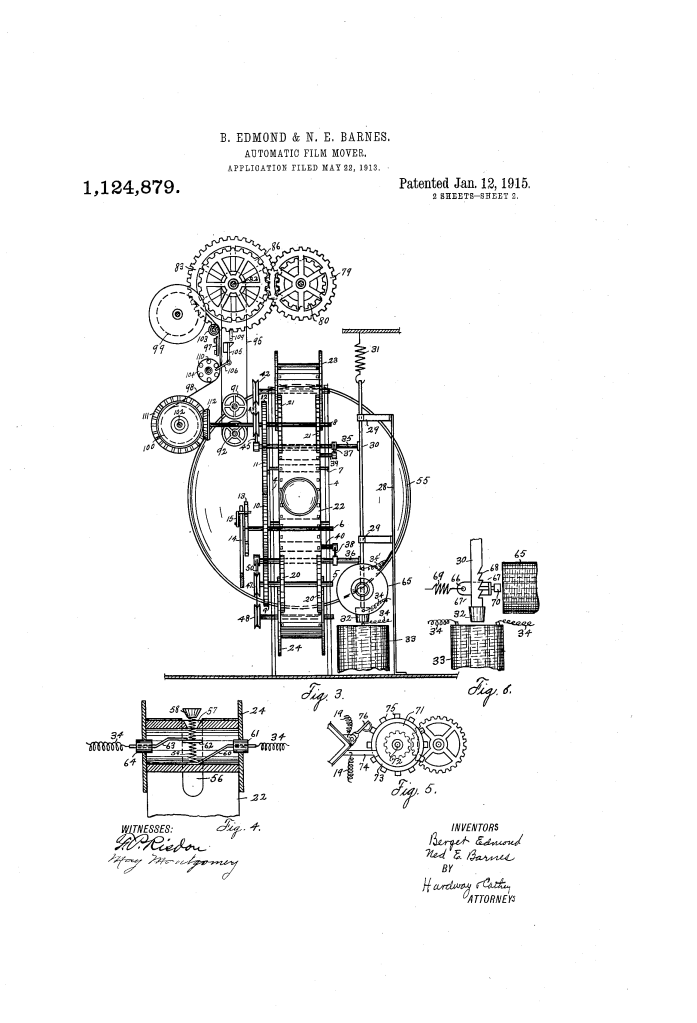
- Tension Control: When the solenoid (33) is triggered, the rod moves down, pulling the film away from the “forward” sprocket wheels and engaging it with the “reverse” sprocket wheels (20).
- Action: At the same time, it tightens a drive cable for the take-up spool, effectively reversing the direction of the film automatically.
3. Automatic End-of-Film Detection (58, 62)
To trigger the reversal, the inventors designed “smart” spools made of non-conducting material.
- The Spring-Plug (58): Inside each spool is a spring-loaded plug (58).
- Contact Maker: As long as film is wound around the spool, the weight of the film keeps the plug depressed.
- Trigger: When the film is completely unwound, the plug pops up, causing a contact point (62) to hit a metallic tongue. This completes the circuit to the reversing solenoid, switching the machine’s direction instantly.
4. The Automatic Timer (71, 75)
- The Contact Wheel: For advertising use, the device includes a wheel (71) geared to a clock (2).
- Timed Pulses: Metal points (75) on the wheel’s rim hit a contact tongue at predetermined intervals.
- Function: This allows the signs to change automatically every few minutes without any manual input, turning the device into a self-contained digital billboard of the 1910s.
Concepts Influenced by This Invention
Edmond and Barnes’s automatic film mover influenced the development of transportation signaling and automated display technology.
- The Automated Next-Stop Indicator: The logic of using a remote signal (a push button or sensor) to advance a visual display is the direct mechanical ancestor of the LED stop-announcement signs found in modern buses and trains.
- Dead-End Sensory Logic: The use of a physical sensor to detect the end of a media roll (the spring-plug) is a principle later used in cassette tape players and modern printers to detect “out of paper” or “end of tape” conditions.
- Variable Gear Direction: The system for shifting a drive rod to change which gears are engaged with the film is a fundamental principle in mechanical transmissions and early film editing equipment.
- Projected Advertising: Their design for a translucent screen display helped pioneer the industry of back-lit and projected signage, which dominated public advertising before the advent of television.
