
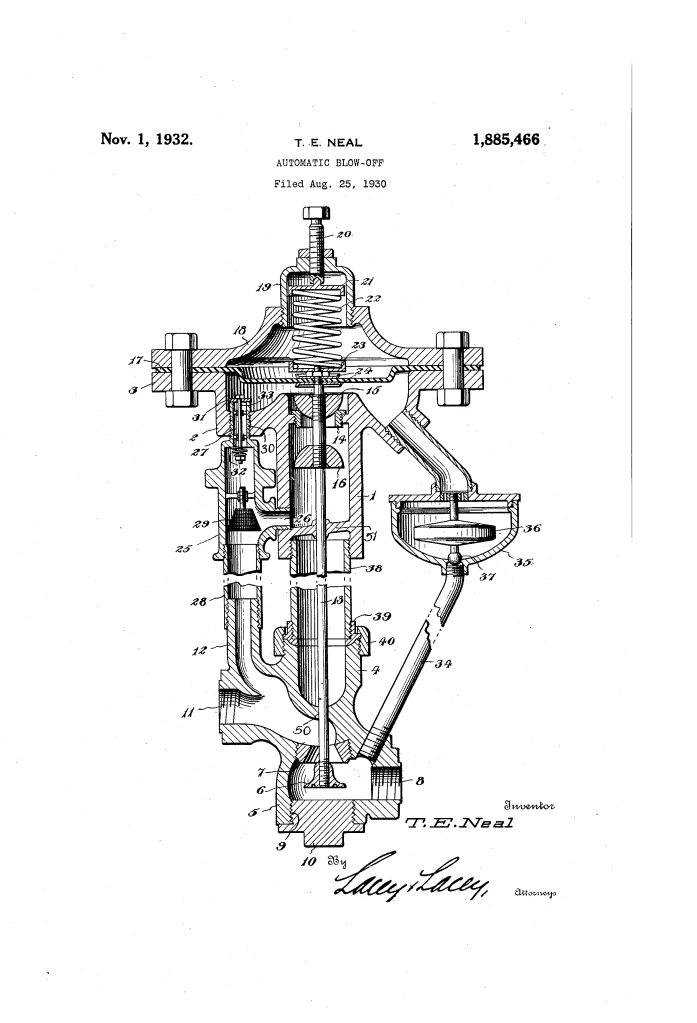
Automatic Blow Off and Steam Trap, Theophilus Ealey Neal, Patent No. 1,885,417
The patent by Theophilus Ealey Neal of Prairie View, Texas describes an Automatic Blow Off (Patent No. 1,885,417). This invention is a self-regulating safety and maintenance valve designed for steam boilers and generators. It automatically detects the accumulation of “slush, scales, and other foreign matter” and triggers a high-pressure discharge to clear the lines without requiring manual intervention or shutting down the system.
The “Why”
In the early 20th century, steam engines and boilers were the heart of industry and transportation. However, they suffered from a constant “pain point”: the buildup of mineral scale and sediment (slush) at the bottom of the boiler. If not cleared, this sediment would clog the pipes, leading to efficiency loss or, worse, catastrophic boiler explosions. Manual “blowing off” was inconsistent and dangerous. Neal sought to create a device that could sense a clog through temperature changes and use the boiler’s own pressure to “self-purge.”
Inventor Section: Theophilus Ealey Neal
Theophilus Neal was an educator and inventor associated with Prairie View A&M, a historically Black university in Texas. His engineering philosophy focused on autonomous mechanical feedback loops. During an era where industrial safety was often overlooked, Neal’s work provided a sophisticated, automated solution that protected both the machinery and the operators from the volatile nature of high-pressure steam.
Key Systems Section
1. Thermal-Differential Sensing
The “brain” of the device is a thermostat (36) located in a bypass casing.
- Modern Engineering Term: Thermal feedback actuator.
- Under normal operation, hot steam keeps the thermostat expanded, closing a small vent. If the inlet clogs with sediment, the flow of hot steam stops, the temperature drops, and the thermostat contracts. This contraction opens a valve that initiates the “blow off” sequence.
2. Pressure-Balanced Diaphragm & Stem
The vertical valve stem (13) is controlled by a large flexible diaphragm (17) at the top of the unit.
- Modern Engineering Term: Pneumatic diaphragm actuator.
- This system uses a spring-loaded (22) mechanism. When steam pressure is high under the diaphragm, it lifts the stem to keep the main waste valve closed. When the thermostat vents that pressure (due to cooling), the spring forces the stem down, blasting the sediment out through the discharge.
3. Self-Cleaning Frusto-Conical Screen
Before steam reaches the sensitive upper chambers, it passes through a screen (29).
- Modern Engineering Term: Conical sediment strainer.
- The “frusto-conical” (cone-shaped) design is intentionally “self-cleaning.” As the steam moves upward, it naturally sheds heavier particles back toward the lower discharge port, ensuring the control mechanism remains free of debris.
4. Differential Check Valve (Lag Control)
A small spring-seated disc valve (31) manages the timing of the reset.
- Modern Engineering Term: Damping or Delay Valve.
- This valve ensures that the main discharge stays open long enough to thoroughly flush the system. It creates a “lag” by restricting how fast steam can re-pressurize the upper diaphragm, preventing the valve from “chattering” or closing too early.
Comparison: Manual Blow-Off vs. Neal’s Automatic System
| Feature | Manual Standard (1930) | Neal’s Innovation |
| Trigger | Human observation/schedule. | Automatic thermal detection of clogs. |
| Mechanism | Manual gate or globe valves. | Pressure-balanced diaphragm with spring return. |
| System Health | Scale builds up until manually cleared. | Constant monitoring; clears as soon as sediment is detected. |
| Safety | Risk of steam burns or boiler over-pressure. | Sealed, autonomous operation reduces human error. |
Significance
- Foundational Steam Trapping: Neal’s use of a thermostat to distinguish between “hot steam” and “cool condensate/slush” is the fundamental principle used in modern Thermostatic Steam Traps.
- Industrial Automation: This was an early precursor to “set it and forget it” maintenance hardware, reducing the need for constant human monitoring in boiler rooms.
- Precursor to Modern HVAC: The combination of a diaphragm, spring, and thermal element is a direct ancestor to the Thermostatic Expansion Valves (TXV) used in modern air conditioning and refrigeration today.
