
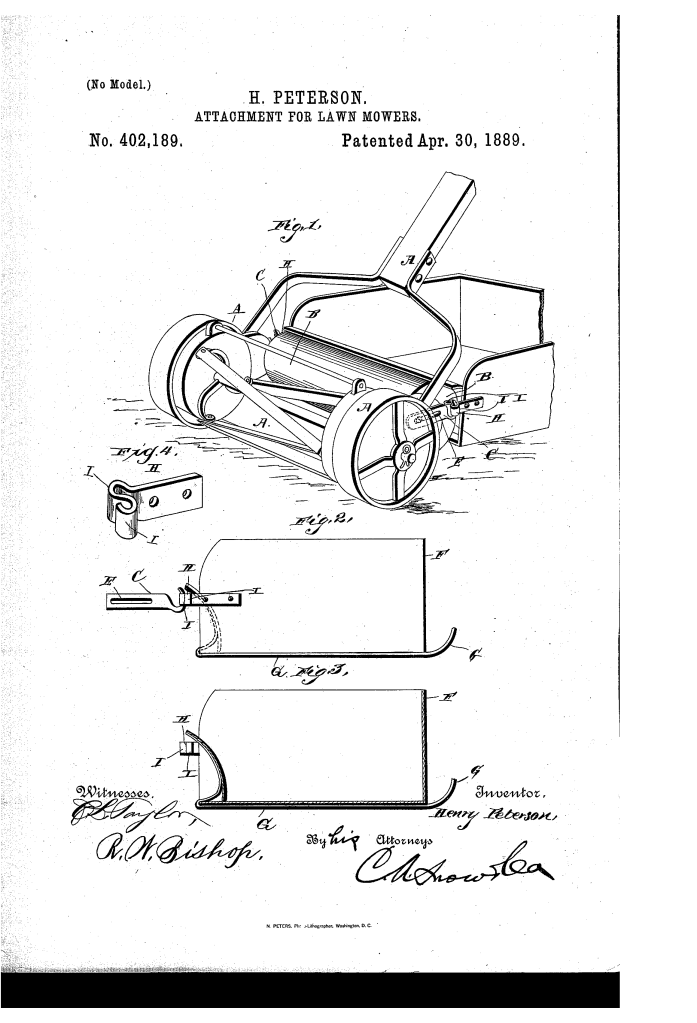
Attachment for Lawn-Mowers, Henry Peterson, Patent No. 402,189
The patent by Henry Peterson of Berkeley, California, describes an Attachment for Lawn-Mowers (Patent No. 402,189). This invention is a detachable, adjustable grass-collection receptacle designed to follow behind a standard walk-behind mower, capturing clippings as they are discharged to eliminate the need for manual raking.
The “Why”
In the late 19th century, lawn maintenance was a labor-intensive, two-step process. Mowers would shear the grass, but the clippings remained on the turf. To maintain a “manicured” look, a worker had to follow up with a hand rake—a process that was both time-consuming and physically taxing. Peterson sought to create a modular synchronization between the cutting and collection phases, solving the “pain point” of secondary cleanup.
Inventor Section: Henry Peterson
Henry Peterson was an inventor based in Berkeley during the post-Reconstruction era, a time when Black innovators were increasingly filing patents to assert their intellectual property rights despite systemic barriers. Peterson’s engineering philosophy centered on universal compatibility. He recognized that mowers came in various widths and roller sizes, so he focused on “peculiar means of securing” the device—meaning he prioritized adjustable linkages over a one-size-fits-all rigid frame. His work reflects the classic Industrial Revolution drive to maximize efficiency through accessory automation.
Key Systems Section
1. Adjustable Hook-and-Slot Coupling
Instead of a permanent weld, Peterson utilized a longitudinal slot (E) in the mounting hooks (C).
- Modern Translation: This is a slotted bracket assembly. It allows for variable depth adjustment, ensuring the collector can be calibrated to the specific diameter of different mower rear rollers.
2. Reversible Lateral Arms
The attachment features detachable arms (H) with offset eyes (I).
- Modern Translation: This is a reversible offset hitch. By flipping the arms inward or outward, the effective width of the mounting points changes, allowing the “aftermarket” part to fit both narrow and wide mower chassis.
3. Concave Leading Edge & Runner System
The front of the pan (F) is curved, while the bottom features “rearwardly-projecting runners (G).”
- Modern Translation: This is a contoured housing with skid plates. The concave front creates a tight seal against the mower’s discharge trajectory, while the runners reduce the coefficient of friction ($\mu$) as the tray glides over uneven terrain.
Comparison Table
| Feature | Standard Methods (Pre-1889) | Peterson’s Innovation |
| Workflow | Two-stage: Mow, then Rake. | Single-stage: Mow and Collect simultaneously. |
| Compatibility | Fixed-width bags (if any) for specific models. | Universal fit via reversible arms and slotted hooks. |
| Ground Interaction | Dragging weight caused turf damage. | Skid runners allow the pan to “float” over grass. |
| Maintenance | Clippings left to rot or require manual labor. | Easy-detach tray for centralized composting. |
Significance
- Precursor to the Modern Grass Catcher: Virtually every modern push and riding mower utilizes the “rear-discharge collection” principle established here.
- Interoperability: Peterson’s use of adjustable slots was an early example of “universal fit” engineering, anticipating the modern aftermarket auto-parts industry.
- Ergonomic Reduction: By eliminating the raking stage, this invention significantly reduced the caloric expenditure and time required for landscaping.
