
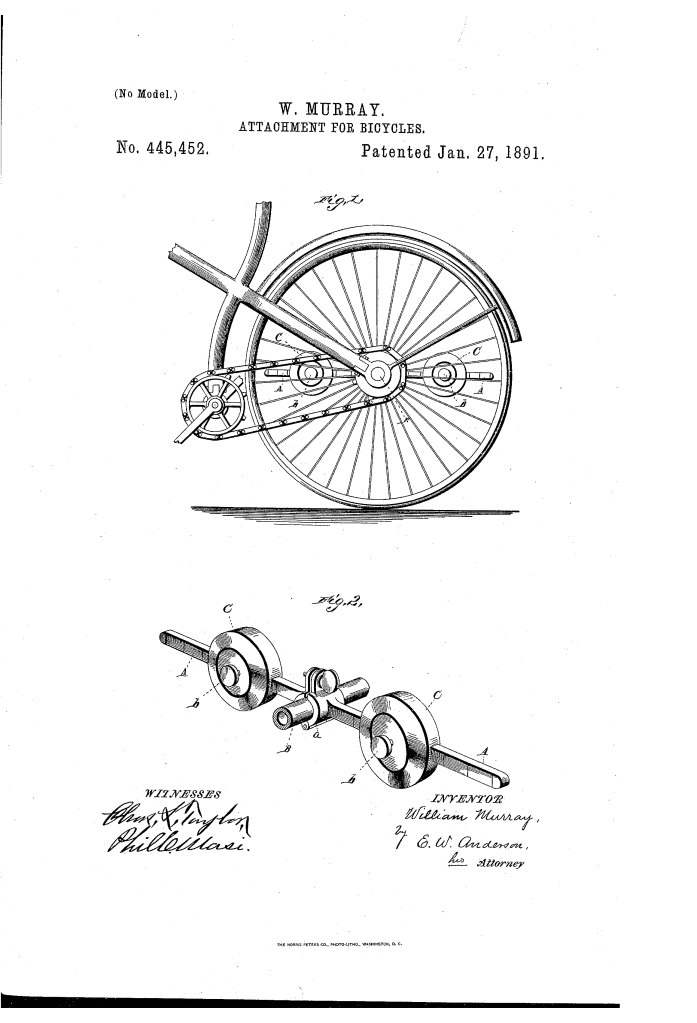
Speed-Regulator Attachment for Bicycles (1891)
U.S. Patent No. 445,452, granted on January 27, 1891, to William Murray, introduces a mechanical momentum-booster designed to assist cyclists in maintaining speed and conquering inclines. Murray, a resident of Washington, D.C., developed this device during the height of the “Bicycle Craze” of the late 19th century, aiming to make cycling less physically demanding.
This invention addressed a fundamental limitation of early bicycles: the reliance on pure leg power to overcome resistance. Murray’s attachment sought to harness the physics of centrifugal force and leverage to provide a “regulating” effect on the machine’s motion.
The Innovation: The Pendulum Lever
The core of Murray’s design is a sectional bar or lever that attaches directly to the axle of the bicycle’s driving wheel. Unlike a standard brake or gear, this was an external “speeding” attachment that used adjustable weights to influence the wheel’s rotation.
How It Functions
The device operates on the principle of shifting mass to change the momentum and torque of the driving wheel:
- Ascending Inclines: The cyclist adjusts the weights to the outer ends of the lever. This increased leverage is designed to “assist the movement” of the machine, helping the rider push through short or slight hills.
- Descending Declivities: The weights are slid back and held close to the axle. By minimizing the lever arm, the weights stop affecting the speed, allowing the rider to descend safely without the weights creating unwanted acceleration or instability.
- Level Ground: When properly adjusted, the attachment allows the bicycle to achieve greater speed than would be possible with a standard wheel setup alone.
Key Technical Components
The assembly is deceptively simple, consisting of a few rugged, cast-metal parts:
| Component | Function |
| Angular Bar/Lever (A) | The main structural arm, made in sections to allow for installation and movement. |
| Coupling/Clamp (a) | Hinged sections at the inner end of the lever that lock securely onto the wheel axle. |
| Adjustable Weights | Pendulum-shaped masses that can be moved along the bar to change the center of gravity. |
| Driving-Wheel Axle (B) | The mounting point; the device rotates in tandem with the wheel to provide momentum. |
The Physics of the “Speed Regulator”
Murray’s patent focuses on the practical application of the pendulum effect. By placing weights on a lever extending from the axle, the device acts as a mechanical flywheel.
- Momentum Storage: As the wheel turns, the weights gain kinetic energy.
- Torque Assistance: When the rider hits a slight incline and their pedaling cadence slows, the momentum of the outward-set weights provides a slight “push” to help the wheel complete its revolution.
- Speed Regulation: By moving the weights inward (decreasing the moment of inertia), the rider “shuts off” the boost, effectively regulating the machine’s behavior based on the terrain.
Historical Context: William Murray
William Murray’s invention arrived during an era of rapid experimentation in bicycle mechanics.
- The Era: In 1891, the “Safety Bicycle” (with two equal-sized wheels and a chain drive) was beginning to replace the dangerous high-wheeler “Penny Farthing.” Murray’s attachment was designed to be compatible with bicycles and tricycles alike.
- Collaboration: Murray assigned half of the patent rights to Charles Butt, a common practice for inventors seeking the capital necessary to manufacture or market their designs.
- Legacy: While modern cycling relies on complex multi-speed gearing, Murray’s patent is a fascinating look at early “kinetic energy recovery” concepts. It represents a bridge between simple machines and the sophisticated speed regulators used in later industrial applications.
Summary of Claims
The patent explicitly protects:
- A sectional bar or lever featuring hinged coupling sections at the meeting ends.
- A design specifically adapted to be held upon the driving-wheel axle.
- The use of adjustable weights carried by the lever to assist or regulate motion depending on their position.
