
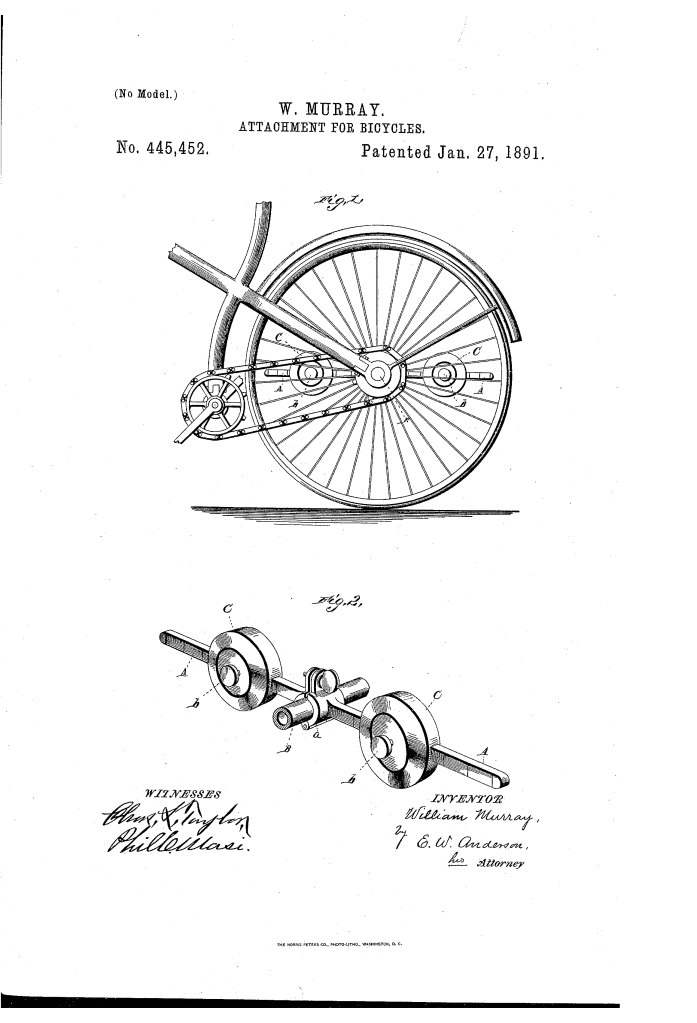
Attachment for Bicycles – Patent No. 445,452
Inventor: William Murray, of Washington, D.C.
Patent Number: 445,452
Date of Patent: January 27, 1891
Description: William Murray’s patent for a “Speed-Regulator for Bicycles and Tricycles” was a unique device designed to assist a cyclist by using adjustable weights. The invention consisted of a two-piece bar or lever that clamped to the main axle of the bicycle’s driving wheel. This bar had movable weights that could be adjusted along its length. When a cyclist was going up an incline, they would slide the weights toward the outer ends of the bar. This would use the force of gravity to assist the pedal motion, similar to how a pendulum works. For going down a hill, the weights would be moved inward, closer to the axle, to avoid affecting the speed of the machine. The goal was to help with ascents and to increase speed on flat ground.
Societal Impact
Murray’s invention represents a fascinating, if ultimately unsuccessful, attempt to apply mechanical principles to an everyday vehicle. It was a product of the late 19th-century “bicycle craze,” a period of widespread technological innovation and social change driven by the popularization of the bicycle.
- The Bicycle’s Rise: In the 1890s, the bicycle was no longer a toy; it was becoming a serious mode of transportation and a symbol of personal freedom. This created a massive market for new inventions, from gears and brakes to novel accessories like Murray’s.
- A Different Approach to Efficiency: While most bicycle innovations focused on improving the gear ratio or reducing weight, Murray’s patent tried to harness the principles of leverage and pendulum motion to make cycling easier. This shows the creative problem-solving that was happening across the industry. Although the device would likely have been more cumbersome than effective, it highlights the kind of ingenuity that was applied to improving a new form of personal mobility.
- The Inventor’s Legacy: The provided information does not contain details about William Murray’s personal life beyond his residence in Washington, D.C. However, his invention, like many from this era, shows how ordinary individuals contributed to the technological landscape through practical, if sometimes unconventional, ideas.
