
Assembled Composition Printing Process (Charles A. Bankhead, No. 3,097,594)
This 1963 patent by Charles A. Bankhead describes an innovative silk screen stencil process (Patent No. 3,097,594). The invention provides a method for creating high-quality, inexpensive printing stencils using “movable type units” made of a gum substance. This allowed small organizations like schools, churches, and small businesses to produce professional signs and posters without expensive photographic equipment or complex hand-cutting.
1. The Core Innovation: The “Resist” Method
Bankhead’s process relies on the principle of selective solubility. By using two different materials—one that dissolves in water and one that dissolves in chemicals like gasoline—he creates a perfect stencil “mask” on a mesh screen.
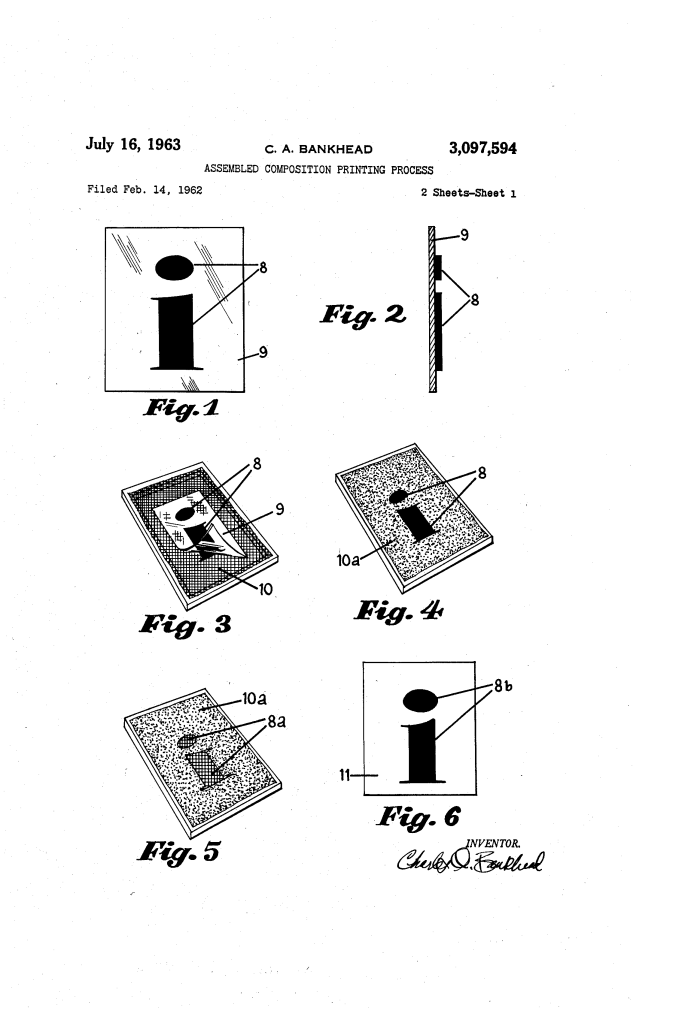
- Indicia Body (8): The letters or designs are first formed out of a water-repellent gum substance (such as tar, pitch, or ester gum).
- Backing Sheet (9): These gum letters are applied to a non-adhesive backing sheet (like waxed paper). These units can be stored and used like “movable type” to assemble different words or legends.
2. The Step-by-Step Process
The creation of the final printing screen follows a sophisticated chemical “transfer” logic:
| Step | Action | Mechanical Purpose |
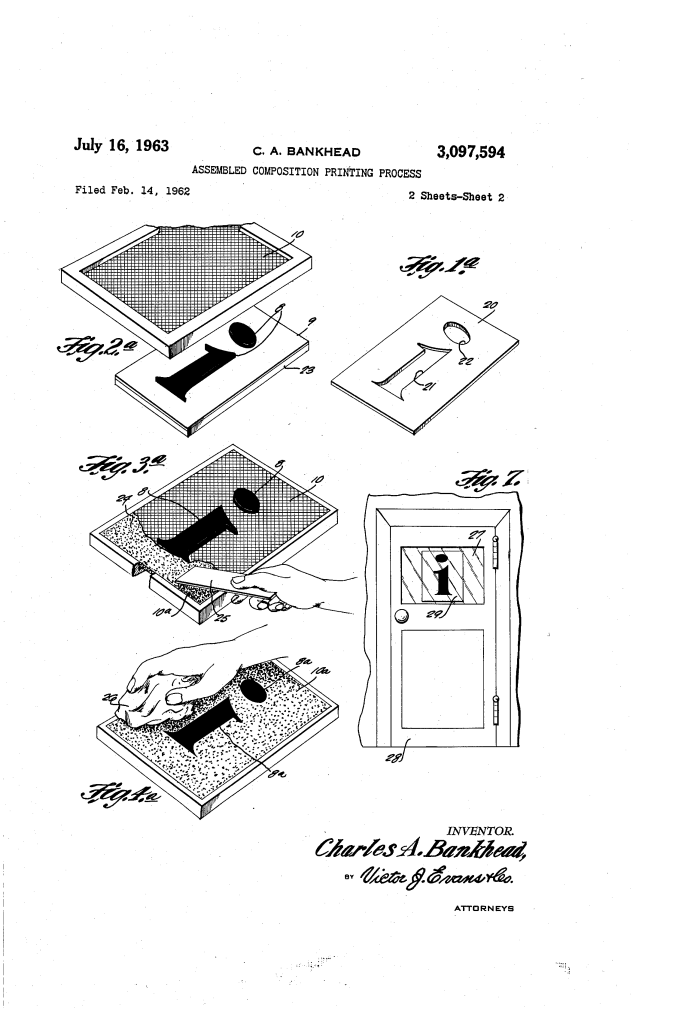
| Transfer | Press the silk screen (10) onto the gum body (8). | The gum adheres to the mesh of the screen. |
| Peeling | Remove the backing sheet (9) from the gum. | Leaves the gum letter on the screen with “clean and sharp marginal edges.” |
| Coating | Spread a water-soluble glue (24) over the entire screen. | The glue fills all the holes in the screen except where the gum body is located. |
| Dissolving | Scrub the screen with a solvent (gasoline/acetone). | The solvent melts the gum but does not touch the water-soluble glue. |
| Result | Clear pervious area (8a). | The area formerly occupied by the gum is now open mesh, ready for ink. |
3. Engineering and Practical Advantages
Bankhead’s method was designed for scalability and economy.
- Movable Type Units: Because the gum letters could be printed through a standard stencil onto waxed paper in bulk, a user could “set type” for a sign just by picking letters from a box and sticking them to a screen.
- Surface Versatility: The patent notes that the screen can print on paper, wood, plastic, or glass.
- Contoured Printing (Fig. 7): Bankhead describes a clever way to print on textured glass doors. By printing the legend onto a temporary paper backing in reverse, the tacky ink can be pressed into the grooves of the glass before the paper is stripped away.
- Long-Term Storage: To prevent the gum letters from sticking together in storage, Bankhead suggests sprinkling them with powdered shellac. When it’s time to use them, a quick wipe with alcohol softens the shellac and makes the letter tacky again.
4. Technical Specifications Summary
- Materials: Tar, pitch, ester gums (for the image); water-soluble glue or spirit-dissolved shellac (for the background).
- Solvents: Naphtha, gasoline, acetone, or benzol.
- Mechanism: Chemical displacement/solvent resistance.
- Key Benefit: Economical production of identical signs without photographic stencils.
Significance to Graphic Arts
Charles Bankhead’s invention bridged the gap between manual hand-painting and expensive industrial printing.
- Democratizing Design: It allowed non-professionals to create perfectly uniform lettering by reusing “gum type” units.
- Robustness: Unlike thin paper stencils, the “thick” gum bodies (8) ensured a deep, secure bond with the silk mesh, preventing “bleeding” or blurry edges during the printing process.
- Continuation of Innovation: This patent (filed in 1962) was an improvement on his earlier work from 1958, showing a refined understanding of foraminous (holed) fabric behavior.
