
Cartridge (1891)
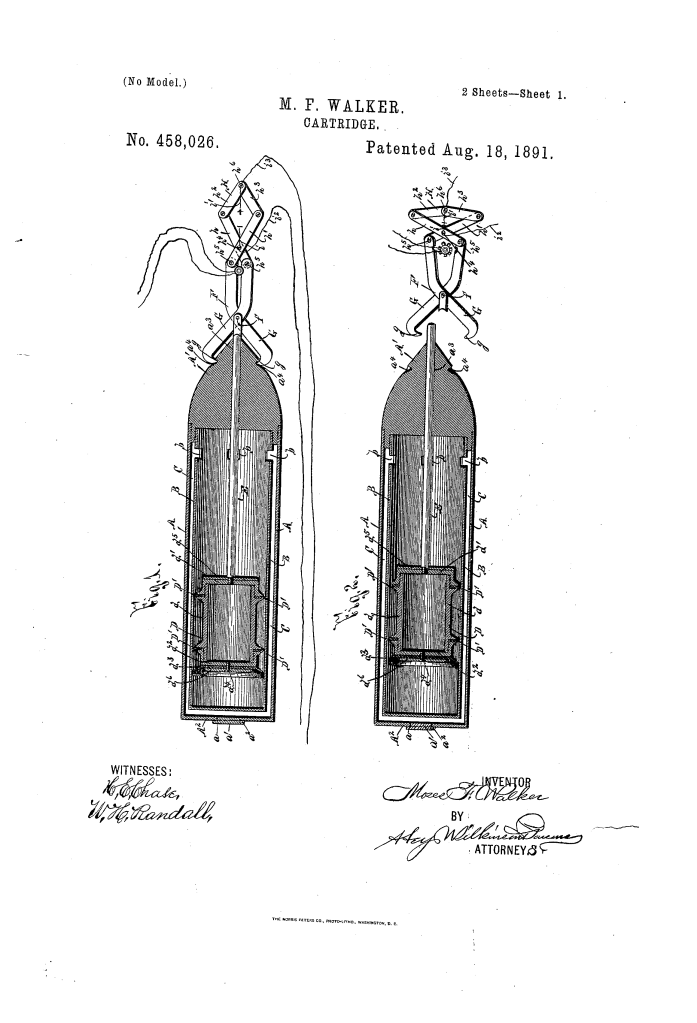
U.S. Patent No. 458,026, granted on August 18, 1891, to Moses F. Walker, introduces a sophisticated safety mechanism for a “dynamite cartridge” intended to be fired from a cannon. At the time, the volatile nature of dynamite made it extremely dangerous to launch using traditional explosives; the sudden shock of the cannon’s discharge would often detonate the payload prematurely, destroying the firearm and its operator.
Walker’s invention solved this by creating an internal suspension system that isolated the explosive carrier from the initial shock of the propellant, ensuring it only detonated upon reaching the target.
The Innovation: The “Pneumatic Buffer” System
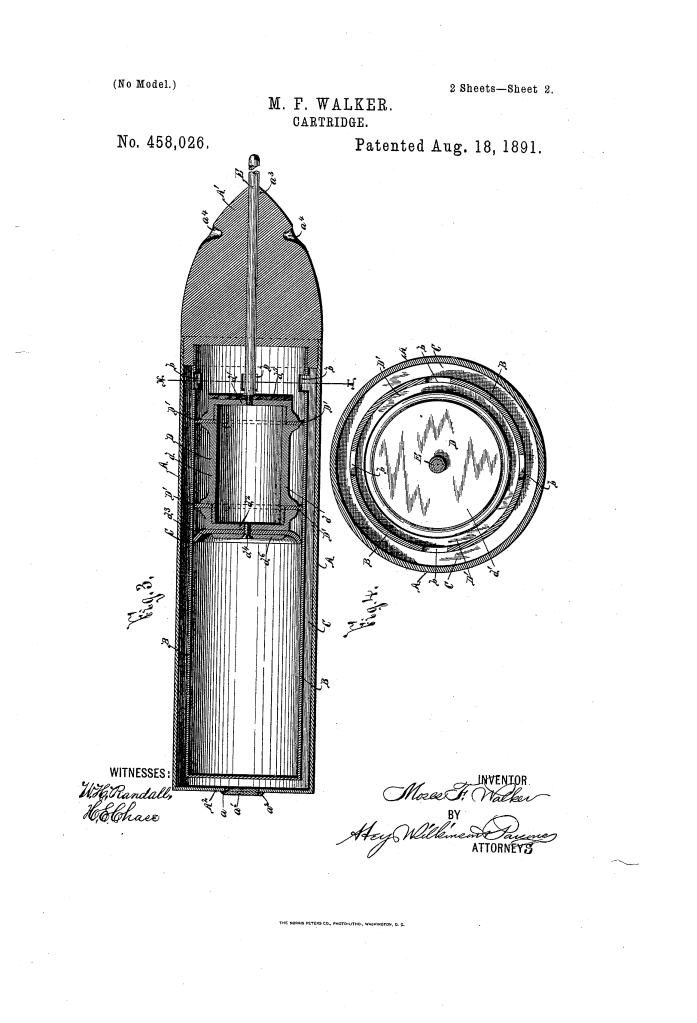
The core of Walker’s design is a “shell-within-a-shell” architecture that uses air pressure and vacuum forces to cushion the movement of the explosive payload. Unlike standard solid projectiles, this cartridge features an internal movable carrier (D) that slides within an inner chamber.
1. Dual-Chamber Stability
- The Vacuum Chamber: Located at the front of the carrier, this area is exhausted of air to reduce resistance as the carrier moves forward.
- The Compressed-Air Chamber: Located at the rear, this chamber acts as a pneumatic spring. As the carrier is “locked” into its rearward position, it compresses the air behind it, storing energy.
2. The Internal Rod (E) and External Lock
A central rod is attached to the explosive carrier and extends through the nose of the shell. This rod serves two purposes:
- Pre-Launch Locking: It is held by an external lock (F) that keeps the carrier pinned against the compressed air, preventing it from rattling during transport.
- Impact Detonation: Once the cartridge is in flight, the rod projects forward. Upon hitting the target, the rod is driven back into the dynamite, acting as the firing pin to ensure “absolute certainty of explosion.”
How the Apparatus Functions
The firing sequence is a carefully timed “two-step” process designed to move the dynamite before the cannon’s main charge hits the shell:
| Step | Action | Safety Purpose |
| 1. Release | An electric circuit fires a small primary charge in the lock mechanism. | Disengages the rod and allows the compressed air to nudge the carrier forward. |
| 2. Pre-Acceleration | The carrier begins its internal forward movement within the shell. | This “head start” minimizes the inertia shock when the main cannon propellant ignites. |
| 3. Main Launch | The main cannon charge fires, projecting the entire shell. | Because the carrier is already in motion, the relative shock is significantly reduced. |
| 4. Impact | The projecting rod (E) strikes the target first. | Ensures the dynamite detonates on contact rather than by the heat or friction of flight. |
Technical Components
- Outer Shell (A): Preferably formed of cast steel for maximum rigidity and strength to withstand the cannon’s pressure.
- Inner Shell (B): A secondary casing of smaller diameter, creating an interposed air chamber (C) that provides further insulation.
- Yielding Supports (D’): Rings or buffers at the ends of the carrier that allow it to “ride” smoothly against the inner periphery without metal-on-metal friction.
- Electric Fusing: The use of electrical poles ($i, i’$) to synchronize the release of the carrier lock with the ignition of the cannon’s powder.
Historical and Scientific Impact
Moses F. Walker’s invention was a bridge between 19th-century ballistics and the need for high-stability chemical delivery.
- Overcoming Inertia: The patent identifies the “great demand” for carrying dynamite accurately. By starting the carrier’s movement before the shell moves, Walker pioneered the concept of “soft-launch” mechanics.
- Precision Detonation: By using a rod that extends “during transit,” the design avoided the common failure of shells that either exploded too soon or failed to explode at all upon hitting soft targets.
About the Inventor: Moses F. Walker
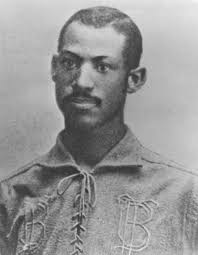
Moses F. Walker was an inventor based in Syracuse, New York. His work on this cartridge demonstrates a deep understanding of pneumatic physics and mechanical timing. Working during the “Golden Age of Invention,” Walker’s contributions to ordnance safety addressed one of the most terrifying technical hurdles of his era: the safe handling of nitroglycerin-based explosives in military applications.
Summary of Claims
The patent explicitly claims:
- A movable explosive carrier within an outer shell, governed by a locking rod extending through the nose.
- The use of vacuum and compressed-air chambers to facilitate and cushion the movement of the internal carrier.
- A firing mechanism designed to release the internal carrier lock immediately before bringing the cartridge-projecting force (the cannon charge) into action.
