
Dynamite Cartridge (Moses Fleetwood Walker, No. 458,026)
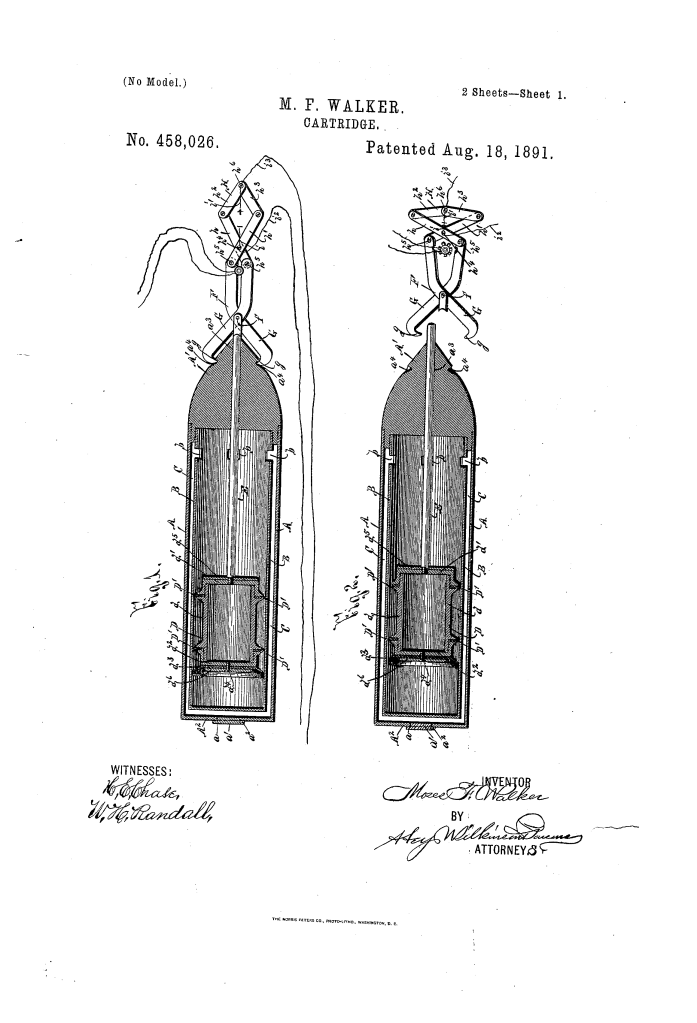
The patent by Moses Fleetwood Walker of Syracuse, New York, describes an advanced Dynamite Cartridge (Patent No. 458,026, 1891). This invention is a highly specialized artillery projectile designed to carry volatile explosives like dynamite. Walker’s primary objective was to overcome the “shock of discharge”—the tendency for the explosive to detonate inside the gun barrel due to the sudden force of the powder blast. His innovation utilizes a pneumatic internal suspension system that allows the explosive carrier to begin moving forward before the gun fires, effectively “pre-cushioning” the dynamite against the coming blast.
Inventor Background: Moses Fleetwood Walker
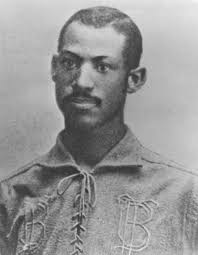
Moses Fleetwood Walker (1856–1924) was a man of extraordinary and diverse talents. While history remembers him primarily as the first African American to play Major League Baseball (hitting .263 for the Toledo Blue Stockings in 1884), he was also an inventor, philosopher, and civil rights advocate. Granted just months after his artillery shell patent (No. 452,551), this 1891 cartridge patent demonstrates his deep expertise in mechanical engineering and ballistics. Walker’s work sought to solve the leading military engineering problem of the day: how to harness the massive power of dynamite as a weapon without killing the crew operating the gun.
Key Mechanical & Safety Systems
The cartridge is a complex “machine within a shell,” using air pressure and vacuum forces to stabilize its dangerous cargo.
1. The Dual-Shell and Air-Chamber (A, B, C)
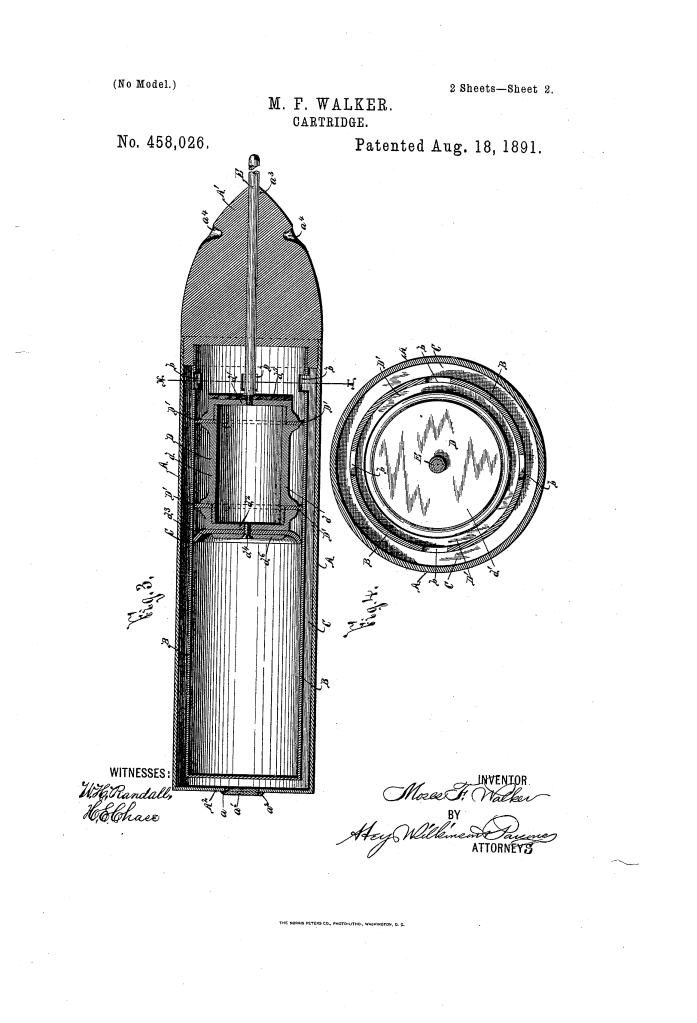
- Outer and Inner Shells: The cartridge features a heavy cast-steel outer shell (A) and a smaller inner shell (B).
- Air-Chamber (C): A space is left between the shells to act as a buffer.
- Function: This nested construction protects the internal components from the heat and physical deformation of the outer shell during its journey through the rifled barrel.
2. The Pneumatic Carrier Suspension (D, D’)
- The Carrier (D): The explosive is held in a cylindrical carrier (D) of less diameter than the inner shell.
- Yielding Support Rings (D’): The carrier is held in place by yielding supports (rings) that “ride” against the inner walls.
- Function: These rings absorb vibration and friction. Most importantly, the space behind the carrier acts as a compressed-air chamber, while the space in front acts as a vacuum chamber.
3. The Pre-Firing Release Rod (E) (Key Innovation)
- The Rod (E): A rod is secured to the carrier and extends through the front of the cartridge.
- The Lock (F): A mechanical lever lock holds the rod in a “depressed” position, keeping the rear air chamber compressed.
- Action: Before the gun’s main powder charge is ignited, a small electric primer fires a cap that releases the Lock (F). The compressed air instantly “shoots” the dynamite carrier forward inside the cartridge shell. This forward momentum counteracts the massive backward “jerk” (inertia) of the gun’s launch, preventing the dynamite from slamming into the rear wall and exploding.
4. Certainty of Explosion (Impact Rod)
- Direct Contact: Once the cartridge is in flight, the rod (E) projects out the front.
- Trigger: Upon hitting a target, the rod is forced back into the carrier.
- Function: This ensures that the dynamite explodes only upon physical contact with the target, providing “absolute certainty of explosion” while maintaining safety during transit.
Improvements Over Standard Projectiles
| Feature | Standard High-Explosive Shells | Walker’s Pneumatic Cartridge |
| Operator Safety | High risk of the gun barrel exploding. | Pre-starting the carrier eliminates shock to the explosive. |
| Accuracy | Projectiles often wobbled due to internal shifts. | Vacuum/Air chambers keep the center of gravity stable. |
| Ignition | Relied on unreliable chemical fuzes. | Mechanical impact rod (E) ensures detonation on target. |
| Protection | Explosives sat directly against metal walls. | Yielding buffer-plates (d4, d5) provide secondary protection. |
Significance to Engineering and Ballistics
Moses Fleetwood Walker’s cartridge influenced the development of kinetic energy management and failsafe weaponry.
- Dynamic Inertia Management: Walker’s logic of moving the “payload” forward to counteract the launch force is a precursor to the soft-recoil systems used in modern heavy artillery and shoulder-fired rockets.
- Integrated Safety Interlocks: By using one electrical circuit to release the safety (the carrier lock) and another to fire the weapon (the powder charge), he pioneered sequential firing safety protocols.
- Pneumatic Buffering: The use of compressed air and vacuum as a suspension system for sensitive cargo remains a core principle in modern logistics and aerospace transport.
- Multidisciplinary Excellence: Walker’s ability to apply philosophical principles of “cause and effect” to the physics of ballistics highlights the intellectual depth of early Black inventors in STEM.
