
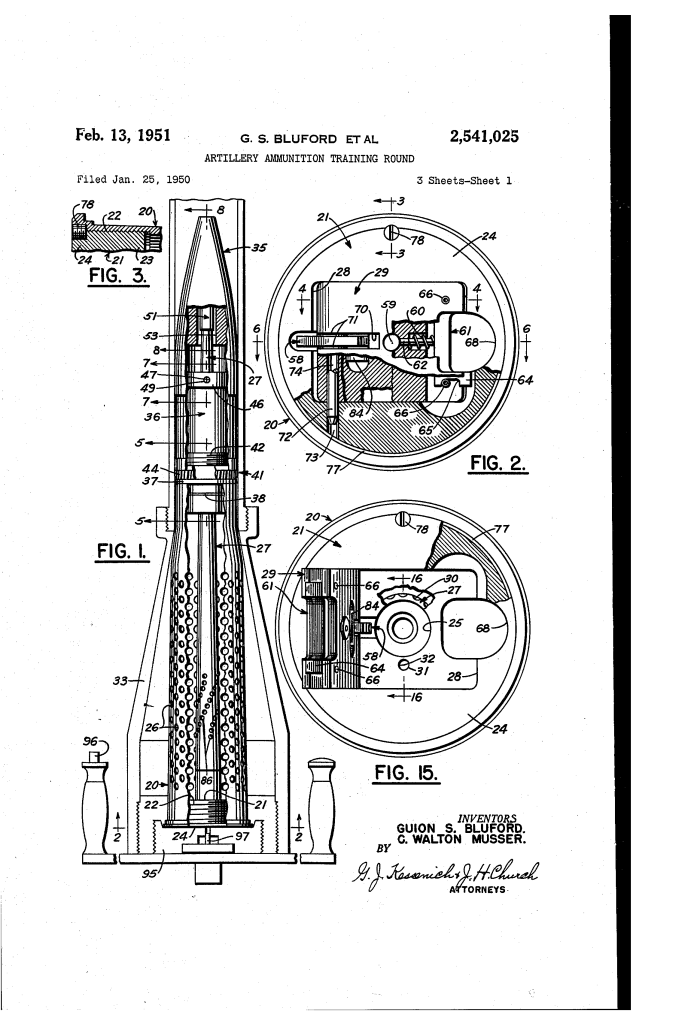
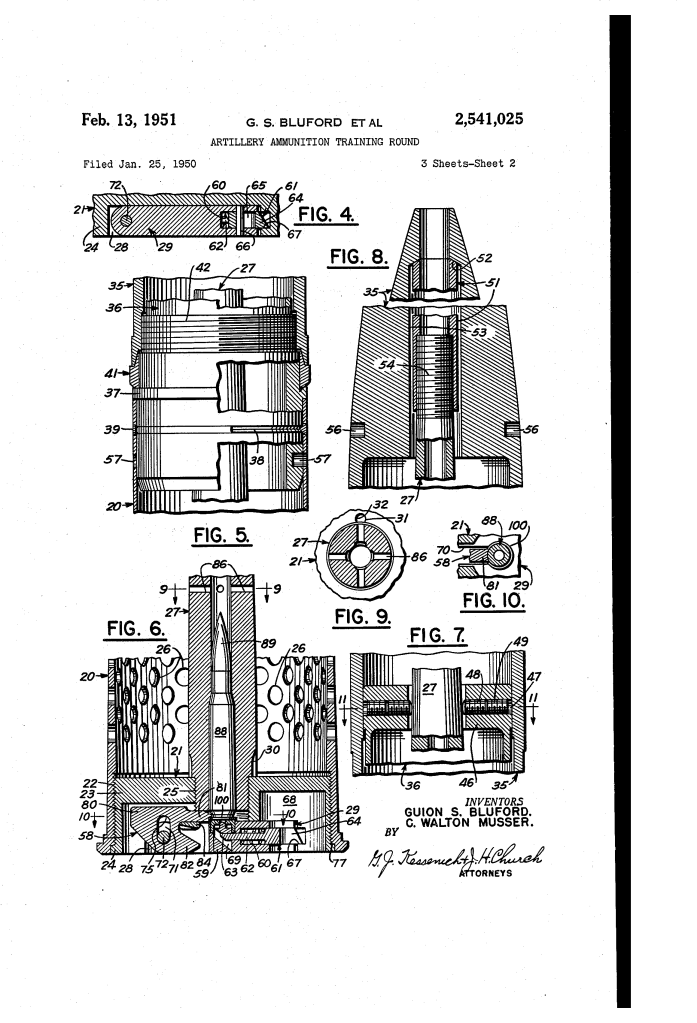
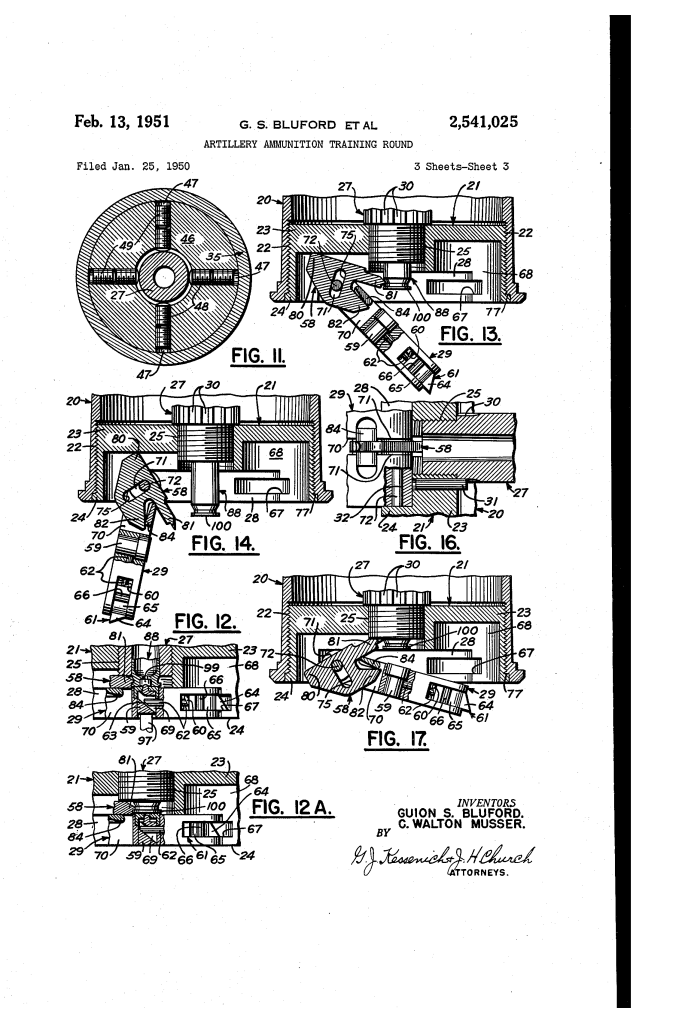
Artillery Ammunition Training Round (1951)
Patented on February 13, 1951 (U.S. Patent No. 2,541,025), this invention was the work of Guion S. Bluford and C. Walton Musser. It addressed a critical need for the U.S. military following World War II: providing realistic training for heavy artillery and recoilless rifles without the massive expense of firing full-caliber shells.
The “Bluford-Musser” round is essentially a sub-caliber insert disguised as a 75 mm shell. It allows soldiers to practice loading, aiming, and firing a large weapon while actually discharging a much smaller, less expensive .30 caliber machine gun bullet.
The “Why”
- Economic Efficiency: Full-size artillery shells are expensive and use strategic war materials. This round uses standard small arms ammunition.
- Realistic Simulation: To be effective, a training round must weigh the same, look the same, and have the same ballistic trajectory as the real thing.
- Weapon Preservation: The round functions without any modification to the actual gun, meaning training and combat readiness are interchangeable.
- Visual Feedback: For recoilless rifles, the inventors even engineered a way to simulate the “back blast” of flame and gas so the trainee experiences the true hazards of the weapon.
Key Systems Section
1. The Sub-caliber Barrel Assembly
At the heart of the 75 mm cartridge case (20) is a standard .30 caliber rifle barrel (27).
- Rear Support: The barrel is threaded into a heavy breech block (21) located at the base of the shell.
- Front Support: The muzzle is held in place by a coupler (35) and an adapter (50) within the hollow nose (ogive) of the shell.
- Axial Alignment: The entire assembly ensures the small bullet travels perfectly down the center of the large artillery bore.
2. The Integrated Breech Door and Firing Pin
Unlike a real shell, which is a single-use object, this training round features its own miniature “breech.”
- Breech Door (29): A small hinged door at the base of the shell that opens to allow the insertion of a .30 caliber cartridge.
- Firing Pin (59): When the large gun’s firing pin strikes the base of the training round, it hits this internal pin, which in turn strikes the small arms primer.
- Automatic Cocking: A clever cam mechanism (62) automatically retracts the firing pin into a “safe” or cocked position the moment the latch is pushed to open the door, preventing accidental discharges during reloading.
3. Realistic “Flash-Back” Simulation
For use in recoilless rifles, the inventors added a specific feature to mimic the dangerous rearward exhaust of a real shot:
- Ventilated Barrel: Holes (86) are drilled into the grooves of the small arms barrel.
- Gas Path: When fired, a portion of the high-pressure powder gases escapes through these holes into the hollow 75 mm case.
- Exhaust: The gas then exits through the perforations in the artillery case wall, creating a realistic flash and bang out the back of the recoilless rifle.
Component & Operation Table
| Component | Part # | Function |
| Cartridge Case | 20 | Provides the 75 mm exterior shape and weight. |
| Rifle Barrel | 27 | Fires the .30 caliber projectile accurately. |
| Breech Block | 21 | Houses the internal firing and extraction mechanisms. |
| Breech Door | 29 | Hinged gate for manual loading of small arms rounds. |
| Extractor | 58 | Automatically pulls the spent .30 cal casing out when the door opens. |
| Ogival Shell | 35 | The “nose” of the projectile that matches the real 75 mm shell. |
Significance
The Bluford-Musser patent represents a masterclass in mechanical simulation:
- Safety: It allowed crews to practice “hot” fire in smaller ranges where a full 75 mm shell would be too destructive.
- Muscle Memory: Because the weight and balance were identical to live ammunition, loaders developed the correct physical strength and speed required for combat.
- Longevity: The major components—the barrel, the breech block, and the shell—were “non-expendable,” meaning they could be used thousands of times, with only the tiny .30 caliber bullet being consumed.
Final Insight: Guion S. Bluford Jr. and C. Walton Musser turned an artillery shell into a reusable firearm. By nesting a machine gun inside a cannon shell, they saved the government millions while ensuring soldiers were trained with 100% realism.
