
Arithmetic Unit for Digital Computers (1968)
U.S. Patent No. 3,395,271, granted on July 30, 1968, to Marvin C. Stewart, describes a serial-parallel arithmetic unit engineered to execute addition, multiplication, subtraction, accumulation, and shifting in digital computers. Marvin C. Stewart, an engineer based in Hempstead, New York, assigned the patent to the Sperry Rand Corporation, a major force in mid-century computing and data processing.
This invention resolved a major dilemma in early computer hardware architecture: the costly tradeoff between physical circuitry size and operational speed. Standard parallel arithmetic units demanded an entire full adder for every individual bit, creating bulky, expensive hardware. Meanwhile, existing serial-parallel units that saved equipment operated too slowly, requiring separate, alternating cycles for every addition and shift operation. Stewart developed an architecture that slashed the required adder hardware by half while simultaneously boosting execution speed.
The Innovation: The Bit-Pair Architecture and Simultaneous Add-Shift
Stewart achieved this breakthrough by reorganizing how binary data moves through the arithmetic core. Instead of processing bits one by one or dedicating a full adder to every bit position, the system pairs adjacent bits (bits 1 and 2, 3 and 4, and so on).
Key Operational Advantages
- 50% Adder Reduction: By handling bits in two-step pairs—first processing odd bits, then even bits—the computer requires only one full adder circuit for every two operand bits.
- Streamlined Data Transfer: The parallel transfer paths between the accumulator and the multiplier register (M-register) are cut by half, alternating odd-bit and even-bit transfers over the same shared gating paths.
- Simultaneous Add-and-Shift: Conventional multipliers performed an add cycle followed by a distinct shift cycle, requiring at least 2M bit times (where M represents the multiplier bit length). Stewart’s unit adds and shifts simultaneously in a single cycle, slashing multiplication down to M + 2 bit times.
Circuit Components and Organization
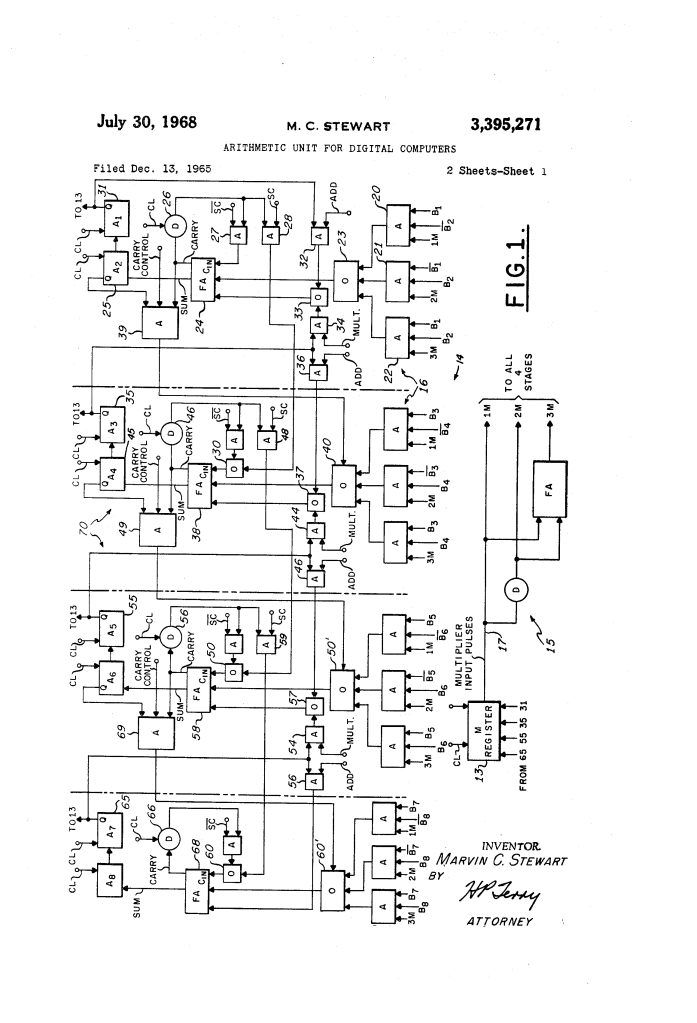
The arithmetic unit uses a modular, multi-stage structure where each stage manages a bit pair:
| Component | Identifier | Architectural Function |
| M-Register | 13 | Storage register holding the multiplier operator, feeding serial pulses into the generator. |
| M-Generator | 15 | Multiplier logic generator producing multiples of the operator: 1M, 2M (shifted 1 position left), and 3M (2M + M). |
| Decoder Gates | 16 (AND gates 20, 21, 22) | Evaluates multiplicand bit pairs (01, 10, 11) to gate the matching multiple (1M, 2M, or 3M) into the adder. The 00 state requires no gate. |
| Full Adder (FA) | 24, 38, 58, 68 | Performs 3-input binary summation for each bit pair. |
| Shift Registers | 25, 31, 35, 45, 55, 65 | Flip-flop stages (such as J-K flip-flops) forming the main accumulator (70) and temporary operand holding registers. |
| Carry Delay and Control | Delay 26; AND gates 27, 28, 39 | Delays carry outputs by one bit time, selectively shifting carries to higher stages or rippling them down through adjacent stages. |
How the Unit Operates
The unit dynamically reconfigures its internal wiring paths via gating signals depending on whether it is running an addition or multiplication sequence:
Addition in Four Clock Pulses
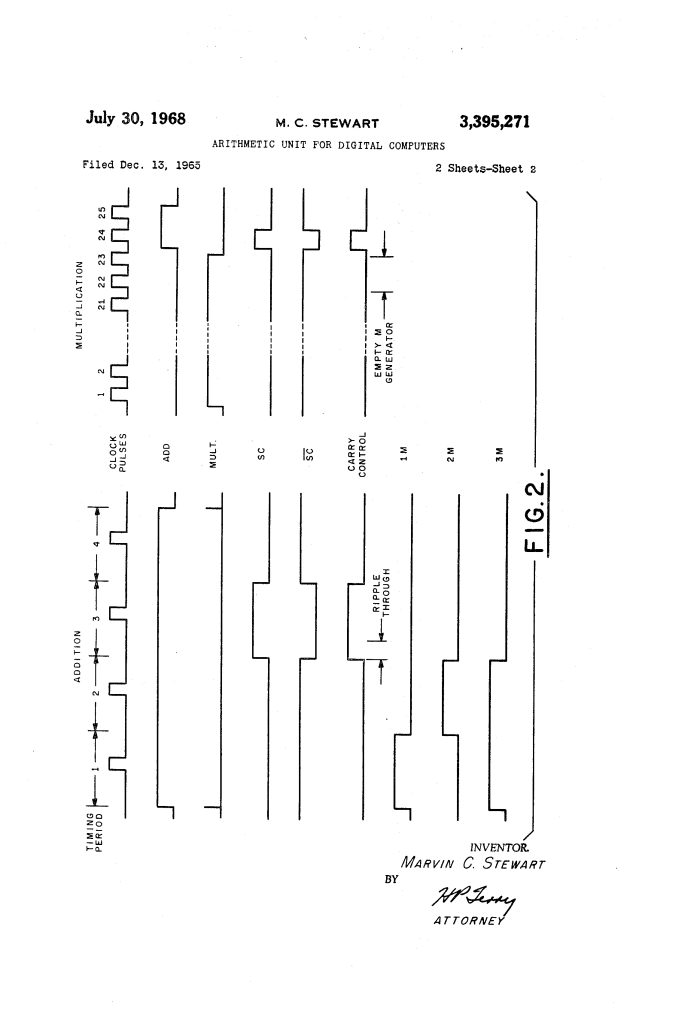
- Pulse 1: Odd bits of the addend and augend (A1 and B1, A3 and B3) enter the full adders and their initial sums load into the shift registers.
- Pulse 2: Even bits (A2 and B2, A4 and B4) are summed along with any carry generated by the odd bits.
- Pulse 3: The shift carry signal (SC) gates remaining carries to the next higher adder stage while carry-overflow conditions are sampled and routed into unused inputs.
- Pulse 4: Final carry resolution ripples through without loss of overflow information, leaving the completed sum in the accumulator.
Multiplication in a Single Word Time
- Multiplier Setup: The accumulator bits transfer into the M-register in two swift shifts—odd bits first, followed by even bits—before the accumulator clears.
- Pipelined Multiply-Shift: A continuous multiplication signal (MULT) gates the shift register outputs of adjacent stages directly into the full adders. As the multiplier streams serially through the M-generator, each stage generates 1M, 2M, or 3M products, sums them with the partial products from the adjacent higher stage, and clocks the result downward.
- Carry Absorption: Once the multiplier stream clears the M-generator, an ADD pulse reconfigures the gates to absorb all remaining carries across two clock cycles.
Historical and Technical Impact
Marvin C. Stewart’s design represented a crucial optimization during the mainframe era of the 1960s, when discrete transistors and early integrated circuit logic gates were costly in both hardware budget and thermal dissipation.
- Component Economy: By eliminating half the full adders and their associated shifting gates, computer mainframes could be built with substantially smaller circuit board counts and lower component failure rates.
- Unified Hardware Utility: Unlike earlier specialized serial multipliers that could not handle standard math, Stewart’s unit functioned as a universal arithmetic engine, executing addition, subtraction, multiplication, shifting, and accumulation using the exact same hardware footprint.
- Speed Optimization: Reducing multiplication time to just two bit times beyond the length of the multiplier word provided a major computational speedup for enterprise and scientific computing systems produced by Sperry Rand.
About the Inventor: Marvin C. Stewart
Marvin C. Stewart was an electrical engineer and inventor who worked during the golden age of American digital computing development on Long Island, New York. Assigned to the Sperry Rand Corporation—famed for its UNIVAC computer systems—Stewart contributed fundamental patents in binary arithmetic units, logic decoding, and computer system timing, focusing on maximizing throughput while minimizing component complexity.
Summary of Claims
The patent explicitly claims:
- A serial-parallel arithmetic unit combining operand bit-pair storage, operator storage, an M-generator, decoding logic, full adders, and shift registers to selectively execute multiplication and addition.
- A gating network incorporating carry control, shift carry, and add/multiply selector gates that reconfigures the arithmetic unit between operational states.
- An architecture where multiplication is executed within two bit times in excess of the multiplier operator word time.
- Serial-parallel adder logic utilizing one full adder per bit pair, featuring carry control circuits that ripple remaining carries through adjacent stages and decoding gates across successive clock pulses.
