
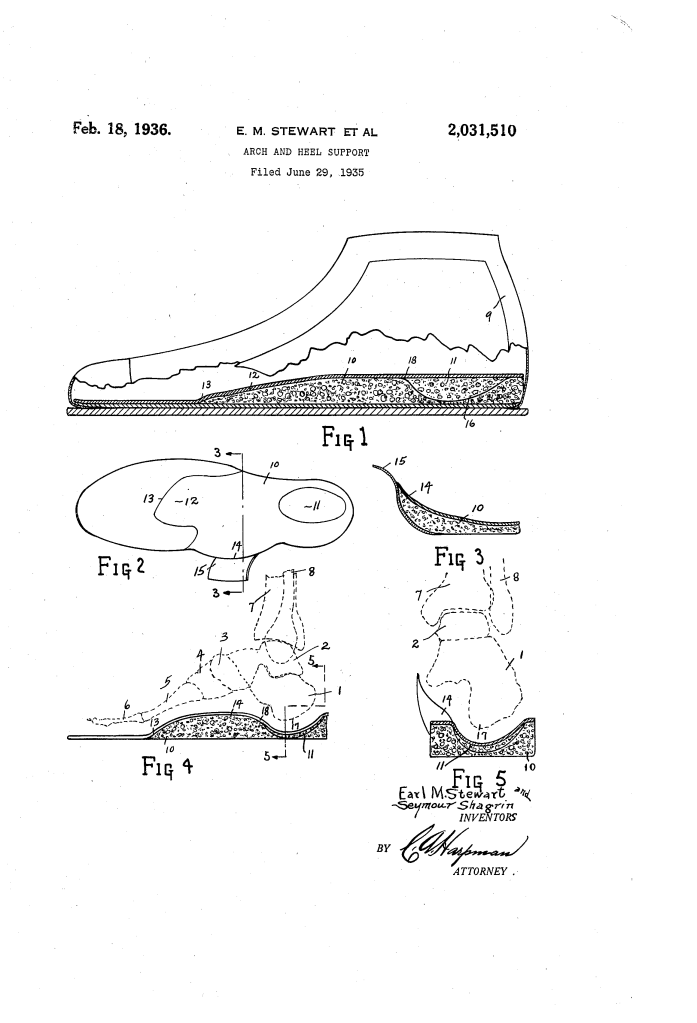
Arch and Heel Support | Stewart & Shagrin | Patent No. 2,031,510
The patent by Earl M. Stewart and Seymour Shagrin of Youngstown, Ohio, describes an Arch and Heel Support (Patent No. 2,031,510), issued on February 18, 1936. This invention is a multi-density resilient orthopedic insert designed to be integrated into shoe construction or used as an insole to prevent the mechanical collapse of the foot’s skeletal structure under weight-bearing conditions.
The “Why”
In the 1930s, foot pathology—specifically “weak foot”—was a common ailment. The inventors observed that foot flattening wasn’t just a simple downward sink; it was a complex mechanical chain reaction. When weight is applied, the os calcis (heel bone) tilts, causing the astragalus (ankle bone) to rotate and glide inward. This “internal lateral displacement” breaks the longitudinal arch. Stewart and Shagrin identified the “pain point” of skeletal malalignment, seeking to create a support that didn’t just cushion the foot, but actively “checked” or blocked the bones from rotating out of their natural form.
The Inventor Section
The work of Stewart and Shagrin reflects an engineering philosophy of Biomechanical Bracing. Rather than treating the foot as a soft mass, they treated it as a system of levers and joints subject to structural failure. Their focus on the “anterior part of the os calcis” shows a sophisticated understanding of podiatric anatomy, moving beyond simple comfort to preventative skeletal engineering.
Key Systems Section
Dual-Density Resilient Body
- Differential Compression: The device uses two grades of sponge rubber. The main body ($10$) provides firm support, while a “semi-saucer” shaped heel insert ($11$) is made of a more resilient, softer material.
- The “Pocket” Effect: By making the heel support softer and positioning it slightly to the outer side, the device creates a pocket that “captures” the heel, preventing the inward tilting that precedes arch collapse.
Longitudinal Arch & Tab Extension
- Side-Wall Integration: A unique “tab extension” ($15$) is built into the arch support. This tab is designed to be attached to the side wall of the shoe.
- Lacing Leverage: By anchoring the support to the shoe upper, the device utilizes the tension from the shoe’s laces to pull the support snugly against the inner longitudinal arch, providing “active” lifting.
Anatomical Metatarsal Support
- Varying Length Alignment: The front edge ($13$) of the metatarsal support is not straight; it is specifically contoured to match the varying lengths of the metatarsal bones ($5$), providing targeted pressure relief to the ball of the foot.
Comparison Table: Standard Insoles vs. The Stewart-Shagrin Support
| Feature | Standard 1930s Cushioning | The New Innovation |
| Material Logic | Single-density felt or leather. | Dual-density sponge rubber (Zoned Resiliency). |
| Arch Support | Passive “shelf” under the arch. | Active lifting via tab extension and shoe lacing. |
| Heel Mechanics | Flat or slightly cupped. | “Semi-saucer” recess to prevent bone rotation. |
| Metatarsal Care | Uniform thickness at the forefoot. | Shaped edge conforming to metatarsal lengths. |
Significance
- Precursor to Modern Orthotics: The use of multi-density foams to control “pronation” (inward rolling) is the foundational principle of modern athletic and corrective footwear.
- Integrated Shoe Design: The concept of attaching an arch support to the upper of the shoe anticipated modern “arch-wrap” technologies found in high-performance running shoes.
- Anatomical Correctness: By specifically targeting the astragalo-scaphoid joint, the inventors moved orthopedic design toward medical-grade intervention.
