
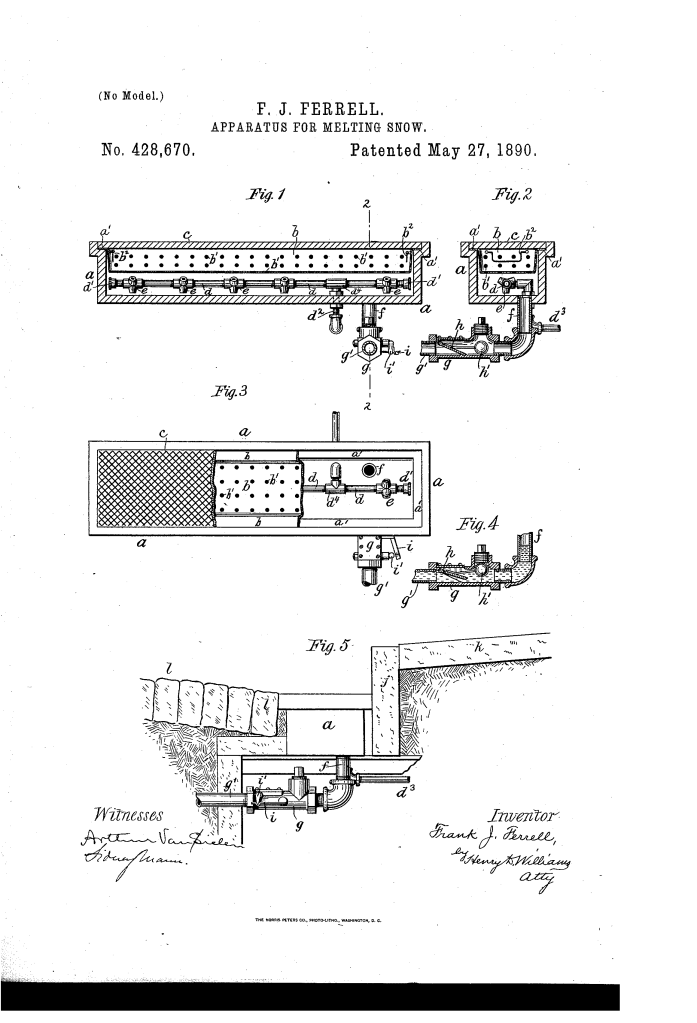
Apparatus for Melting Snow (1890)
U.S. Patent No. 428,670, granted on May 27, 1890, to Frank J. Ferrell, introduces a specialized system for the rapid disposal of snow and ice in urban environments. Frank Ferrell, a resident of New York City, designed this apparatus to solve the logistical nightmare of snow accumulation on city streets, proposing a permanent, steam-powered infrastructure built directly into the municipal gutter system.
This invention addressed a major civic challenge of the late 19th century: the labor-intensive and costly process of hauling snow away by horse and cart. Ferrell’s solution was to melt the snow on-site and divert the resulting water directly into the city’s sewer system.
The Core Design: The Gutter-Integrated Melter
The apparatus consists of a cast-metal box (a) embedded in the street so that its cover sits flush with the pavement, functioning as a standard gutter bed when not in use.
- The Perforated Tray (b): Inside the box sits a removable tray that catches snow and ice. The perforations are designed to allow meltwater to pass through while trapping stones, sticks, and debris that might otherwise clog the sewer pipes.
- The Multi-Nozzle Steam Pipe (d): Running along the bottom of the box is a pipe connected to a heated fluid source—typically the steam-heating system of an adjacent building.
- Five-Way Fittings (e): The steam pipe is joined by specialized couplings featuring nozzles that point upward to blast the snow with heat and downward to prevent internal condensation buildup.
How the Apparatus Functions
To clear a street, the process followed a specific operational sequence:
| Step | Action | Purpose |
| 1. Preparation | The removable cover (c) is lifted and the steam supply is turned on. | Readies the chamber for high-heat melting. |
| 2. Loading | Snow and ice are shoveled from the street/sidewalk into the tray (b). | Brings the frozen material into direct contact with steam. |
| 3. Melting | Steam escapes through the nozzles, passing through the tray perforations. | Rapidly converts solid ice into liquid water via direct thermal action. |
| 4. Drainage | Water flows through an outlet (f) equipped with an automatic steam trap. | Directs water to the sewer while preventing the waste of “live” steam. |
Technical Components
- Automatic Steam Trap (g): A critical efficiency feature. It uses a float-ball mechanism that keeps the valve closed to prevent steam from escaping. The valve only opens when enough condensed water has collected to lift the float, ensuring the steam remains in the box to do work.
- The “Key” Spring (i): When the melter is not in use, a spring holds the valve open to allow natural rainwater to drain freely into the sewer without engaging the steam mechanism.
- Roughened Cover: The top of the box is textured with grooves or raised lines to provide traction for pedestrians and horses, maintaining street safety when the device is dormant.
Historical and Urban Impact
Frank J. Ferrell’s invention represented a forward-thinking approach to urban engineering and public works in the 1890s.
- Infrastructure Synergy: By suggesting that the melters connect to the steam-supply of “adjacent houses,” Ferrell envisioned a decentralized utility network where private heating could assist public maintenance.
- Labor Efficiency: This system aimed to eliminate the need for massive snow-shoveling crews and the “carting away” of snow, which frequently paralyzed New York City traffic during winter storms.
- Public Safety: By integrating the device into the gutter, Ferrell ensured that the transition from street to sidewalk remained clear and that the device itself did not create a tripping hazard.
About the Inventor: Frank J. Ferrell
Frank J. Ferrell was a prolific African American inventor based in New York City during the late 19th century.
- Innovation Breadth: While the snow melter was a significant contribution to civil engineering, Ferrell is also well-known for his improvements to steam engine valves and various apparatuses for handling fluids under pressure.
- Patents: He held several patents during this era, including a notable “Steam Engine Valve” (Patent No. 420,138) which showcased his deep understanding of thermodynamics and mechanical regulation.
- Legacy: Ferrell’s work exemplifies the contributions of Black inventors to the industrialization and modernization of American cities, applying complex mechanical principles to solve everyday municipal problems.
Summary of Claims
The patent explicitly claims:
- A melting box featuring a perforated tray and a duct for heated fluid.
- The use of an automatic steam trap to regulate the exit of water while retaining live steam.
- A removable cover specifically designed to function as the bed or bottom of a street gutter.
- The use of multi-nozzle couplings (five-way fittings) to distribute heat efficiently throughout the melting chamber.
