
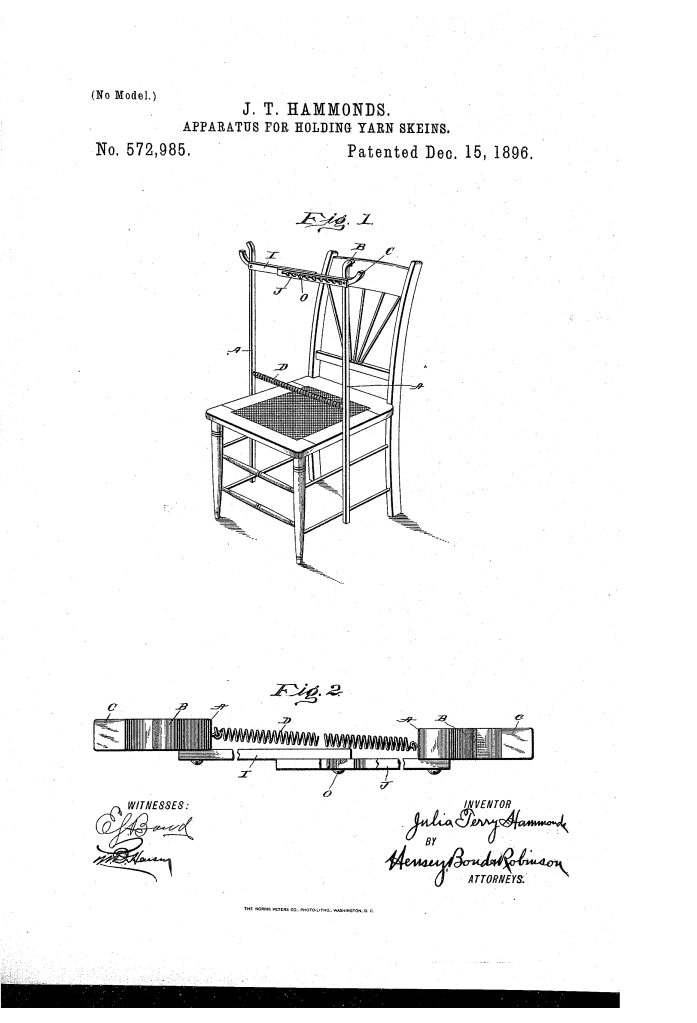
Apparatus for Holding Yarn Skeins (1896)
U.S. Patent No. 572,985, granted on December 15, 1896, to Julia Terry Hammonds, describes a clever, portable mechanical aid designed to hold and tension skeins of yarn, silk, or cotton during the winding process.
This domestic invention solved a universal, everyday frustration in late 19th-century households: the tedious task of winding tangled hanks of textiles into neat, usable balls, which traditionally required a second person—often a child or reluctant spouse—to stand with outstretched arms to hold the yarn. Hammonds’s design transformed this labor-intensive task into an efficient, independent, one-person operation.
The Innovation: The Self-Clamping Tension Frame
The brilliance of Hammonds’s apparatus lies in its reliance on opposing mechanical forces to secure itself. Instead of utilizing heavy, expensive clamps or damaging screws that would mar household furniture, the device leverages a dynamic combination of a tension spring and an adjustable, rigid brace to lock itself firmly against the outer edges of a standard chair back.
1. The Pronged Upper Guides (B, C)
The top of each vertical upright features a specialized, dual-purpose architectural fork:
- The Outwardly-Curved End (B): Curved sharply to the outside to ensure the loop of the yarn skein cannot slip off the top during rapid winding.
- The Upwardly-Curved Support Arm (C): Projects upward to catch the lower loops of the textile, preventing the heavy skein from dropping down or sagging under its own weight.
2. The Floating Spring Assembly (D)
Positioned lower on the vertical uprights, this spring exerts a constant inward pulling force. This contraction creates tight frictional contact between the lower legs of the device and the wood of the chair back, allowing the user to slide the entire apparatus up or down to their preferred working height without it slipping.
3. The Notched Locking Brace (I, J)
To counteract the inward pull of the spring at the top of the device, Hammonds engineered a two-part adjustable interlocking crossbar:
- One arm is solid and features a protruding headed stud (O).
- The matching arm features a central horizontal slot lined with a series of precision locking notches.
- The user drops the stud into the appropriate notch to lock the upper forks at the exact width required to stretch and hold the specific size of the yarn hank being wound.
How the Apparatus Functions
The mechanism utilizes a simple, tool-free setup sequence that can be easily executed at home:
| Step | Action | Mechanical Purpose |
| 1. Attachment | The two vertical uprights (A) are pulled apart against the spring tension and fitted over the outer frame of a chair back. | Uses opposing tension to clamp the device firmly to the furniture without screws. |
| 2. Width Adjust | The interlocking braces (I, J) are pulled together until the headed stud (O) drops into a chosen notch. | Establishes a rigid upper framework that perfectly matches the width of the yarn skein. |
| 3. Loading | The hank or skein of yarn, silk, or zephyr is draped over the specialized fork ends (B, C). | Keeps the material elevated, open, and untangled. |
| 4. Winding | The user pulls the thread to wind the ball; the frame holds its position under dynamic tension. | Eliminates the need for an assistant to hold the yarn during knitting preparation. |
Key Technical Components
- Uprights (A): Dual vertical wooden or metal structural standards that act as the main structural chassis.
- Tension Spring (D): The primary kinetic fastener providing the clamping force required to grip a chair or alternative household support.
- Headed Stud and Notched Slot (O, I, J): A primitive yet highly effective linear ratchet system that allows the user to expand or contract the upper profile of the machine to fit varying textile dimensions.
Historical and Domestic Impact
Julia Terry Hammonds’s invention was a meaningful contribution to the late-Victorian era’s growing movement toward domestic labor-saving appliances.
- Feminine Independence: The patent explicitly notes that the apparatus was “especially adapted for ladies who use yarn, silk, cotton, and other light materials for knitting and crocheting.” It allowed independent crafters to manage their materials entirely on their own schedule.
- Collapsible Storage: Hammonds engineered the device for tight living quarters. When winding was complete, the user could unhook the spring, separate the interlocking cross-braces, and fold the components completely flat into alignment with the uprights, allowing the entire machine to be packed away into a tiny drawer.
- Universal Furniture Compatibility: By utilizing a floating spring and an adjustable notch system, the invention was entirely modular—adapting seamlessly to thin, thick, wide, or narrow chair back styles without requiring custom modifications.
About the Inventor: Julia Terry Hammonds
Julia Terry Hammonds was an American inventor residing in Lebanon, Illinois, located in St. Clair County. Operating during an era when women faced immense systemic barriers to acquiring independent patent protections and commercializing engineering projects, Hammonds successfully secured her legal title to this utility mechanism in the winter of 1896. Her design demonstrates a keen understanding of household efficiency, mechanical leverage, and practical ergonomics.
Summary of Claims
The patent explicitly claims:
- An apparatus for winding yarn and silk consisting of two vertical uprights with curved upper ends and supporting arms, working in combination with a spring that draws them together and a two-part adjustable stabilizing brace.
- A specific interlocking brace design wherein one arm carries a headed stud and the second arm features a notched slot designed to catch and rigidly lock the stud to hold the upper frame apart against the force of the spring.
