
Heat-Regulating Casing for Transport Refrigeration, Frederick M. Jones (1950)
Patented on October 24, 1950, this invention (U.S. Patent No. 2,526,374) solved a critical “reverse” problem in transport refrigeration. While Frederick M. Jones had already mastered cooling cargo in hot weather, he realized that in extreme cold, the refrigeration unit itself could fail.
When a truck travels through sub-zero temperatures, the internal combustion engine and compressor—which are mounted outside in the wind—can become too cold to operate. Furthermore, to heat the cargo (to keep produce from freezing), the unit needs to capture the heat generated by its own engine. Jones invented a “smart” casing with automatic shutters that trap engine heat when it’s cold and exhaust it when it’s hot.
The “Why”
- The Over-Cooling Paradox: In winter, the wind hitting a moving truck can strip away so much heat that the engine won’t stay at operating temperature, and the refrigerant won’t circulate properly to heat the cargo.
- Dual-Purpose Necessity: Perishable goods (like eggs or fresh fruit) must stay within a tight temperature range. Spoilage occurs if they get too hot or too cold.
- The “Cyclic” Heat Solution: Jones wanted to create a way for the unit to “recycle” its own waste heat from the engine to keep the condenser warm and the cargo safe.
Key Systems Section
1. The Automatic Shutter Assemblies
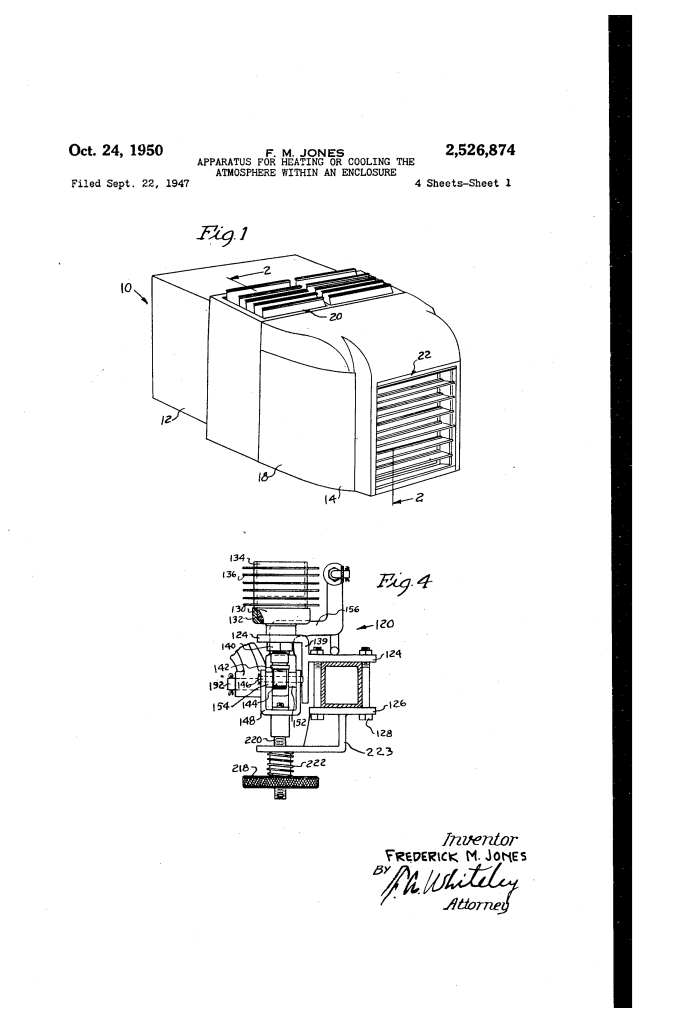
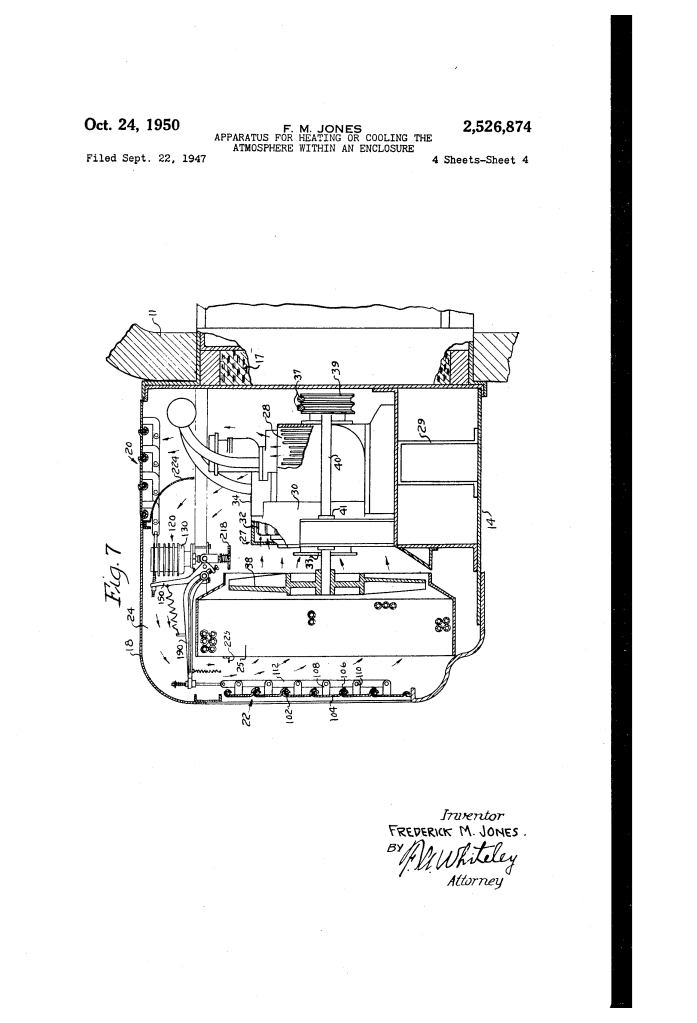
The casing (18) features two sets of shutters: one on the top (20) and one on the front (22).
- The Function: These shutters act like the “lungs” of the machine.
- Closed Position: They trap heat inside the casing, creating a warm micro-climate for the engine and compressor.
- Open Position: They allow maximum airflow to prevent the engine from melting down during summer operation.
2. The Thermal Control Device (The “Brain”)
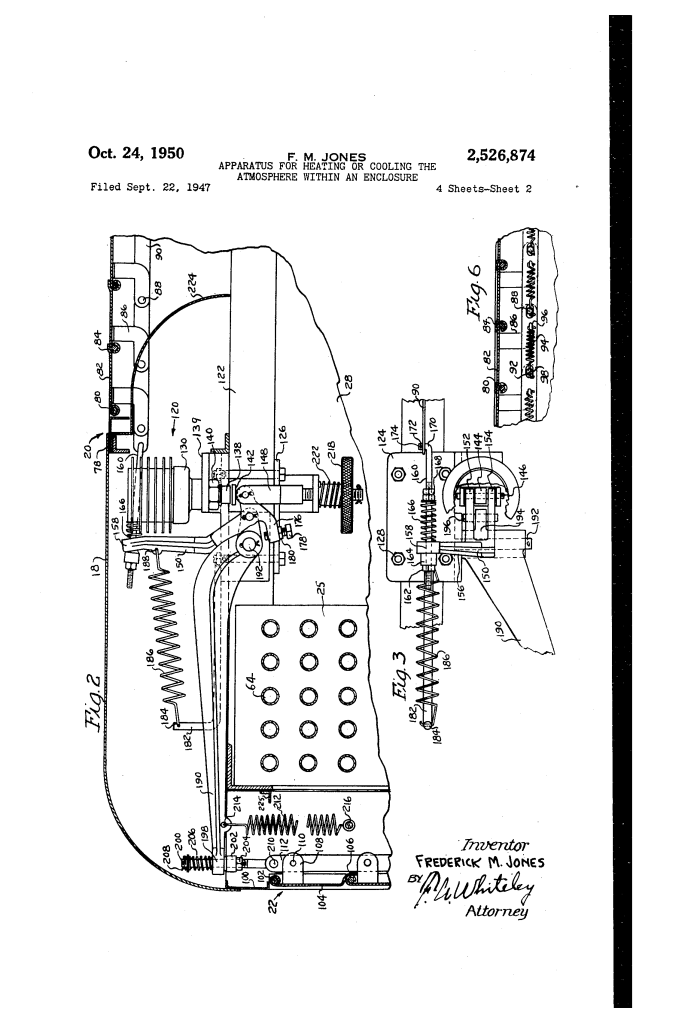
Inside the casing sits a control unit (120) filled with a thermally expansible material, like wax (132).
- Expansion: As the air inside the casing gets too hot, the wax expands, pushing a piston (142) that moves a series of levers.
- Sequential Opening: Jones designed the levers to be sequential. First, the top shutter opens to let out rising heat. If it’s still too hot, the front shutter opens to allow a blast of ram air from the truck’s movement to cool the system.
3. The Cyclic Airflow & Baffle Plate
When the shutters are closed (during heating mode), the air must move in a specific way to prevent “hot spots.”
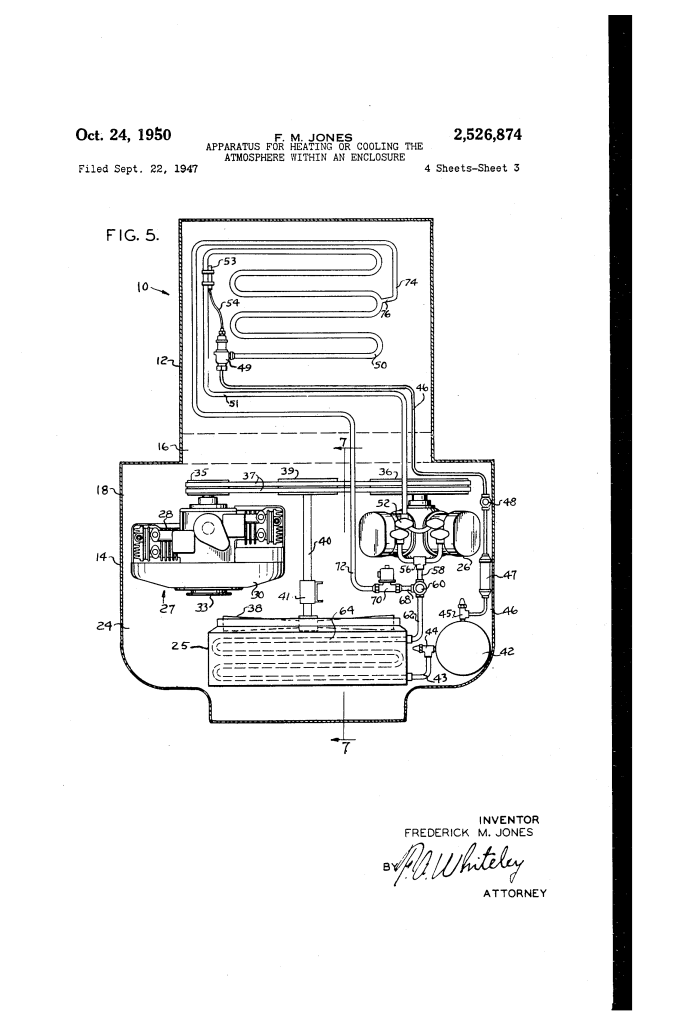
- The Baffle (224): A curved metal plate sits above the engine. It catches the rising heat and deflects it forward toward the condenser.
- The Cycle: Fans (32 & 38) pull air over the hot engine, past the baffle, through the condenser, and back to the engine. This “cyclic” travel ensures the entire internal space stays warm and the refrigerant stays pressurized enough to provide heat to the cargo.
Operating Modes
| Mode | Outside Temp | Shutter Status | Airflow Pattern |
| Cooling Mode | Hot (Summer) | Fully Open | High-velocity outside air passes through the unit to dump heat. |
| Heating Mode | Cold (Winter) | Fully Closed | Internal air is “recycled” over the engine to stay warm. |
| Regulating | Moderate | Partially Open | Top shutters vent excess heat while front shutters stay closed to maintain engine temp. |
Mechanical Innovations
- Lost Motion Connection: Jones added slots (92) to the shutter rods. This “lost motion” ensures that even if one shutter slat is slightly bent or stuck, the others can still close tightly.
- Manual Override: A large hand wheel (218) allows the driver to manually lock the shutters open during the summer, bypassing the thermostat if needed.
- The Shroud (30): The engine is encased in its own shroud with a dedicated fan to ensure it receives precise cooling even when the main casing shutters are closed.
Significance
This patent transformed the Thermo King units from mere “coolers” into true all-weather climate control systems.
- Global Shipping: It allowed trucks to drive from the frozen winters of Canada to the heat of the American South without the driver having to manually adjust the equipment.
- Fuel Efficiency: By using “free” engine heat to warm the cargo, the system saved massive amounts of fuel compared to using electric heaters.
- Reliability: The thermal wax control was incredibly rugged, requiring no electricity to operate—meaning the unit could regulate its own temperature even if the electrical system flickered.
Final Insight: Frederick M. Jones didn’t just build a box; he built a machine with a “metabolism.” By using wax that expanded with heat to move mechanical levers, he gave the refrigeration unit the ability to “sweat” (open shutters) or “shiver” (close shutters) just like a living organism.
