
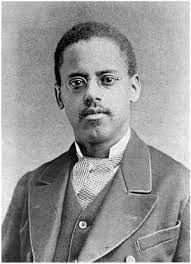
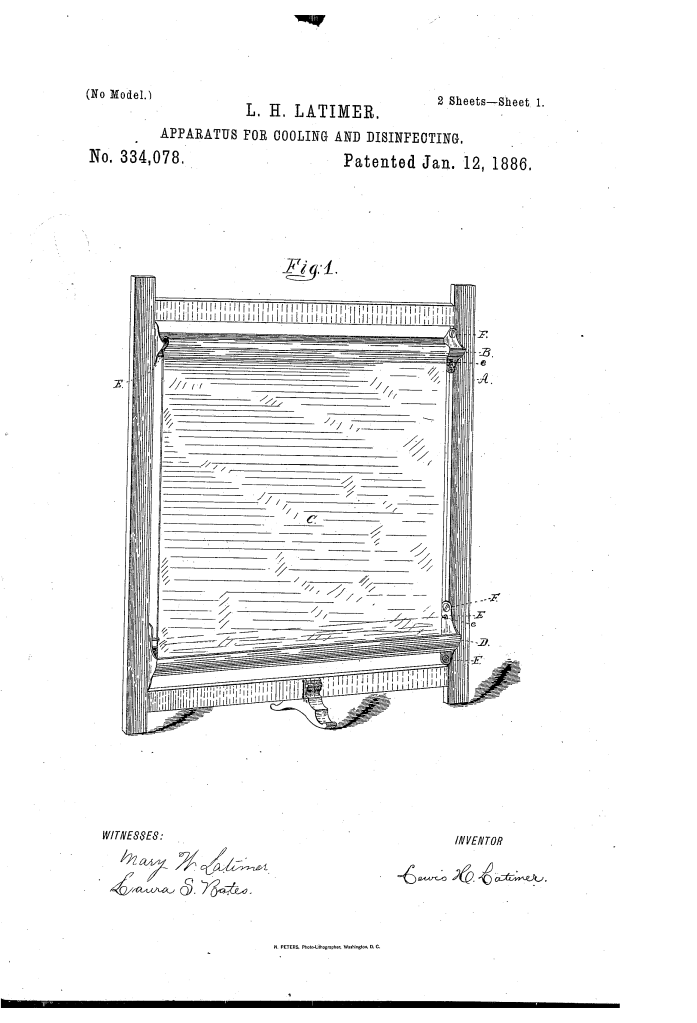
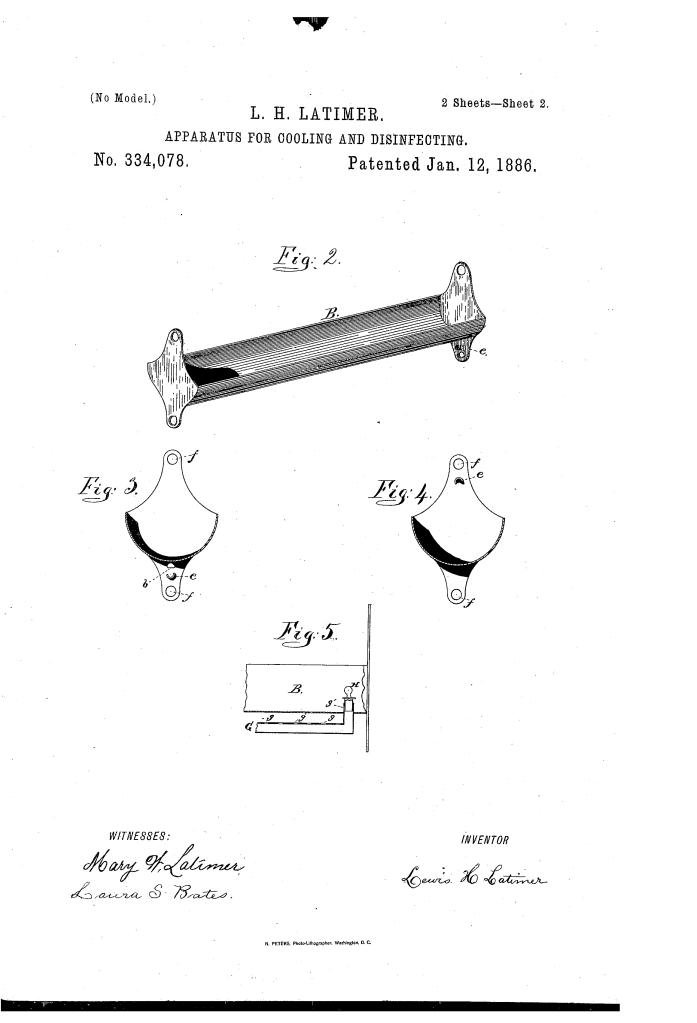
Lewis Howard Latimer’s 1886 patent (#334,078), co-invented with John Tregoning, was for an “Apparatus for Cooling and Disinfecting.” This device was an early form of an air conditioner or refrigerator, designed to improve ventilation and hygiene in rooms, particularly hospital rooms.
Details of the Patent
The patent described a self-contained unit that cooled and disinfected the air. It was a forward-thinking invention that addressed both comfort and health. 💨
- The Invention: The apparatus consisted of a vessel or reservoir that could hold a cooling agent, such as ice, and a disinfecting substance, like carbolic acid.
- Mechanism: Air was drawn into the vessel, passing over the cooling and disinfecting agents before being expelled back into the room. A fan or similar mechanism was used to circulate the air. The design was portable and could be placed in any room where fresh, cool air was needed.
- Problem Solved: This invention tackled the dual problem of poor air quality and high temperatures, especially in enclosed spaces like hospitals where clean, cool air was essential for patient recovery.
Significance of the Invention and Inventor
Lewis Howard Latimer was a highly accomplished African-American inventor and draftsman. His contributions to science and technology spanned several fields, with his work in electricity being particularly notable.
- Contribution to Modern Technology: While the “Apparatus for Cooling and Disinfecting” wasn’t a commercial success, it was a significant early step in the development of modern air conditioning and refrigeration. It demonstrated Latimer’s understanding of thermodynamics and air purification, foreshadowing technologies that would become commonplace decades later.
- Legacy as a Polymath: Latimer’s genius wasn’t limited to a single field. He was a gifted draftsman who worked with some of the greatest inventors of his time, including Alexander Graham Bell and Thomas Edison. He drafted the patent drawings for Bell’s telephone and later became a leading figure at the Edison Electric Light Company, where he invented a more durable carbon filament for light bulbs. This innovation made electric lighting more affordable and practical, playing a key role in bringing it to a wider audience.
- Overcoming Barriers: As an African-American inventor, Latimer faced significant racial discrimination. Despite this, he became an indispensable part of some of the most important technological advancements of the late 19th century. His life and work serve as a powerful example of perseverance and intellectual brilliance in the face of systemic prejudice.
