
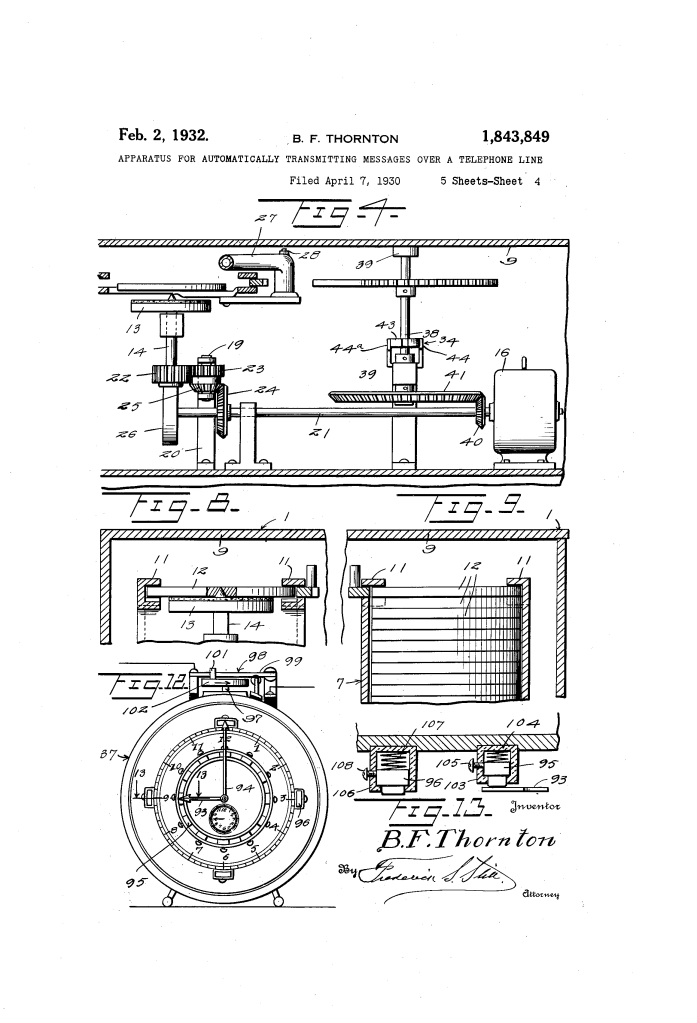
Automatic Message Transmitting Apparatus (Benjamin F. Thornton, No. 1,843,849)
This 1932 patent by Benjamin F. Thornton of Landover, Pennsylvania, introduces a sophisticated companion to his message recording device. While his previous invention focused on receiving calls, this apparatus was designed to automatically transmit pre-recorded messages over a telephone line at scheduled times.
A primary objective was to allow a subscriber to send recorded telegrams or messages late at night to take advantage of cheaper telephone rates without having to be physically present or employ a secretary.
1. Scheduled Transmission: The Time Switch
The “brain” of this apparatus is a complex time switch (37) that allows the user to program when the messages should be sent.
- Dual Hand Contacts: The clock face features an hour hand (93) and a minute hand (94) that pass over series of adjustable contacts (95, 96).
- Programmable Intervals: By setting specific screws (105, 108), the user could program the machine to wake up and transmit messages at 15-minute intervals or any other desired time.
- Automatic Shut-off: An alarm-style arbor (97) is used to trip a master switch (98) once all programmed messages have been sent, preventing the machine from running indefinitely.
2. The Transmission Mechanism
When the time switch triggers the circuit, the apparatus performs a four-phase mechanical sequence similar to Thornton’s recording device.
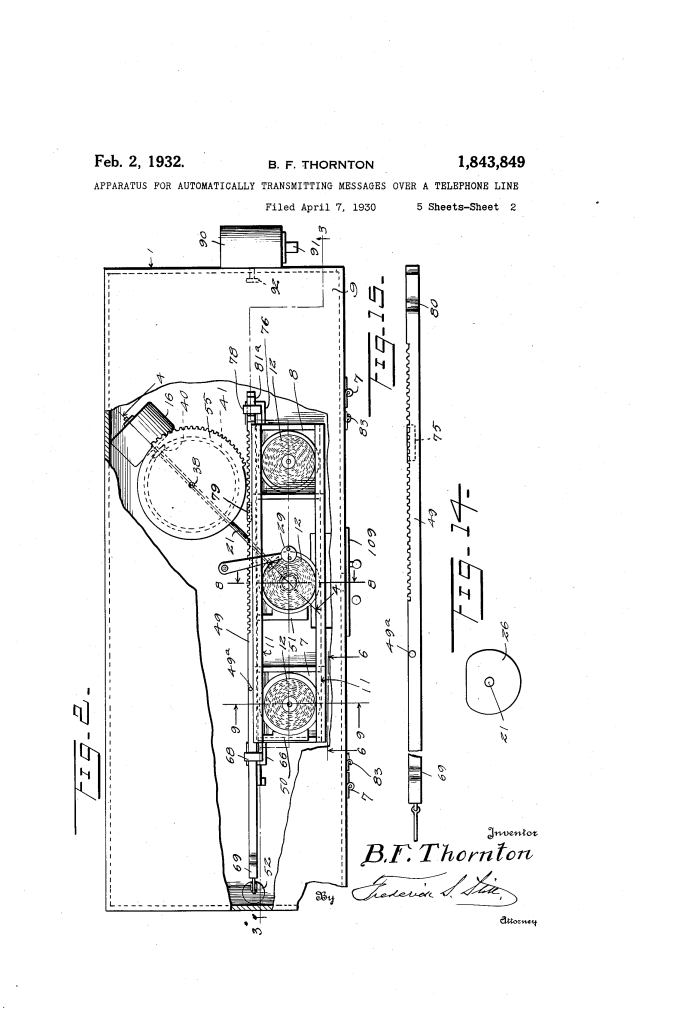
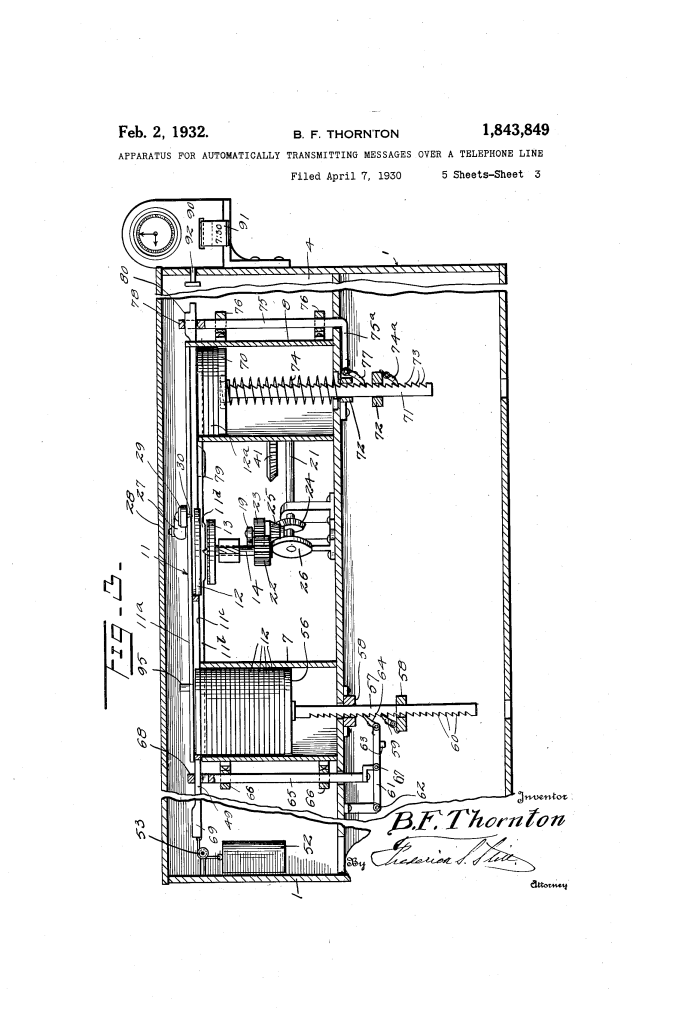
- Phonographic Reproduction: An electric motor (16) rotates a turn table (13) holding a record disc. An electrical reproducer (29) with a stylus (30) reads the grooves of the disc.
- Signal Transmission: The reproducer is connected directly to the telephone line wires (32). An electromagnetic switch (33) closes the connection, which also triggers a “red light” at the central telephone office to signal that a message is being transmitted.
- Vertical Adjustment: A cam (26) lifts the turn table and disc up to meet the stylus at the start of the transmission and lowers it once the message is complete.
3. Automated “Jukebox” Disc Management
The machine can send multiple different messages in a single session thanks to an automated disc-swapping system.
- Disc Magazines: The machine features a “To-Send” magazine (7) and a “Sent” magazine (8).
- Rack Bar (49): After a disc has finished playing and the turn table lowers, a mechanical rack bar slides across. Its arms (50, 51) push the played disc into the “Sent” magazine and pull a fresh disc from the “To-Send” magazine onto the turn table seat.
- Gravity and Weights: The rack bar is returned to its starting position by a weight (52) and cable system, preparing it for the next transmission cycle.
4. Dual Function: Local Reproduction
Thornton included a feature for the subscriber to listen to their own recorded messages locally (for instance, to check messages recorded while they were away).
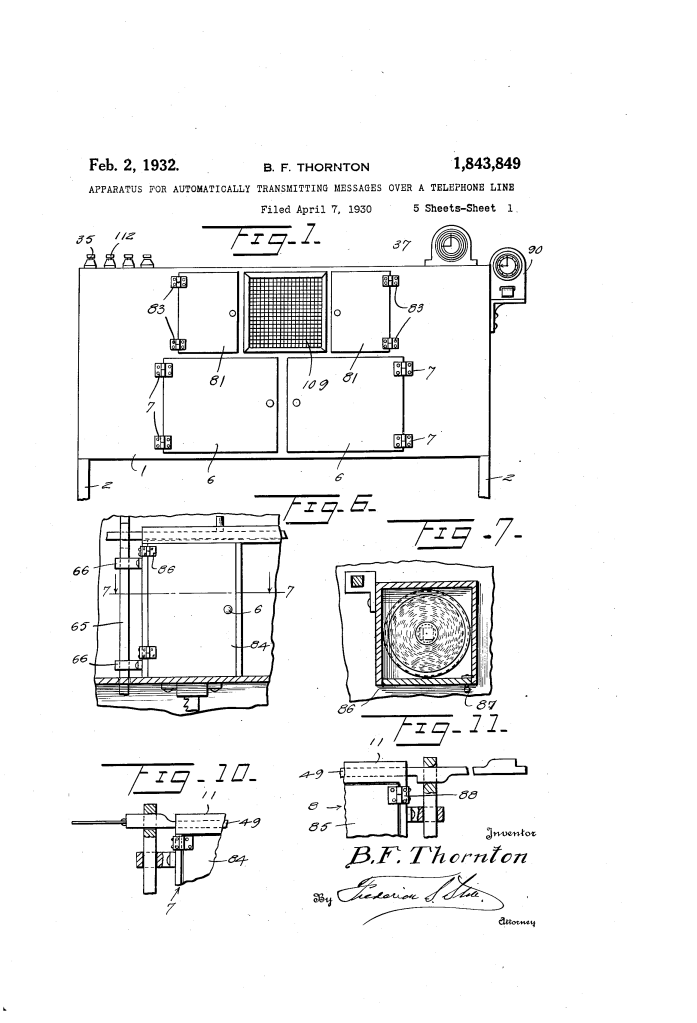
- Microphone and Horn: The apparatus includes a microphone (109) and an amplifying horn (110).
- Privacy Switch: A manual switch (112) allows the user to disconnect the telephone line and route the audio from the reproducer through the horn. This ensures that the central office does not “hear” the subscriber reviewing their messages.
Comparison: Recording vs. Transmitting
While Thornton’s two patents (No. 1,831,331 and No. 1,843,849) use similar mechanical chassis, they serve opposite functions:
| Feature | Recording Apparatus (1,831,331) | Transmitting Apparatus (1,843,849) |
| Trigger | Incoming call from a person. | Internal clock/timer (37). |
| Disc Source | Blank discs magazine. | Pre-recorded discs magazine. |
| Audio Path | Phone Line → Recording Stylus. | Reproducer Stylus → Phone Line. |
| Purpose | Answering machine. | Automated “outbox” or scheduler. |
Technical Components Summary
| Component | Function |
| Segmental Pinion (55) | Engages the rack bar to swap discs between cycles. |
| Time Clock (90) | Stamps the transmission time onto a paper strip (91) for record-keeping. |
| Segmental Contact Strip (43) | Maintains the motor circuit during the disc-swapping phase after the clock trigger passes. |
