
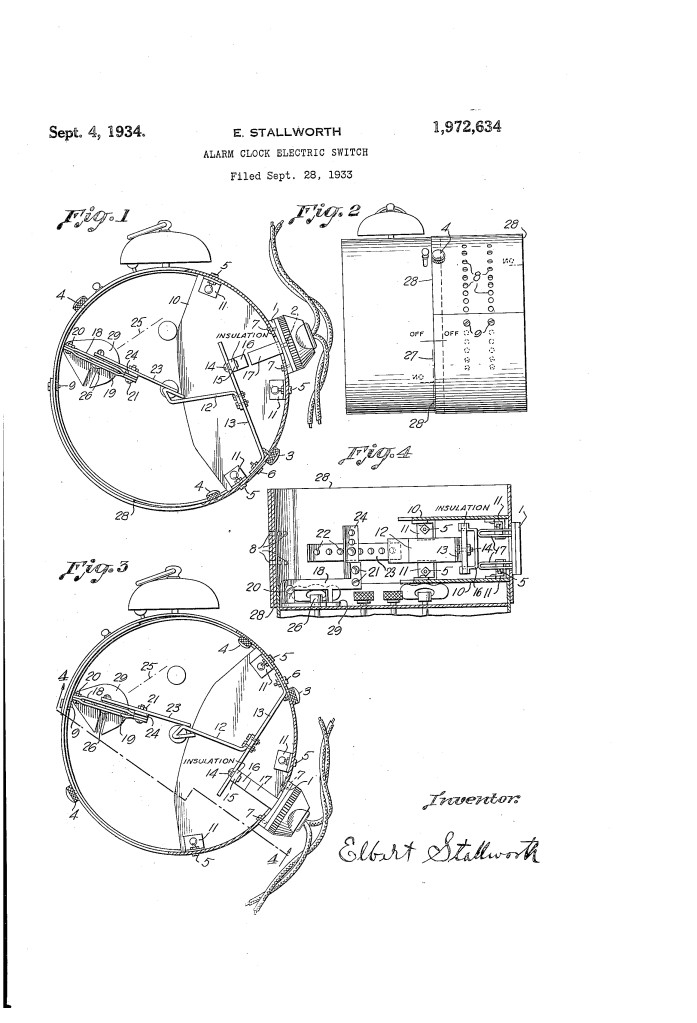
Alarm Clock Electric Switch; Elbert Stallworth; 1,972,634
The patent by Elbert Stallworth of Americus, Georgia, describes an Alarm Clock Electric Switch (Patent No. 1,972,634). This invention is a modular, universal attachment designed to wrap around a standard cylindrical alarm clock, utilizing the physical rotation of the alarm’s winding stem to mechanically trigger an electrical circuit to either “on” or “off” positions.
The “Why”
In the early 1930s, electrified household automation was a luxury. While some high-end systems existed, the average consumer could not afford specialized timers to turn on a lamp or a heater at a specific hour. Stallworth identified a pain point in this lack of accessibility. He sought to create a “low-cost” device that could turn any existing mechanical alarm clock into a programmable electrical timer, effectively democratizing home automation during the Great Depression.
The Inventor: Elbert Stallworth
Elbert Stallworth was an innovator driven by pragmatic adaptability. His engineering philosophy focused on “aftermarket” compatibility—creating tools that improved the technology people already owned rather than requiring them to buy something new. Working from Georgia, Stallworth’s design highlights a sophisticated understanding of mechanical-to-electrical transduction, ensuring his switch could be calibrated to various clock sizes and winding stem depths.
Key Systems Section
Adjustable Universal Mounting Band
- Overlapping Circumference Control: The switch is housed on a metal band with overlapping ends and dual rows of adjustment holes. This allows it to “clamp” onto virtually any cylindrical clock body on the market.
- Alignment Notations: The band features “on” and “off” markings that the user aligns with the clock body to pre-set the desired electrical outcome when the alarm triggers.
Winding Stem Transduction Linkage
- Clamp-on Actuator: A specialized jaw clamps onto the clock’s winding stem. As the alarm goes off and the stem rotates (unwinding the spring), it moves a cross-arm member.
- Triangular Contact Arm: The cross-arm strikes a triangular projecting arm attached to a flat metal spring, converting the clock’s rotational force into a lateral displacement of the electrical contacts.
Modulating Contact Assembly
- Leaf Spring Switch: A flat metal spring holds a bow-shaped contact member. Depending on the setting, this spring is either held open or pressed closed against U-shaped terminal sockets.
- Sensitivity Calibration: A set screw allows the user to fine-tune the distance between the contacts, ensuring the switch triggers reliably regardless of how much “play” or torque is in the clock’s mechanical movement.
Comparison: Standard Manual Operation vs. The Stallworth Switch
| Feature | Standard Alarm Clock | The Stallworth Attachment |
| Primary Function | Audible wake-up call | Electrical circuit trigger (Automation) |
| Output | Sound only | Power to lamps, radios, or appliances |
| Versatility | Single purpose | Can be set to “Circuit Open” or “Circuit Closed” |
| Installation | Internal/Factory set | External/User-adjustable “Plug & Play” |
Significance
- Early Home Automation: This is a direct conceptual ancestor to the “smart plug” and digital timers used in modern smart homes.
- Safety Engineering: Stallworth included fan-shaped shields to protect the internal electrical mechanism from debris and to prevent the user from accidental shocks.
- Economic Democratization: By designing a “universal” attachment, he bypassed the need for consumers to purchase expensive, integrated electric clocks, providing a high-tech solution through low-cost mechanical means.
