
Airplane with Foldable Wings: Hermon L. Grimes (Patent No. 2,137,486)
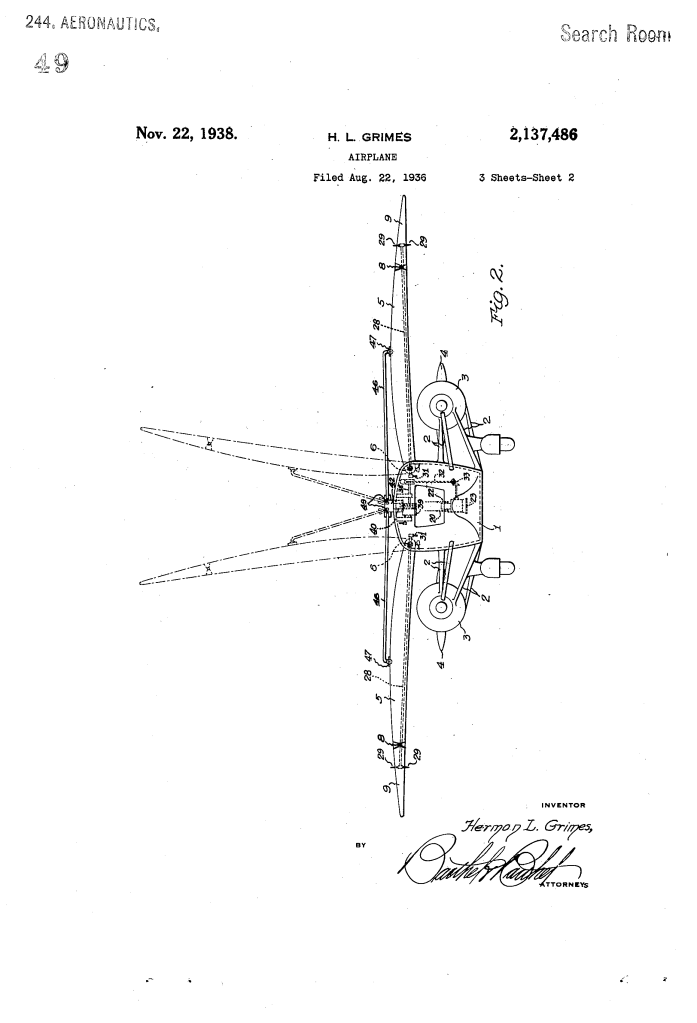
The patent by Hermon L. Grimes describes an Airplane (Patent No. 2,137,486), granted on November 22, 1938. This invention is a sophisticated “heavier than air” flying machine featuring high-aspect-ratio wings and a specialized mechanical transmission system. Its primary innovation is a power-driven wing-folding mechanism that allows the large sustaining wings to swing from a horizontal operative position to a vertical inoperative position. This design addressed the critical need for space conservation in hangars while maintaining a high-strength structural airframe capable of handling flight loads through unique external strut supports.
The “Why”
In the 1930s, as aircraft wingspans grew to improve lift and efficiency, storage became a major “pain point.” Large fixed-wing aircraft required massive, expensive hangar space. Furthermore, wing structures often lacked sufficient stiffening without adding excessive weight. Grimes sought to solve these issues by creating a dual-purpose bracing and folding system. By using external struts connected to a central sliding track, he provided a method to both strengthen the wings against flight stresses and mechanically retract them for ground storage.
Inventor Section: Hermon L. Grimes
Hermon L. Grimes was an aviation innovator focused on mechanical integration. His engineering philosophy centered on centralized control—the idea that a pilot should be able to manage flight surfaces, engine power, and structural configuration (wing folding) from a single cockpit station. This patent showcases an early, complex geared transmission system that diverted engine power to mechanical tasks, effectively treating the airplane as a “powered tool” as much as a vehicle.
Key Systems Section
1. The Power-Driven Wing Folding Track
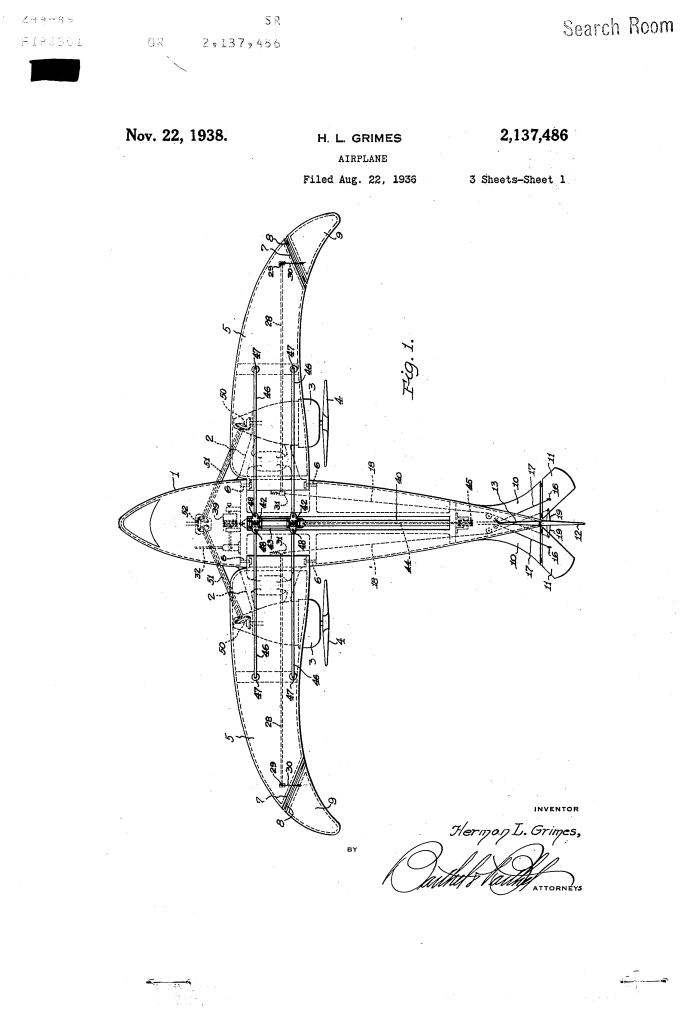
The fuselage (1) features a longitudinal slot (41) on its top surface containing a guide bar (40).
- Modern Term: Linear Actuator Track.
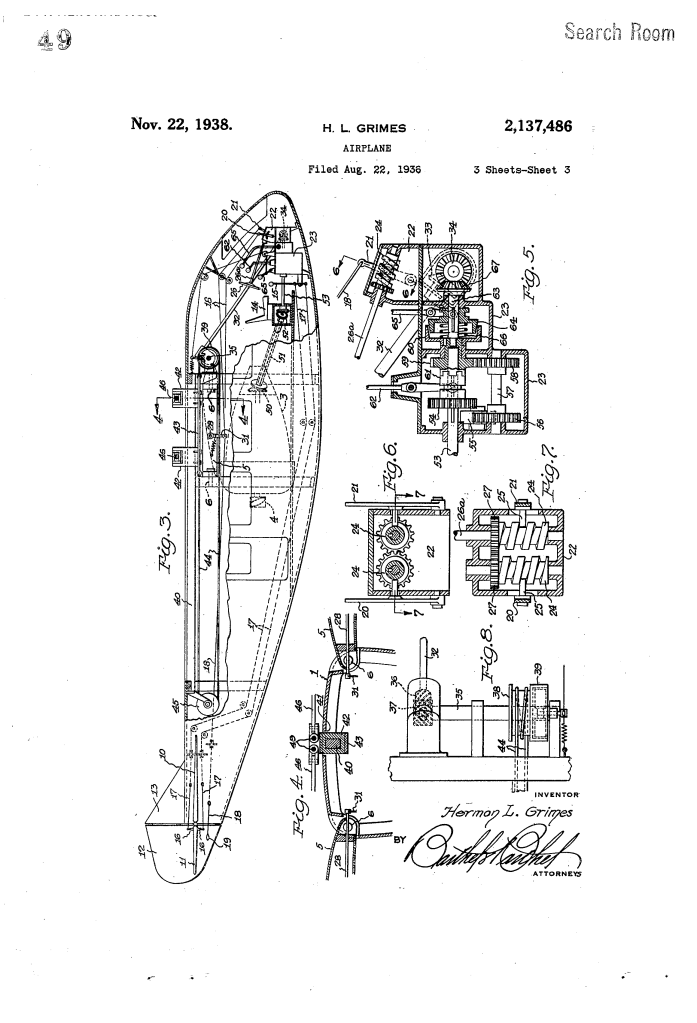
- A pair of blocks (42) slides along this track, driven by a cable (44) wrapped around a winding drum (38). As the blocks move rearward, they pull the wing struts, swinging the wings into a vertical “folded” position.
2. Parallel Strut Bracing (46)
Each wing is supported by a pair of stiff strut rods (46) attached intermediate to the wing’s length.
- Modern Term: External Structural Shoring.
- In flight, these rods are in “longitudinal alignment,” meaning they form a straight line across the top of the fuselage. This configuration translates upward air pressure into a direct end-thrust on the rods, reinforcing the wing against bending without requiring a heavy internal spar.
3. Integrated Aileron-Rudder Control
Grimes designed unique “wing tips” (9) hinged at an acute angle to the wing ends.
- Modern Term: Coupled Flight Control Surfaces.
- These tips are connected via cables (18) to the steering rudder (12). When the pilot turns the steering wheel, the airplane simultaneously swings the rudder and adjusts the wing tips, automatically “banking” the plane into a turn to prevent side-slip.
4. The Geared Power Take-Off (PTO)
A transmission casing (23) in the nose of the fuselage diverts power from the underslung pusher-propeller motors to the wing-folding drum.
- Modern Term: Mechanical Power Take-Off (PTO) Transmission.
- Using a system of bevel gears (33) and a cone clutch (64), the pilot can engage the engine’s rotation to fold the wings, then apply a brake (39) to lock them in place.
Comparison Table
| Feature | Standard 1930s Aircraft | Grimes’ Airplane |
| Wing Design | Fixed position; internal bracing. | Foldable; reinforced by external strut rods. |
| Hangar Footprint | Large and static. | Significantly reduced via vertical folding. |
| Banking Logic | Manual coordination of aileron/rudder. | Automatically coupled via geared steering. |
| Power Utility | Motors only for propulsion. | Geared transmission for structural adjustment. |
Significance Section
- Space-Saving Naval Precursor: While Grimes’ design was for general use, the concept of power-folding wings became a standard requirement for carrier-based naval aircraft in WWII.
- Structural Load Distribution: By attaching struts to the middle of the wing rather than just the root, Grimes anticipated modern cantilever-and-brace physics used in high-load transport planes.
- Ergonomic Centralization: The “gear box” (22) centralization of all flight and mechanical controls was a major step toward the modern “cockpit management” systems found in complex aircraft.
- Pusher-Propeller Efficiency: The use of “underslung pusher” propellers (4) reduced turbulence over the wings, a design principle seen in modern UAVs and experimental fuel-efficient craft.
