
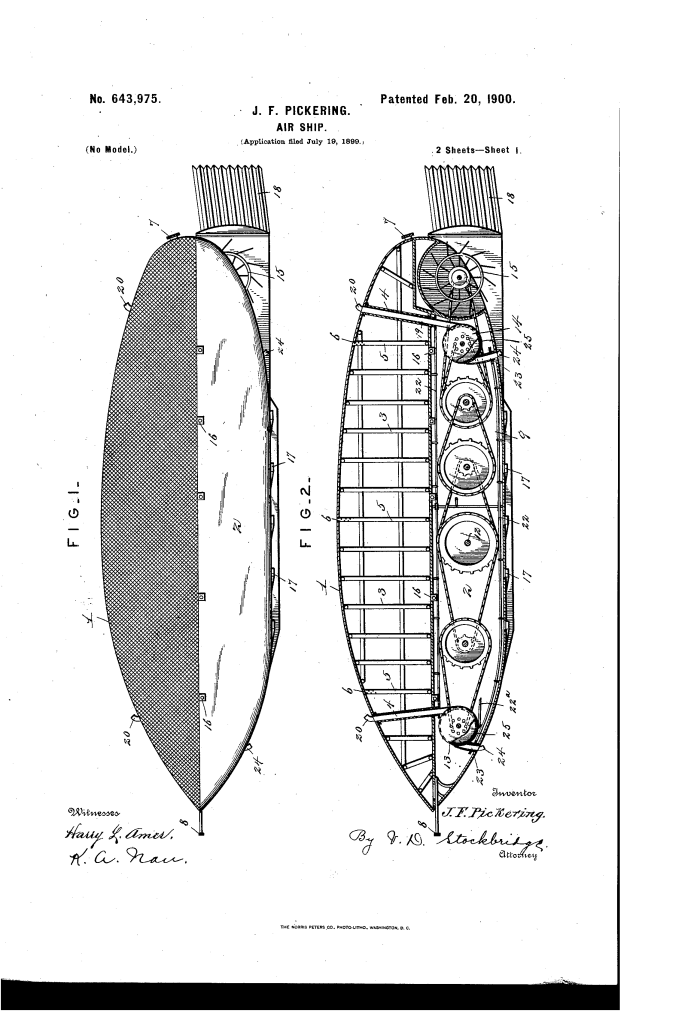

Air-Ship (John F. Pickering, No. 643,975)
The patent by John F. Pickering of Gonaives, Haiti, describes a new and useful Air Ship or Launch (Patent No. 643,975, 1900).1 The primary object is to provide a ship of great strength and durability that combines a buoyancy float with mechanical appliances that give the operator complete control over all movements: propulsion, gradual raising or lowering, and turning to any point of the compass.
Inventor Background: John F. Pickering
John F. Pickering, a subject of the Queen of Great Britain residing in Haiti, was an inventor focused on the ambitious challenge of powered flight in the early 20th century. His invention is part of the extensive, global experimentation in aeronautics, attempting to create a functional, dirigible airship combining lighter-than-air buoyancy with powered control.
Invention and Mechanism (Simplified)
The airship is a rigid-framed balloon connected to a powered car. Its primary control system uses fans to blow air through adjustable, bent pipes (cowls) to control its attitude and elevation.
- Float and Structure:
- Gas Dome (1): The balloon or float is made with a frame of strong, light tubing (3) (e.g., aluminum) and covered with silk or gas-holding fabric.
- Hold (2): A rigid structure or car is fastened beneath the dome, containing compartments (9) for the motor (11) and machinery.
- Propulsion: The motor (11) drives traditional paddles (15) near the stern and forward fans (13, 14) for general propulsion. A traditional rudder (18) is also used for guidance.
- Attitude and Elevation Control (Key Innovation):
- Fans/Blowers (13, 14): The motor drives internal fans.
- Upward Air Ducts (19): Ducts lead from the fans up into the float (1).
- Downward Air Ducts (23): Ducts lead from the fans down through the bottom of the car (2).
- Movable Bent Tubes/Cowls (20, 24): These bent tubes are mounted telescopically on the ducts and are controlled by rods (22) and internal flap valves (21).2
- Operation via Air Blast: The air blast from the fans can be controlled by the operator to achieve specific movements:
- Forward Propulsion: Air is directed rearward through the bent tubes.
- Elevation (Upward Movement): The blast is directed downward through the downward-projecting ducts (23, 24).
- Descent (Downward Movement): The blast is directed upward through the upward-projecting ducts (19, 20), forcing the air inside the dome, thus pushing the ship downward toward the earth.
- Turning/Steering: The upwardly and downwardly projecting bent tubes can be turned to any desired angle, quickly turning the entire ship through a wide arc.
Concepts Influenced by This Invention
Pickering’s airship influenced subsequent aerospace and fluid control designs by pioneering a vector-thrust, gas-based attitude control system for lighter-than-air craft.
- Vector Thrust Attitude Control: The core concept of using fans (blowers) and adjustable, hinged/bent cowls (20, 24) to vector the air blast for controlling pitch, roll, and ascent/descent is foundational to modern vertical takeoff and landing (VTOL) aircraft and thruster systems . It allows for precise maneuvering without relying solely on large flight surfaces.
- Internal Gas Pressure Control: The design’s use of fans to direct air blast upward into the gas dome (float) to increase the internal pressure and force the ship downward influenced the design of dirigibles and balloons that use internal ballonet systems (gas compartments) and pressure regulation to control buoyancy and altitude.
- Redundant Control Systems: The inclusion of both traditional steering (rudder 18) and dynamic thrusters for turning influenced the design philosophy of large, complex vehicles that require backup or high-authority control systems for maneuvering.
- Rigid/Lightweight Framing: The use of strong, light tubing (aluminum) to create a rigid internal frame for the balloon influenced the design of early airframes and modern ultralight aircraft structures.
