
Vertical-Lift Aeroplane (William Hale, No. 1,563,278)
The patent by William Hale of Litwar, West Virginia, describes a multi-functional Aeroplane (Patent No. 1,563,278, 1925). This invention is a “hybrid” craft designed to combine the characteristics of a helicopter, an airplane, and a ground vehicle. Hale’s primary objective was to solve the problem of limited maneuverability in early aviation by creating a ship that could hover, ascend and descend vertically, and travel along the ground in both forward and reverse with dual steering. This design represents an early, visionary attempt at a Vertical Take-Off and Landing (VTOL) aircraft.
Inventor Background: William Hale
William Hale was an African American inventor and engineer based in the coal-mining region of West Virginia. His 1925 patent was filed during a period of intense experimentation in aviation, often referred to as the “Golden Age of Flight.” While mainstream aviation focused on fixed-wing speed, Hale’s work anticipated the modern helicopter and the concept of a “flying car.” His design—featuring armored superstructures and gun ports—suggests it was intended as a versatile military “air-ship,” reflecting the global interest in aerial defense following World War I.
Key Mechanical & Propulsion Systems
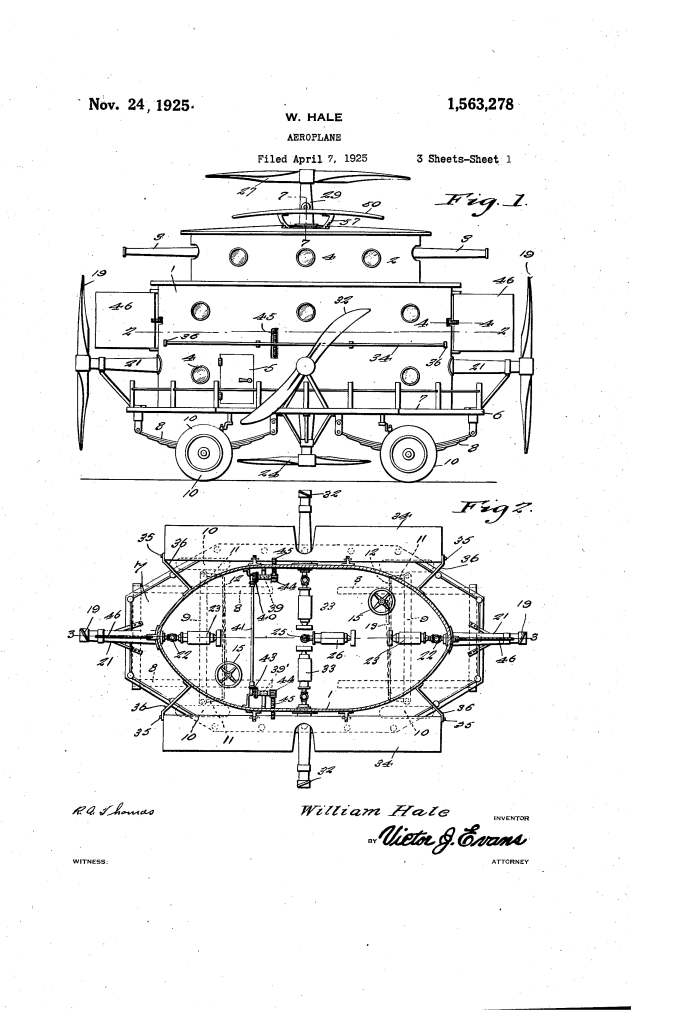
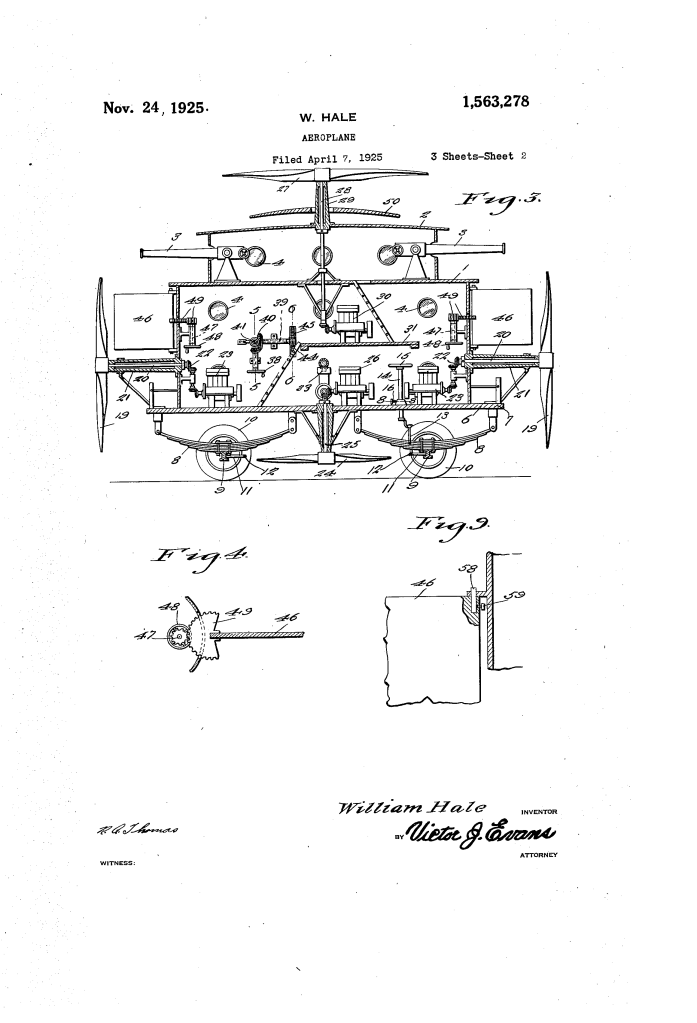
Hale’s design is unique for its use of six independent propellers, each driven by its own dedicated motor, to manage thrust in every direction.
1. The Vertical Lift System (24, 27)
To achieve vertical movement and hovering, Hale utilized a “top-and-bottom” horizontal propeller configuration.
- Top Propeller (27): Mounted above the superstructure on a vertical shaft (28).
- Under-Body Propeller (24): Positioned beneath the fuselage between the wheels.
- Function: By running these horizontal propellers, the pilot could generate vertical lift to “hover” or ascend without a runway. This allowed the ship to remain stationary in the air, providing a stable platform for the guns (3).
2. Multi-Directional Propellers (19, 32)
- Horizontal Propellers (19): One placed at the front and one at the rear of the body.
- Function: These provided the thrust for horizontal flight and also served to move the craft along the ground like a car.
- Side Propellers (32): One mounted on each side of the fuselage.
- Function: These assisted in lateral stability and helped the craft “hover” by providing corrective thrust.
3. Dual Steering and Ground Gear (10, 16)
The craft features a complex chassis for ground travel.
- Bi-Directional Steering: Steering columns are provided at both ends of the craft.
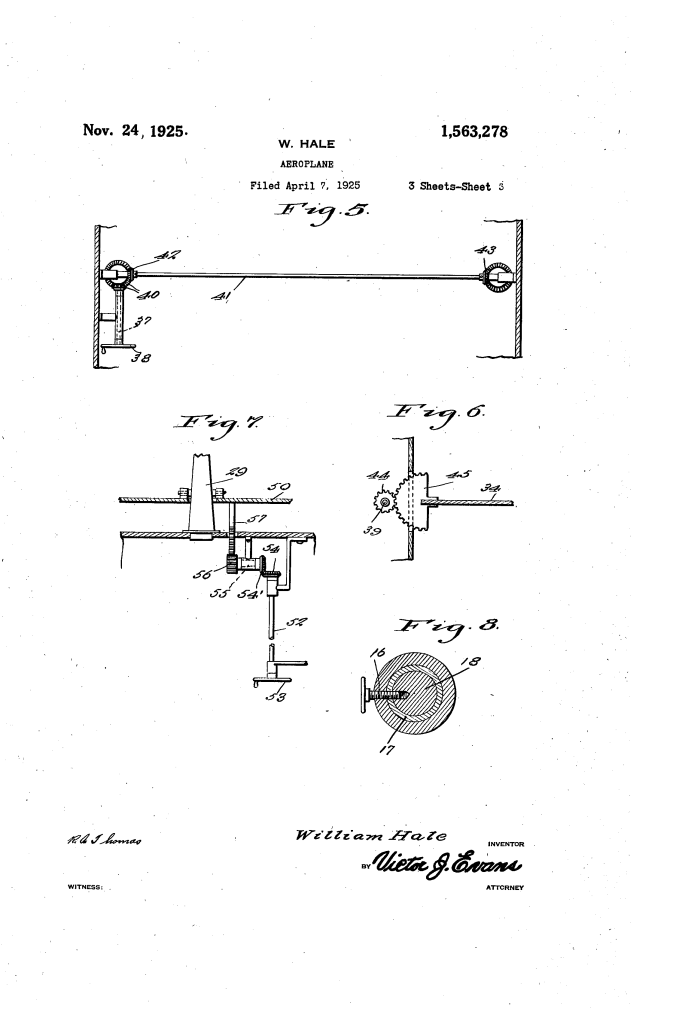
- Hand Bolt (16): A locking mechanism for the steering column.
- Function: This allowed the pilot to steer from either end. To prevent confusion, a hand bolt would “lock” the inactive steering column, allowing the vehicle to retrace its route without turning around.
4. Adjustable Planes and Wings (34, 45, 50) (Key Innovation)
Hale included a variety of control surfaces to manage the craft’s attitude in the air.
- Hinged Wings (34): Mounted on the sides and tilted simultaneously via segmental gears (45).
- Top Plane (50): A large pivoted plane at the very top of the craft.
- Function: By manually adjusting these planes using hand wheels (38, 53), the pilot could change the angle of attack and stabilize the ship against wind while hovering.
Improvements Over Standard 1920s Aircraft
| Feature | Standard Biplanes/Monoplanes | Hale’s Vertical-Lift Aeroplane |
| Take-Off | Required long, flat runways. | Capable of vertical ascent from any location. |
| Stability | Could not stay stationary; had to maintain speed to stay aloft. | Can hover in a fixed position for observation or defense. |
| Ground Travel | Difficult to taxi; could not reverse easily. | Operates like a wheeled vehicle with dual steering and reverse. |
| Power Plant | Single engine (if the engine failed, the plane fell). | Six independent motors; failure of one did not mean total loss of control. |
Significance to Aeronautical Engineering
William Hale’s aeroplane influenced the conceptual development of VTOL technology and amphibious/multi-modal transport.
- The Hovering Principle: Hale’s recognition that vertical thrust must be balanced (using top and bottom propellers) is a foundational principle in coaxial rotor design, used today in high-performance helicopters.
- Independent Propulsion: His “one motor per propeller” philosophy anticipated the distributed electric propulsion systems currently being developed for modern “air taxis” and drones.
- Redundancy in Design: By separating the lift, thrust, and steering motors, Hale pioneered the concept of system redundancy, a core safety requirement in modern aerospace engineering.
- The Flying Car Concept: The integrated ground-steering and locking mechanisms represent an early engineering solution for the “roadable aircraft,” a dream that continues to drive innovation in urban air mobility.
