
Aeroplane Aerofoil Wing, Jay H. Montgomery, Patent No. 1,910,625
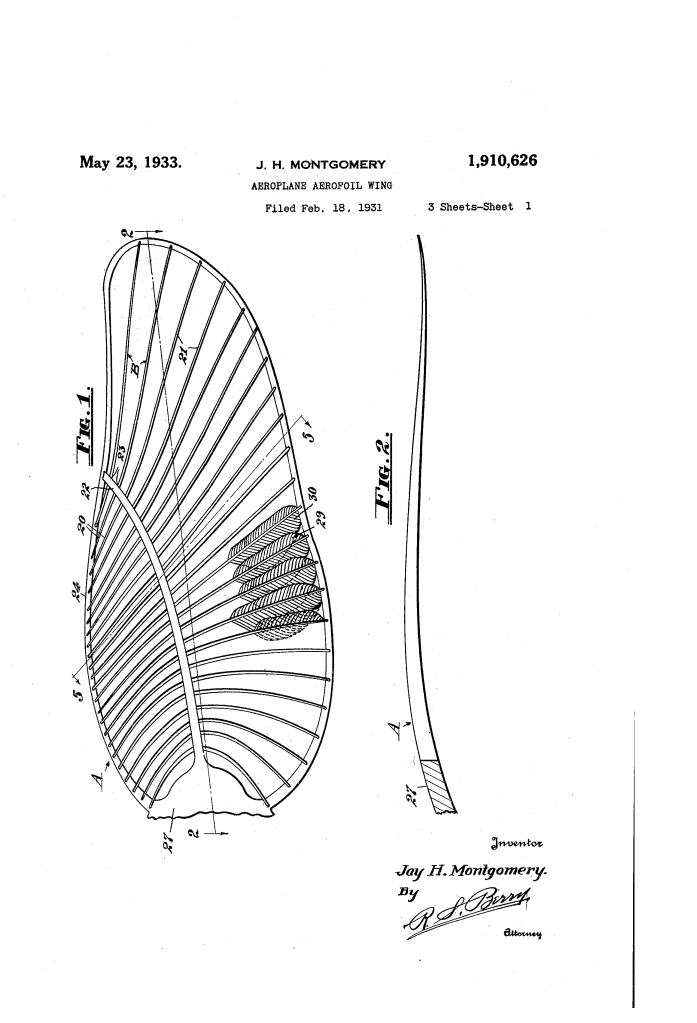
The patent by Jay H. Montgomery of San Gabriel, California describes an Aeroplane Aerofoil Wing (Patent No. 1,910,625). This invention is a biomimetic, multi-tiered fractal wing structure designed to simulate the aerodynamic properties of a soaring bird’s wing. By utilizing a complex manifold of overlapping blades and vanes, it creates a series of internal vacuum spaces and air vortices that drastically increase lift, reduce fuel consumption, and allow for ultra-low takeoff and landing speeds of approximately 15 miles per hour.
The “Why”
In the early 1930s, aviation was limited by the “brute force” approach to lift—relying on high engine power and high speeds to stay aloft. This led to high fuel consumption and dangerous landing speeds. Montgomery sought to solve the power-to-lift efficiency pain point. He observed that soaring birds achieve incredible stability and lift not through flat surfaces, but through the interaction of thousands of individual feathers. He aimed to engineer a wing that “entrains” the air, stepping up its velocity through mechanical geometry rather than just engine thrust.
Inventor Section: Jay H. Montgomery
Jay Montgomery was an aeronautical visionary who believed that the “secret” to efficient flight lay in vortex dynamics. His engineering philosophy centered on the fractalization of airflow. By breaking a single air current into thousands of smaller, high-velocity vortices, he aimed to create a wing that was essentially “buoyant” in the air. His work, assigned to the Vert-Wing Corporation, represents a radical departure from the smooth-skin monoplanes of the era, leaning instead toward what we now call “active flow control.”
Key Systems Section
1. The Fractal Blade Manifold (Primary, Secondary, Tertiary)
The wing is not a solid surface but a complex assembly of three levels of “feathers.”
- Modern Engineering Term: Multiscale hierarchical airfoil array.
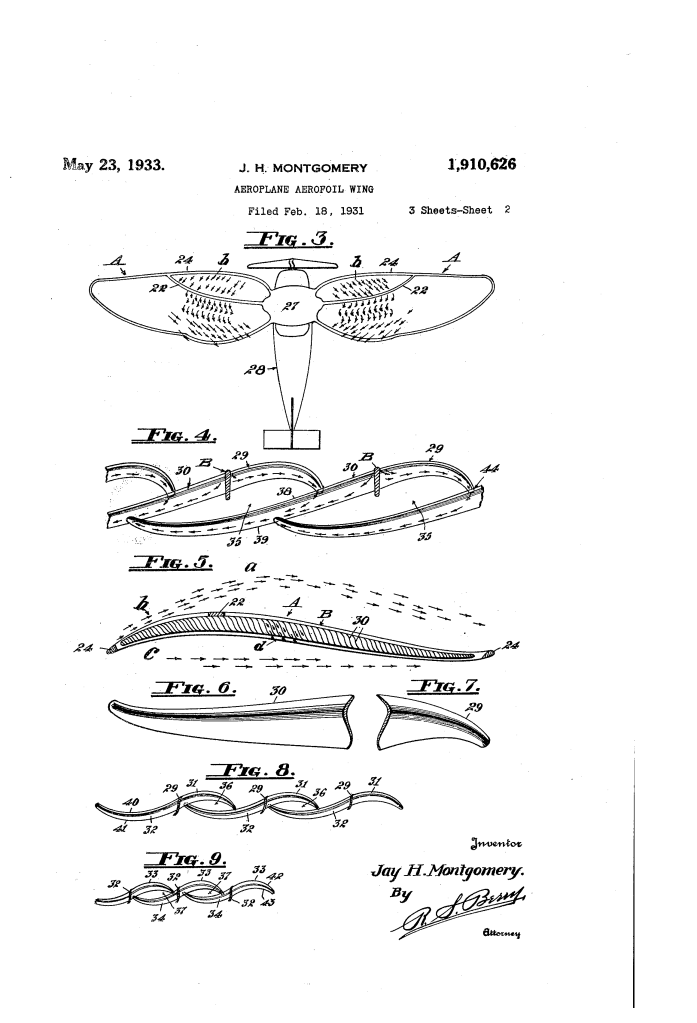
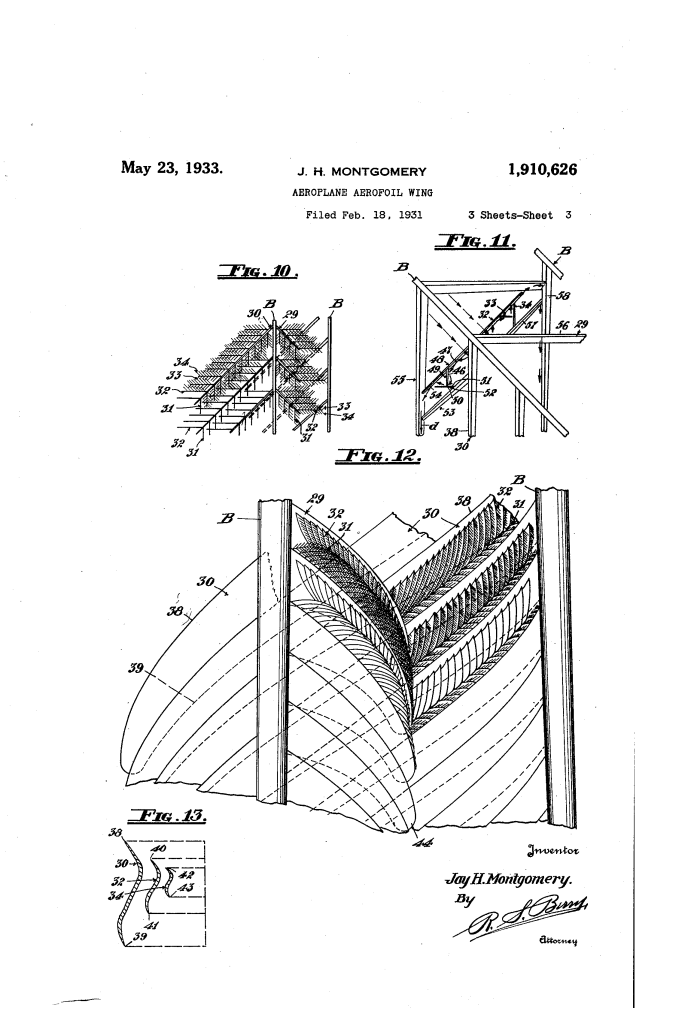
- The structure begins with supporting ribs (B). From these lead primary blades (29, 30). Superimposed on these are secondary blades (31, 32), and finally, tertiary vanes (33, 34). Each level is progressively smaller (a ratio of 20:1), creating a microscopic-to-macroscopic lift system.
2. Vortex-Induced Vacuum Spaces
The blades are arranged with specific overlaps and underlaps.
- Modern Engineering Term: Vortex generator cavities.
- These overlaps create vacuum spaces (35, 36, 37). As air flows over the “S-shaped” cross-sections of the blades, it is transformed into thousands of tiny vortices. These vortices pull air out of the enclosed spaces, creating a high-vacuum lift effect across the entire wing surface.
3. Reverse-Curve (Serpentine) Contours
Every element, from the main ribs to the tiniest vanes, features a double or “reverse” curvature.
- Modern Engineering Term: Reflexed camber airfoil.
- This serpentine shape (Fig. 13) ensures that air is sub-deflected in a tortuous path. This increases the velocity of the air discharging from the trailing edge to six times the speed of the impinging air, providing a “reactive push” similar to a jet effect.
4. The 45-Degree Oblique Flow
The blades and vanes are positioned at 45-degree angles relative to their supports.
- Modern Engineering Term: Spanwise flow modulation.
- This creates a diagonal flow of air across the wing toward the fuselage. This specific angle facilitates lateral and longitudinal stability, acting as an inherent “auto-pilot” that keeps the plane on course even in turbulent air.
Comparison: Standard Monoplane Wing vs. Montgomery’s Aerofoil
| Feature | Standard Wing (1930s) | Montgomery’s Fractal Wing |
| Surface | Smooth, continuous skin. | Foraminous (perforated) manifold of blades. |
| Lift Mechanism | Bernoulli’s principle (pressure diff). | Vortex-induced vacuum & additive force. |
| Landing Speed | High (often 50+ mph). | Ultra-low (15 mph). |
| Stability | Relies on ailerons/tail flaps. | Inherent stability via spanwise flow. |
Significance
- Precursor to STOL (Short Take-Off and Landing): Montgomery’s focus on 15 mph landing speeds is the spiritual ancestor to modern bush planes and V/STOL technology.
- Bio-Inspired Engineering: The wing’s “feathered” design is a 1930s precursor to modern studies in avian-inspired morphing wings.
- Boundary Layer Control: By breaking the air into small vortices, Montgomery was essentially attempting an early form of boundary layer control to prevent aerodynamic stall.
