
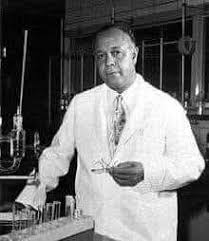
The research and subsequent industrial application by Percy Lavon Julian of Montgomery, Alabama describes a method for extracting and modifying isolated soy protein to create a fire-extinguishing foam known as Aero-Foam (Patent No. 2,373,345, among others). This invention is a chemically engineered protein solution that, when agitated with air and water, creates a stable, heat-resistant blanket used to smother high-intensity oil and gasoline fires.
The “Why”
During World War II, the U.S. Navy faced a catastrophic “pain point”: traditional water streams were ineffective—and often dangerous—against liquid fuel fires on aircraft carriers. Water is denser than gasoline, causing it to sink while the burning fuel floats on top and spreads. Julian sought to engineer a substance with a lower specific gravity than fuel and high surface tension to isolate the fire from its oxygen source.
The Inventor: Dr. Percy Lavon Julian
Dr. Julian’s engineering philosophy was centered on Phytochemical Synthesis—the belief that the complex molecular structures found in plants could be repurposed for advanced industrial and medical use. As a Black scientist in a deeply segregated America, Julian faced immense systemic barriers, including being denied professorships and having his home firebombed. Despite this, he became a “pathologist” of the soybean, breaking down its proteins to create everything from synthetic hormones to life-saving industrial foams.
Key Systems Section
Protein Denaturation and Hydrolysis
- Modern Term: Chemical Polymer Modification.
- Julian developed a process to break down the long-chain soy proteins into smaller, more manageable peptides. This increased the solubility and “stickiness” of the extract.
- Mechanically, this is akin to thinning a high-viscosity lubricant so it can flow through a pump while maintaining its coating properties.
Aeration and Expansion System
- Modern Term: High-Expansion Foam Generation.
- The “system” relies on the soy protein acting as a surfactant. When passed through a specialized nozzle (the “foam finger”), the solution captures air to expand its volume up to 20 times.
- This acts as a volumetric displacement mechanism, using a small amount of liquid to occupy a massive spatial area.
Heat-Resistant Laminar Barrier
- Modern Term: Thermal Insulation Shield.
- The modified soy protein creates a “tough” bubble wall that resists the intense thermal energy of a gasoline fire. Unlike soap-based foams, the protein foam does not “pop” or dehydrate instantly.
- It functions as a sacrificial thermal barrier, absorbing the heat while keeping the oxygen-rich atmosphere separated from the fuel vapor.
Comparison Table
| Feature | Standard Methods (Pre-1940) | Julian’s Aero-Foam |
| Medium | Pressurized Water. | Soy Protein-based Foam. |
| Action | Cooling (ineffective on oil). | Smothering (Oxygen deprivation). |
| Density | High (sinks below fuel). | Low (floats on fuel surface). |
| Material Source | Animal blood/hoof meal (expensive/scarce). | Soybeans (abundant, stable, renewable). |
Significance Section
- Military Dominance: Credited with saving thousands of lives and hundreds of ships in the Pacific Theater during WWII.
- Modern Firefighting: The direct precursor to modern Aqueous Film-Forming Foams (AFFF) used in every airport and municipal fire department today.
- Biotechnology: Proved that plant-based polymers could replace animal-derived or synthetic chemicals in heavy industry.
