
Reed-Organ (Joseph H. Dickinson, No. 624,192)
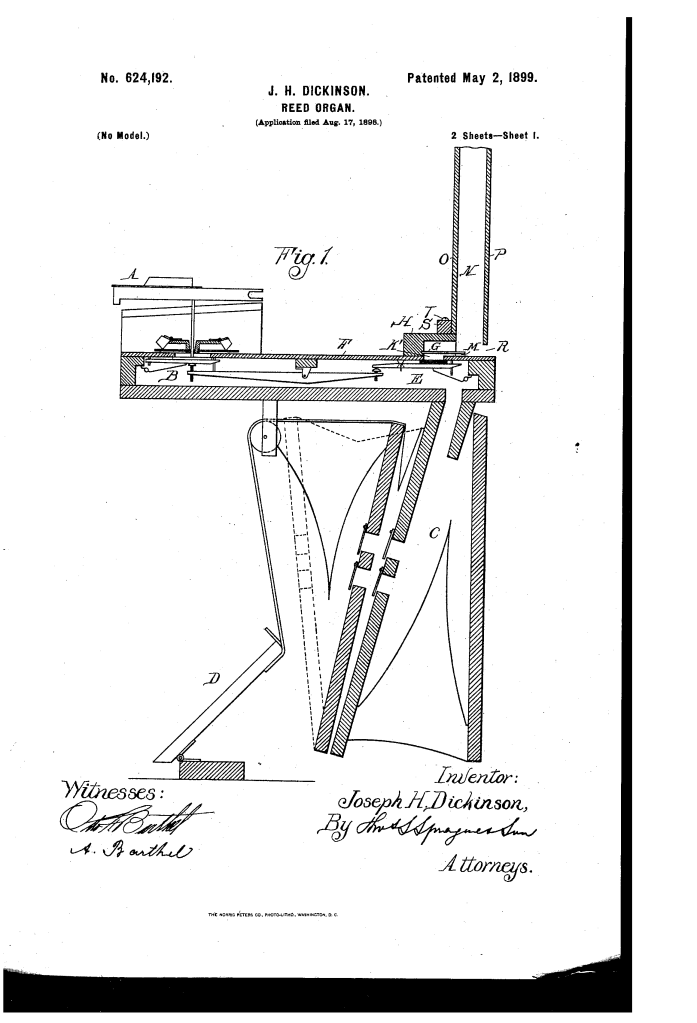
The patent by Joseph H. Dickinson of Detroit, Michigan, describes certain new and useful Improvements in a Reed-Organ (Patent No. 624,192, 1899), relating more particularly to the qualifying-tubes (or acoustic chambers). The object is to improve the construction and arrangement of these tubes to provide unobstructed access to each reed for tuning, while greatly improving the quality and volume of the sound.
Inventor Background: Joseph H. Dickinson
Joseph H. Dickinson was an African-American inventor and master craftsman known for his work on musical instruments, particularly reed organs and pianos. His inventions sought to improve the quality of sound and the efficiency of manufacturing and tuning. Dickinson’s innovations were crucial in an era where reed organs were a common piece of parlor furniture, competing with pianos for market share.
Invention and Mechanism
The invention is a bank of acoustic qualifying-tubes integrated directly over the reed cells, creating sound quality similar to pipe organs.
1. Reed Block and Cells
- Reed-Block (H): Extends transversely on top of the sounding-board (F).
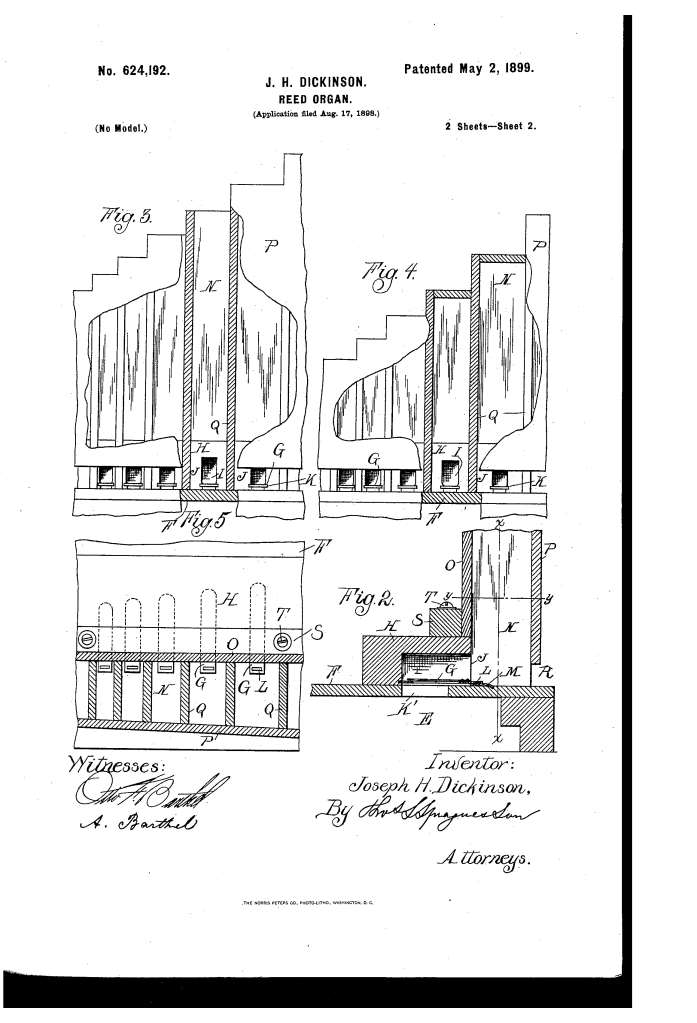
- Cells (I): Individual cells are formed in the block for each reed (G). The cells are entirely separated by division-walls (J).
- Reeds (G): Project slightly beyond the rear end of the cells, with holes (L) to permit ready removal for tuning.
2. The Qualifying-Tube Bank (Key Innovation)
- Structure: The tubes (N) are built as a single bank mounted vertically in rear of the reed-cells. The bank consists of continuous front and rear walls (O, P) and internal vertical division-strips (Q).
- Taper and Graduation: The front and rear walls (O, P) are placed at an angle to each other, and the division strips (Q) are spaced so the space between them is divided into vertical flues of graduated cross-section and height. The tubes are stepped off at the upper end (at different heights).
- Function: The size and shape of these tubes act as acoustic resonators, influencing the harmonic content and volume of the sound produced by the reeds.
- Direct Continuation and Open Outlet:
- The front wall (O) rests on the reed-block, making each tube (N) a direct upward continuation of its particular reed-cell.
- An opening (R) is formed at the bottom rear, giving the tubes a direct open passage or outlet into the atmosphere directly in line with the cell.
3. Acoustic Result
The design provides unobstructed access to each reed (through the open rear) while using the tubes to enhance the tone. Dickinson claimed the sound is greatly improved, making it similar to that of a diapason-pipe. By closing the tubes at their upper ends (Fig. 4), the sound changes to that of a closed diapason-pipe (a softer tone).
Concepts Influenced by This Invention
Dickinson’s reed organ influenced subsequent musical instrument design by pioneering modular, acoustically tuned resonators for mechanical instruments.
- Acoustically Tuned Resonators: The core concept of using a graduated series of acoustically specialized tubes (N) as direct extensions of the sounding source (reeds G) influenced the design of subsequent musical instruments and audio equipment. This technique allows for the refinement of tone color and volume without relying solely on the sound board.
- Modular and Integrated Construction: The assembly of the qualifying tubes as a single, structurally integrated bank that rests on the reed-block influenced the modular manufacturing of large-scale mechanical devices, where numerous identical but acoustically varied components must be assembled efficiently.
- Serviceability and Access: The design that allows the resonators to be integrated while maintaining unobstructed access (R) to the critical maintenance components (the reeds) influenced the engineering philosophy of all musical instruments and complex machinery, balancing performance enhancement with ease of service.
- Acoustic Simulation: The design achieved a closer simulation of the tonal qualities of a pipe organ using
